AI-Driven Black Hole & Gravitational Wave Analysis: How Artificial Intelligence Is Transforming Space-Time Science
Category: AI | 5th January 2026, Monday
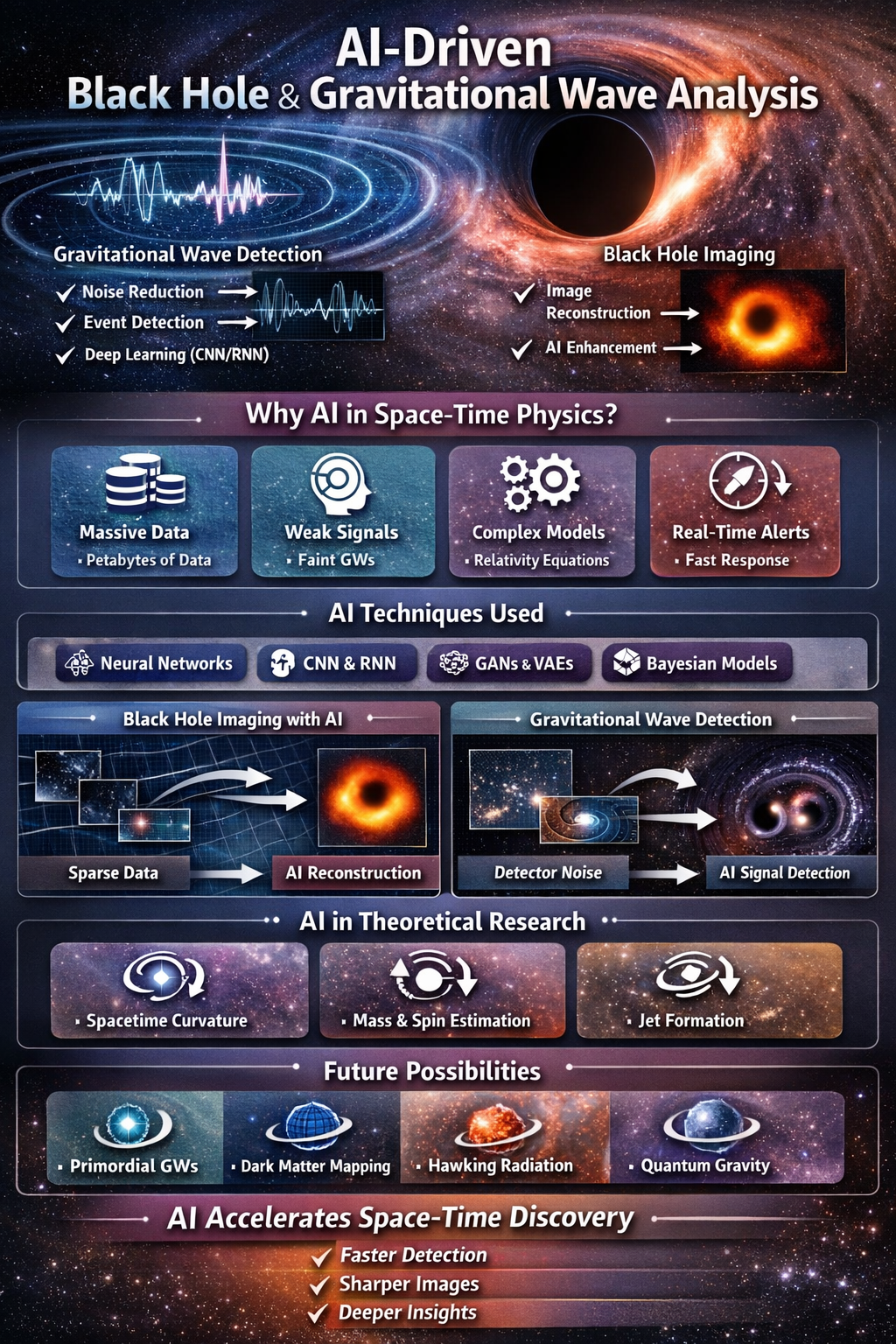
The Study Of Black Holes And Gravitational Waves Represents One Of The Most Challenging Frontiers In Modern Astrophysics. These Phenomena Probe The Extreme Limits Of Space, Time, Gravity, And Matter, Often Involving Vast Datasets, Weak Signals Buried In Noise, And Highly Complex Theoretical Models Derived From Einstein’s General Theory Of Relativity. In Recent Years, Artificial Intelligence (AI) Has Emerged As A Transformative Tool In This Domain, Enabling Scientists To Detect, Analyze, And Interpret Cosmic Events With Unprecedented Speed And Accuracy. AI-driven Techniques Are Reshaping How We Observe The Universe, Turning Space-time Science Into A Data-intensive, Computationally Intelligent Discipline.
Black Holes, Once Considered Purely Theoretical Objects, Are Now Routinely Observed Through Indirect Signatures Such As Gravitational Waves, Accretion Disk Emissions, And Relativistic Jets. Gravitational Waves, Ripples In The Fabric Of Space-time Produced By Accelerating Massive Objects Like Merging Black Holes Or Neutron Stars, Were First Directly Detected In 2015 By The LIGO Collaboration. Since Then, Observatories Such As LIGO, Virgo, And KAGRA Have Generated Enormous Volumes Of High-frequency Time-series Data. Analyzing This Data Using Traditional Signal Processing And Matched Filtering Methods Is Computationally Expensive And Often Limited By Predefined Waveform Templates. AI Overcomes These Limitations By Learning Patterns Directly From Data, Allowing More Flexible, Faster, And Robust Detection Pipelines.
One Of The Most Significant Contributions Of AI To Gravitational Wave Science Lies In Signal Detection. Gravitational Wave Signals Are Extremely Weak By The Time They Reach Earth, Often Obscured By Seismic Noise, Thermal Fluctuations, And Instrumental Artifacts. Deep Learning Models, Particularly Convolutional Neural Networks (CNNs), Have Proven Highly Effective In Distinguishing Genuine Gravitational Wave Signals From Noise. By Training On Simulated Waveforms Combined With Real Detector Noise, These Models Learn Hierarchical Features That Capture Subtle Temporal And Frequency-domain Characteristics Of Astrophysical Events. Unlike Traditional Matched Filtering, AI-based Detection Can Operate In Near Real Time, Enabling Rapid Alerts For Follow-up Observations By Electromagnetic Telescopes.
AI Also Plays A Crucial Role In Parameter Estimation For Black Hole Mergers. Once A Gravitational Wave Signal Is Detected, Scientists Aim To Infer The Physical Properties Of The Source, Such As The Masses, Spins, Orbital Orientation, And Distance Of The Merging Objects. Conventional Bayesian Inference Methods Rely On Computationally Intensive Sampling Techniques That Can Take Hours Or Days To Converge. Machine Learning Models, Including Neural Density Estimators And Surrogate Models, Can Approximate These Complex Likelihood Functions, Dramatically Reducing Inference Time While Maintaining High Accuracy. This Acceleration Is Critical For Real-time Astrophysics, Especially When Coordinating Multi-messenger Observations Involving Light, Neutrinos, And Gravitational Waves.
In Black Hole Imaging, AI Has Demonstrated Remarkable Capabilities, Particularly In The Analysis Of Data From The Event Horizon Telescope (EHT). The EHT Is A Global Network Of Radio Telescopes That Uses Very Long Baseline Interferometry To Achieve Earth-sized Resolution, Enabling The First Direct Images Of Black Hole Shadows, Such As Those Of M87* And Sagittarius A*. The Raw Data Collected By The EHT Is Sparse, Noisy, And Incomplete Due To Atmospheric Disturbances And Limited Sampling. AI-based Image Reconstruction Algorithms, Including Deep Generative Models And Regularized Neural Networks, Help Fill In Missing Information, Enhance Resolution, And Suppress Artifacts, Producing Clearer And More Physically Consistent Images Of Black Hole Environments.
Beyond Detection And Imaging, AI Contributes To Theoretical Modeling And Simulation Of Black Hole Dynamics. Numerical Relativity Simulations, Which Solve Einstein’s Field Equations On Supercomputers, Are Essential For Understanding Black Hole Mergers And Generating Waveform Templates. However, These Simulations Are Computationally Expensive And Cover Only Limited Regions Of The Vast Parameter Space. Machine Learning Models Can Act As Fast Emulators Of Numerical Simulations, Learning Mappings Between Physical Parameters And Resulting Waveforms. These Surrogate Models Enable Rapid Exploration Of Parameter Space, Supporting Both Observational Analysis And Theoretical Research.
AI Is Also Revolutionizing The Study Of Accretion Disks And Relativistic Jets Around Black Holes. These Structures Emit Across The Electromagnetic Spectrum And Are Governed By Complex Magneto-hydrodynamic Processes. Observational Data From X-ray, Optical, And Radio Telescopes Is Often Multi-dimensional And Time-varying. Machine Learning Techniques Such As Recurrent Neural Networks, Autoencoders, And Clustering Algorithms Help Identify Patterns, Classify Variability States, And Detect Anomalies In Accretion Behavior. This Leads To Deeper Insights Into How Black Holes Grow, Interact With Their Surroundings, And Influence Galaxy Evolution.
In Gravitational Wave Astronomy, AI Enhances Noise Characterization And Data Quality Monitoring. Detector Noise Is Non-stationary And Influenced By Environmental And Instrumental Factors, Producing Transient Artifacts Known As “glitches.” These Glitches Can Mimic Or Obscure True Astrophysical Signals. Machine Learning Classifiers Are Trained To Identify And Categorize Glitches Based On Their Time-frequency Signatures, Enabling Automated Data Cleaning And Improved Sensitivity. By Reducing False Positives And Enhancing Signal Fidelity, AI Increases The Overall Reliability Of Gravitational Wave Observations.
Another Transformative Aspect Of AI Is Its Role In Multi-messenger Astrophysics. Events Such As Neutron Star Mergers Produce Gravitational Waves Along With Electromagnetic Emissions And Sometimes Neutrinos. Coordinating Observations Across Different Instruments Requires Rapid Data Analysis And Decision-making. AI-driven Pipelines Can Prioritize Candidate Events, Predict Likely Sky Locations, And Optimize Telescope Scheduling. This Integration Allows Scientists To Capture Transient Phenomena More Effectively, Enriching Our Understanding Of Cosmic Events From Multiple Observational Perspectives.
AI Also Supports The Search For New Physics Beyond General Relativity. By Analyzing Large Datasets Without Imposing Strict Theoretical Assumptions, Machine Learning Models Can Detect Subtle Deviations From Expected Gravitational Wave Signatures. These Deviations May Indicate Exotic Objects, Modified Gravity Theories, Or Extra Dimensions. Unsupervised Learning Techniques, Such As Anomaly Detection And Dimensionality Reduction, Are Particularly Valuable In This Context, As They Can Uncover Unexpected Patterns That Traditional Model-driven Approaches Might Miss.
Despite Its Transformative Impact, The Use Of AI In Black Hole And Gravitational Wave Science Comes With Challenges. One Major Concern Is Interpretability. Deep Learning Models Often Function As “black Boxes,” Making It Difficult To Understand How Specific Predictions Are Made. In A Field Where Physical Interpretability And Theoretical Consistency Are Essential, This Lack Of Transparency Can Be Problematic. Researchers Are Actively Developing Explainable AI Techniques To Bridge The Gap Between Data-driven Predictions And Physical Understanding, Ensuring That AI Complements Rather Than Replaces Fundamental Theory.
Another Challenge Lies In Data Bias And Generalization. AI Models Trained On Simulated Data May Not Fully Capture The Complexity Of Real Astrophysical Signals And Detector Noise. Ensuring Robust Performance Across Different Observational Conditions Requires Diverse Training Datasets, Rigorous Validation, And Continuous Updating Of Models. Collaborative Efforts Between Astrophysicists, Data Scientists, And AI Researchers Are Essential To Address These Issues And Build Trustworthy AI Systems.
The Future Of AI-driven Space-time Science Is Deeply Intertwined With Next-generation Observatories. Upcoming Gravitational Wave Detectors Such As LISA, The Einstein Telescope, And Cosmic Explorer Will Generate Data At Unprecedented Scales And Sensitivities. Similarly, Advanced Telescopes Across The Electromagnetic Spectrum Will Produce High-resolution, High-volume Observations Of Black Hole Environments. AI Will Be Indispensable In Managing, Analyzing, And Interpreting This Data Deluge, Enabling Discoveries That Would Otherwise Be Computationally Infeasible.
In Conclusion, Artificial Intelligence Is Fundamentally Transforming The Study Of Black Holes And Gravitational Waves By Enhancing Detection, Accelerating Inference, Improving Imaging, And Enabling Deeper Theoretical Insights. By Turning Massive, Noisy Datasets Into Meaningful Scientific Knowledge, AI Allows Researchers To Probe The Most Extreme Regimes Of The Universe With Greater Precision And Efficiency. As AI Techniques Continue To Evolve Alongside Observational Capabilities, They Will Play An Increasingly Central Role In Unraveling The Mysteries Of Space-time, Gravity, And The Cosmic Origins Of Structure. The Synergy Between Human Curiosity, Physical Theory, And Machine Intelligence Is Ushering In A New Era Of Space-time Science, Where The Universe Is Not Only Observed But Intelligently Understood.
Tags:
AI-Driven Black Hole & Gravitational Wave Analysis