Heuristic Search And Techniques In AI
Category: AI | 6th January 2026, Tuesday
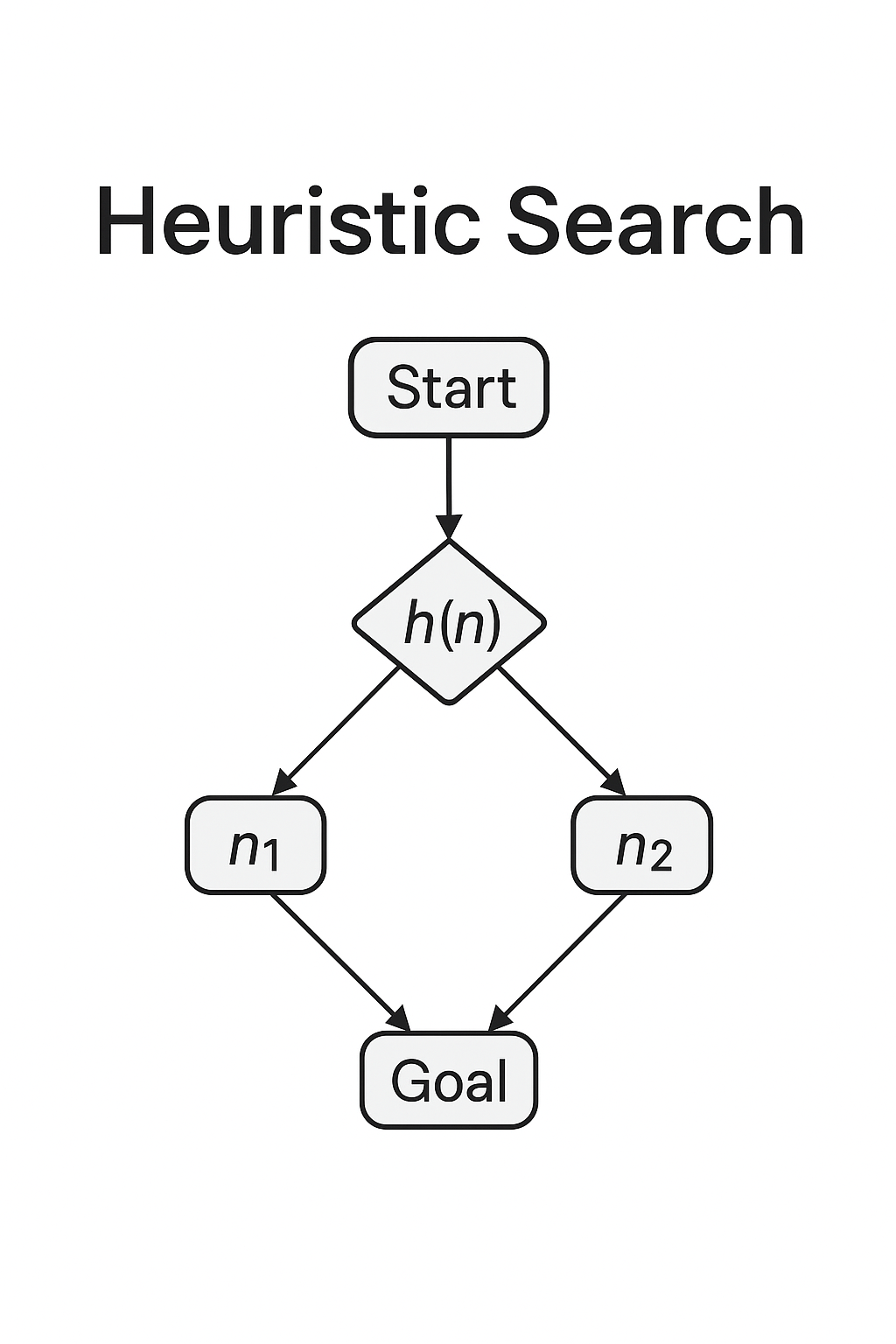
Heuristic Search Is A Fundamental Concept In Artificial Intelligence (AI) That Focuses On Solving Complex Problems Efficiently By Guiding The Search Process Using Domain-specific Knowledge. Unlike Uninformed Or Blind Search Techniques, Heuristic Search Algorithms Use Heuristic Functions—intelligent Rules Of Thumb—to Estimate How Close A Given State Is To The Goal State.
Heuristic Search Approach Significantly Reduces The Search Space, Time Complexity, And Computational Cost, Making Heuristic Search Essential For Real-world AI Applications Such As Pathfinding, Game Playing, Robotics, Planning, Natural Language Processing, And Cybersecurity Systems. In Educational Contexts, Understanding Heuristic Search Provides Learners With A Strong Foundation For Advanced AI Topics, Including Optimization, Machine Learning, And Intelligent Decision-making Systems.
At Its Core, Heuristic Search Is Based On The Idea That Not All Paths In A Problem Space Are Equally Promising. When An AI System Faces A Problem, Such As Finding The Shortest Route On A Map Or Solving A Puzzle, The Total Number Of Possible States Can Be Enormous. Exploring Every State Exhaustively Is Often Impractical Or Impossible.
Heuristics Help By Providing An Estimate Of The “goodness” Of A State, Allowing The Algorithm To Prioritize More Promising Paths. A Heuristic Function, Usually Denoted As H(n), Evaluates A Node N And Estimates The Cost Or Distance From That Node To The Goal. Although Heuristics Do Not Guarantee Perfect Accuracy, A Well-designed Heuristic Can Dramatically Improve Performance.
Heuristic Search Techniques Differ From Traditional Search Methods Like Breadth-First Search (BFS) And Depth-First Search (DFS). BFS Explores All Nodes At A Given Depth Before Moving Deeper, Ensuring Optimal Solutions In Unweighted Graphs But At The Cost Of High Memory Usage.
DFS Explores As Deep As Possible Along One Branch Before Backtracking, Using Less Memory But Risking Getting Stuck In Deep Or Infinite Paths. Heuristic Search Overcomes These Limitations By Intelligently Selecting Which Node To Expand Next Based On Heuristic Evaluations. This Makes Heuristic Algorithms Particularly Suitable For Large And Complex Problem Spaces Where Brute-force Methods Fail.
One Of The Simplest Heuristic Search Techniques Is Greedy Best-First Search. This Algorithm Selects The Node That Appears To Be Closest To The Goal According To The Heuristic Function H(n). It Is Called “greedy” Because It Makes Locally Optimal Choices At Each Step, Hoping To Reach The Global Optimum.
Greedy Best-First Search Is Fast And Often Effective, Especially When The Heuristic Is Informative. However, It Does Not Guarantee Optimal Solutions, As It Ignores The Cost Already Incurred To Reach The Current Node. In Some Cases, It May Get Trapped In Loops Or Choose Suboptimal Paths If The Heuristic Is Misleading.
A More Robust And Widely Used Heuristic Search Technique Is The A* (A-star) Algorithm. A* Combines The Strengths Of Uniform-cost Search And Greedy Search By Considering Both The Cost To Reach The Current Node And The Estimated Cost To Reach The Goal. It Uses An Evaluation Function F(n) = G(n) + H(n), Where G(n) Is The Actual Cost From The Start Node To Node N, And H(n) Is The Heuristic Estimate From N To The Goal.
A* Is Complete And Optimal When The Heuristic Is Admissible, Meaning It Never Overestimates The True Cost To Reach The Goal. This Property Makes A* One Of The Most Important Algorithms Taught In AI Courses And Used In Practical Applications Such As GPS Navigation, Game AI, And Robotics.
The Effectiveness Of Heuristic Search Largely Depends On The Quality Of The Heuristic Function. An Admissible Heuristic Ensures Optimality, While A Consistent (or Monotonic) Heuristic Guarantees That The Estimated Cost Does Not Decrease Along A Path, Improving Efficiency. Designing Heuristics Is Both An Art And A Science, Often Requiring Deep Understanding Of The Problem Domain.
For Example, In The Classic 8-puzzle Problem, Common Heuristics Include The Number Of Misplaced Tiles And The Manhattan Distance, Which Measures The Total Number Of Moves Required To Place Each Tile In Its Correct Position. These Heuristics Significantly Reduce The Number Of States Explored Compared To Uninformed Search.
Another Important Heuristic Search Technique Is Hill Climbing, Which Is A Local Search Algorithm Rather Than A Graph-based Search. Hill Climbing Starts With An Initial Solution And Iteratively Improves It By Moving To A Neighboring State With A Better Heuristic Value. The Process Continues Until No Better Neighbor Exists, At Which Point The Algorithm Stops. Hill Climbing Is Simple And Memory-efficient, Making It Attractive For Optimization Problems.
However, It Suffers From Major Limitations Such As Getting Stuck In Local Maxima, Plateaus, Or Ridges. Variants Like Steepest-ascent Hill Climbing, Stochastic Hill Climbing, And Random-restart Hill Climbing Have Been Developed To Mitigate These Issues.
Beam Search Is Another Heuristic-based Technique That Limits The Number Of Nodes Stored In Memory. Instead Of Keeping All Possible Nodes At A Given Depth, Beam Search Retains Only A Fixed Number, Called The Beam Width, Of The Most Promising Nodes Based On Heuristic Evaluation.
This Approach Balances Performance And Memory Usage, Making It Suitable For Applications Like Natural Language Processing And Speech Recognition. While Beam Search Is Not Guaranteed To Find Optimal Solutions, It Often Produces Good Results In Practice, Especially When Resources Are Constrained.
Heuristic Search Also Plays A Critical Role In Game Playing AI. In Games Like Chess, Checkers, Or Go, The Search Space Is Astronomically Large, Making Exhaustive Search Infeasible. Heuristic Evaluation Functions Are Used To Estimate The Desirability Of A Game State Based On Factors Such As Material Advantage, Board Control, And Positional Strength. Algorithms Like Minimax With Alpha-Beta Pruning Rely Heavily On Heuristics To Evaluate Leaf Nodes When The Search Depth Limit Is Reached. The Quality Of The Heuristic Evaluation Function Often Determines The Strength Of The AI Player.
In Planning And Scheduling Problems, Heuristic Search Enables AI Systems To Generate Efficient Action Sequences To Achieve Specific Goals. Classical Planning Algorithms Use Heuristics To Estimate The Cost Of Achieving Remaining Goals From A Given State. Heuristics Derived From Relaxed Planning Problems Or Problem Abstractions Help Planners Scale To Complex Domains Such As Logistics, Robotics, And Automated Workflow Management. In These Contexts, Heuristic Search Supports Decision-making Under Constraints And Uncertainty.
Heuristic Techniques Are Also Essential In Optimization And Constraint Satisfaction Problems. Algorithms Like Simulated Annealing And Genetic Algorithms Incorporate Heuristic Principles To Explore The Search Space Intelligently. Simulated Annealing Allows Occasional Moves To Worse States To Escape Local Minima, Guided By A Temperature Parameter That Decreases Over Time.
Genetic Algorithms Use Heuristics Encoded In Fitness Functions To Evolve Better Solutions Through Selection, Crossover, And Mutation. Although These Techniques Differ From Classical Heuristic Search, They Share The Common Goal Of Efficiently Navigating Large Solution Spaces Using Informed Guidance.
In Modern AI Systems, Heuristic Search Often Works Alongside Machine Learning Methods. Learned Heuristics, Generated Through Data-driven Approaches, Can Outperform Manually Designed Heuristics In Complex Domains. For Example, Reinforcement Learning Agents Can Learn Value Functions That Serve As Heuristics For Guiding Search.
The Integration Of Heuristic Search With Neural Networks Has Led To Powerful Hybrid Systems, Such As Those Used In Advanced Game-playing AI And Autonomous Navigation. These Systems Demonstrate How Heuristic Principles Remain Relevant Even As AI Technologies Evolve.
From An Educational Perspective, Heuristic Search And Its Techniques Provide Students With Practical Insights Into How Intelligence Can Be Modeled Computationally. Studying Heuristic Search Helps Learners Understand Trade-offs Between Optimality, Efficiency, And Resource Usage.
It Also Illustrates How Domain Knowledge Can Be Leveraged To Solve Problems More Effectively Than Generic Algorithms. By Experimenting With Different Heuristics And Search Strategies, Students Gain Hands-on Experience In Algorithm Design, Evaluation, And Optimization.
In Conclusion, Heuristic Search And Techniques Form A Cornerstone Of Artificial Intelligence, Enabling Efficient Problem-solving In Domains Where Exhaustive Search Is Impractical. By Using Heuristic Functions To Guide Exploration, AI Systems Can Find High-quality Solutions Within Reasonable Time And Memory Limits. Techniques Such As Greedy Best-First Search, A*, Hill Climbing, Beam Search, And Heuristic-driven Game Algorithms Highlight The Diversity And Power Of This Approach.
As AI Continues To Advance, Heuristic Search Remains A Vital Concept, Bridging Classical AI Methods With Modern Intelligent Systems. For Educational Websites, A Thorough Understanding Of Heuristic Search Equips Learners With Essential Knowledge That Underpins Many Real-world AI Applications And Prepares Them For Deeper Exploration Into Intelligent Problem-solving.
Tags:
Heuristic Search And Techniques In AI