How AI Application Solves Space Science Problems?
Category: AI | 5th January 2026, Monday
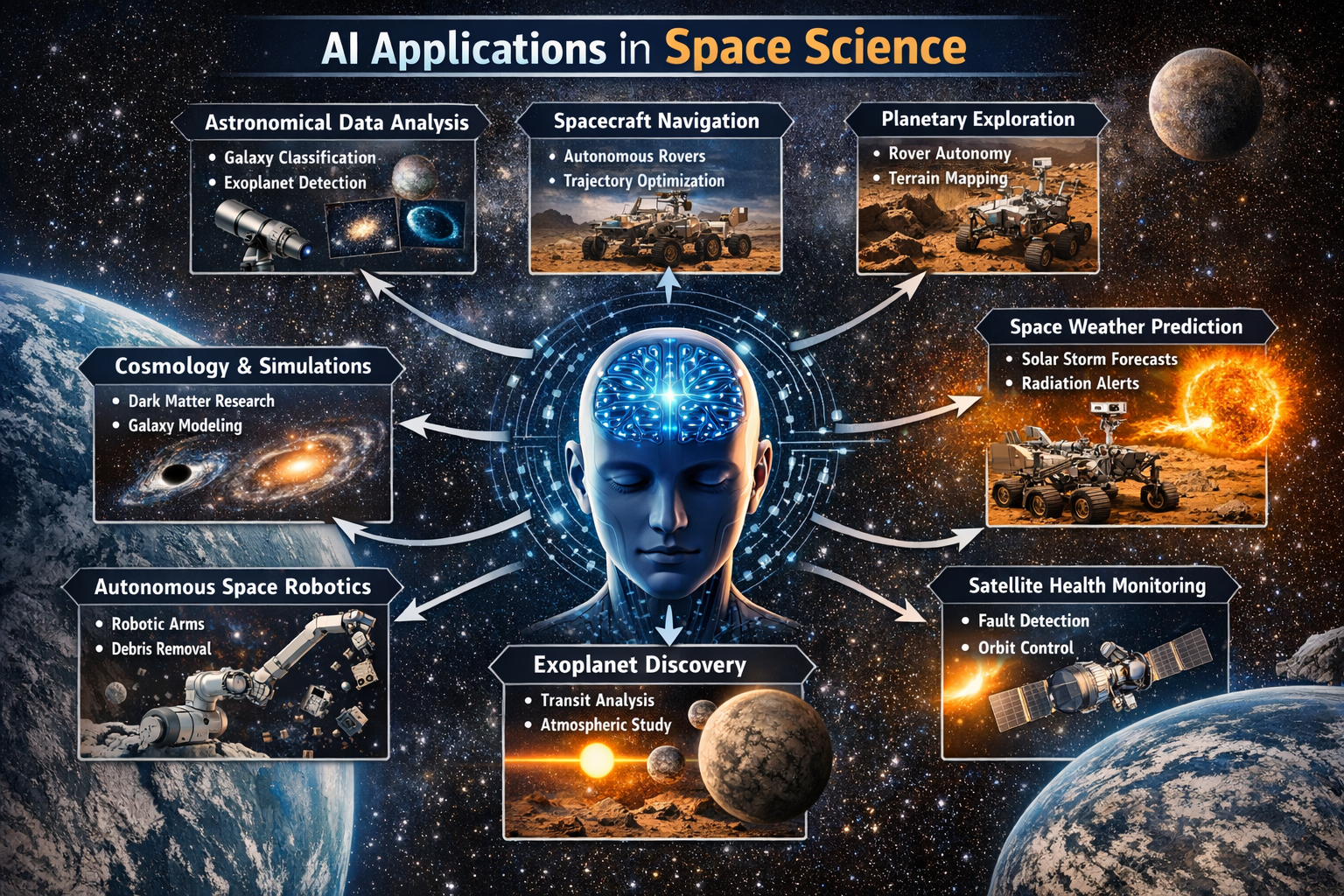
Artificial Intelligence (AI) Has Emerged As One Of The Most Transformative Technologies In Modern Space Science, Fundamentally Changing How Scientists Observe The Universe, Analyze Vast Cosmic Data, Design Missions, And Solve Complex Problems That Were Once Beyond Human Capability. Space Science Deals With Enormous Scales Of Time, Distance, And Data, Ranging From Planetary Exploration And Satellite Operations To Deep-space Astronomy And Cosmology. Traditional Analytical Methods Often Struggle With The Sheer Volume, Velocity, And Complexity Of Space Data Generated By Telescopes, Satellites, Probes, And Simulations. AI, With Its Ability To Learn From Data, Recognize Patterns, And Make Intelligent Decisions, Provides Powerful Tools To Overcome These Limitations And Unlock New Scientific Discoveries.
One Of The Most Significant Ways AI Solves Space Science Problems Is Through The Analysis Of Massive Astronomical Datasets. Modern Observatories Such As The Hubble Space Telescope, James Webb Space Telescope, And Large Ground-based Telescopes Generate Petabytes Of Data In The Form Of Images, Spectra, And Time-series Observations. Manually Analyzing This Data Is Impractical And Error-prone. AI Algorithms, Particularly Machine Learning And Deep Learning Models, Can Automatically Process These Datasets To Identify Galaxies, Stars, Exoplanets, Supernovae, And Other Celestial Phenomena. Convolutional Neural Networks (CNNs), For Instance, Are Widely Used For Image Classification And Object Detection In Astronomical Images, Enabling Rapid And Accurate Identification Of Cosmic Structures That Would Take Humans Years To Catalog.
AI Also Plays A Critical Role In Detecting And Characterizing Exoplanets—planets Outside Our Solar System. Traditional Methods Such As The Transit Method And Radial Velocity Measurements Produce Subtle Signals Buried In Noisy Data. AI Models Are Trained To Recognize These Faint Patterns, Distinguishing Genuine Exoplanet Signals From Stellar Noise And Instrumental Errors. As A Result, AI Has Significantly Increased The Speed And Accuracy Of Exoplanet Discovery, Leading To The Identification Of Thousands Of Candidate Planets And Providing Insights Into Their Size, Orbit, And Potential Habitability. This Capability Directly Addresses One Of The Most Profound Space Science Questions: Whether Life Exists Beyond Earth.
Another Major Application Of AI In Space Science Is In Space Mission Planning And Autonomous Spacecraft Operations. Space Missions Operate In Extreme And Unpredictable Environments, Often Far Beyond Real-time Human Control Due To Communication Delays. AI Enables Spacecraft To Make Intelligent Decisions Independently, Such As Adjusting Trajectories, Avoiding Obstacles, Managing Power Systems, And Responding To Unexpected Conditions. Autonomous Navigation Systems Powered By AI Are Particularly Important For Planetary Rovers Exploring Mars Or The Moon. These Systems Analyze Sensor Data In Real Time To Determine Safe Paths, Identify Scientifically Interesting Targets, And Optimize Mission Objectives Without Constant Instructions From Earth.
AI Also Enhances Satellite Operations And Space Situational Awareness. Thousands Of Satellites Orbit Earth, Along With A Growing Amount Of Space Debris That Poses Collision Risks. Monitoring And Managing This Complex Environment Is A Challenging Problem Involving High-dimensional Data And Real-time Decision-making. AI Algorithms Are Used To Predict Satellite Trajectories, Detect Potential Collisions, And Recommend Avoidance Maneuvers. By Learning From Historical Orbital Data And Physical Models, AI Improves The Accuracy Of Predictions And Helps Ensure The Long-term Sustainability Of Space Activities.
In Astrophysics And Cosmology, AI Is Revolutionizing The Study Of The Large-scale Structure Of The Universe. Understanding How Galaxies Form And Evolve Requires Analyzing Complex Interactions Between Dark Matter, Dark Energy, Gas Dynamics, And Gravity. Traditional Simulations Are Computationally Expensive And Time-consuming. AI-based Surrogate Models Can Approximate These Simulations With High Accuracy At A Fraction Of The Computational Cost. Machine Learning Models Learn The Underlying Relationships From Simulation Data And Then Generate Predictions Quickly, Enabling Scientists To Explore A Wider Range Of Cosmological Scenarios And Refine Theories About The Origin And Evolution Of The Universe.
Gravitational Wave Astronomy Is Another Area Where AI Has Proven Invaluable. Gravitational Wave Detectors Such As LIGO And Virgo Produce Continuous Streams Of Data Containing Weak Signals From Cosmic Events Like Black Hole Mergers And Neutron Star Collisions. These Signals Are Often Buried In Noise, Making Detection Challenging. AI Models Trained On Simulated Gravitational Wave Signals Can Rapidly Identify And Classify Real Events, Improving Detection Sensitivity And Reducing False Alarms. This Capability Allows Scientists To Observe Previously Invisible Cosmic Phenomena And Gain New Insights Into Extreme Astrophysical Processes.
AI Also Contributes Significantly To Planetary Science By Analyzing Data From Orbiters, Landers, And Probes Exploring Planets, Moons, Asteroids, And Comets. For Example, AI Techniques Are Used To Classify Surface Features, Analyze Mineral Compositions, And Detect Geological Changes Over Time. On Mars, AI Has Helped Identify Signs Of Ancient Riverbeds, Volcanic Activity, And Potential Biosignatures By Processing High-resolution Images And Spectral Data. These Discoveries Guide Future Missions And Help Scientists Understand The History And Potential Habitability Of Other Worlds.
Another Important Application Of AI In Space Science Is Climate And Space Weather Modeling. Space Weather, Driven By Solar Activity Such As Solar Flares And Coronal Mass Ejections, Can Disrupt Satellite Communications, Navigation Systems, And Power Grids On Earth. Predicting These Events Is A Complex Problem Involving Nonlinear Interactions In The Sun–Earth System. AI Models Trained On Historical Solar And Geomagnetic Data Can Forecast Space Weather Events More Accurately And Earlier Than Traditional Methods. This Predictive Capability Helps Protect Critical Infrastructure And Ensures The Reliability Of Space-based Technologies.
AI Also Supports The Design And Optimization Of Spacecraft And Space Systems. Engineering Spacecraft Involves Balancing Multiple Constraints Such As Weight, Power, Thermal Stability, And Reliability. AI-based Optimization Algorithms Explore Vast Design Spaces To Identify Optimal Configurations That Meet Mission Requirements. These Techniques Reduce Development Time, Lower Costs, And Improve Performance. In Addition, AI-driven Fault Detection And Diagnosis Systems Monitor Spacecraft Health In Real Time, Identifying Anomalies Before They Lead To Mission Failure.
In Radio Astronomy, AI Is Used To Process Signals From Vast Arrays Of Radio Telescopes, Such As The Square Kilometre Array (SKA). These Instruments Generate Unprecedented Volumes Of Data That Require Real-time Analysis. AI Algorithms Help Filter Out Interference, Detect Transient Signals Like Fast Radio Bursts, And Extract Meaningful Scientific Information. By Automating These Processes, AI Enables Scientists To Focus On Interpretation And Theory Rather Than Data Handling.
AI Also Addresses One Of The Most Challenging Problems In Space Science: The Search For Patterns And Anomalies In High-dimensional Data. Many Space Phenomena Are Rare, Unexpected, Or Poorly Understood. Unsupervised Learning Techniques, Such As Clustering And Anomaly Detection, Allow AI Systems To Identify Unusual Patterns That May Indicate New Physical Processes Or Unknown Objects. This Capability Has The Potential To Lead To Groundbreaking Discoveries That Reshape Our Understanding Of The Universe.
Furthermore, AI Facilitates Interdisciplinary Integration In Space Science By Combining Data From Multiple Sources And Domains. For Example, Integrating Optical, Infrared, X-ray, And Gravitational Wave Observations Provides A More Complete Picture Of Cosmic Events. AI Models Can Learn From These Heterogeneous Datasets, Uncovering Correlations And Insights That Are Difficult To Detect Using Traditional Approaches. This Multi-messenger Astronomy Represents A New Paradigm In Space Science, Enabled Largely By AI.
Education And Accessibility In Space Science Have Also Benefited From AI. Intelligent Data Analysis Tools And Virtual Assistants Help Researchers, Students, And Citizen Scientists Explore Space Data Without Requiring Deep Expertise In Programming Or Statistics. This Democratization Of Space Science Accelerates Research Progress And Fosters Global Collaboration.
Despite Its Many Advantages, The Use Of AI In Space Science Also Presents Challenges. AI Models Require High-quality Training Data And Careful Validation To Avoid Biases And Misinterpretations. Interpretability Is Another Concern, As Complex Deep Learning Models Can Act As “black Boxes,” Making It Difficult To Understand How Decisions Are Made. Space Scientists Are Increasingly Developing Explainable AI Techniques To Ensure That AI-driven Discoveries Are Scientifically Trustworthy And Aligned With Physical Principles.
Looking Ahead, The Role Of AI In Space Science Is Expected To Grow Even Further. Future Missions Will Rely Heavily On AI For Fully Autonomous Exploration Of Distant Worlds, Real-time Scientific Decision-making, And Adaptive Mission Planning. AI Will Also Be Essential For Handling The Data Deluge From Next-generation Observatories And For Exploring Fundamental Questions About Dark Matter, Dark Energy, And The Origins Of Life.
In Conclusion, AI Solves Space Science Problems By Transforming How Data Is Collected, Analyzed, And Interpreted Across All Domains Of Space Research. From Discovering Exoplanets And Detecting Gravitational Waves To Enabling Autonomous Spacecraft And Predicting Space Weather, AI Provides Powerful Tools That Extend Human Capabilities And Accelerate Scientific Discovery. By Handling Complexity, Scale, And Uncertainty, AI Allows Space Scientists To Ask Deeper Questions And Explore The Universe With Unprecedented Precision. As AI And Space Science Continue To Evolve Together, Their Synergy Promises To Unlock New Frontiers And Redefine Our Understanding Of The Cosmos.
Tags:
How AI Solves Space Science Problems