What Is Rational Agent Approach? Rational Agent Approaches In Artificial Intelligence
Category: AI | 3rd December 2025, Wednesday
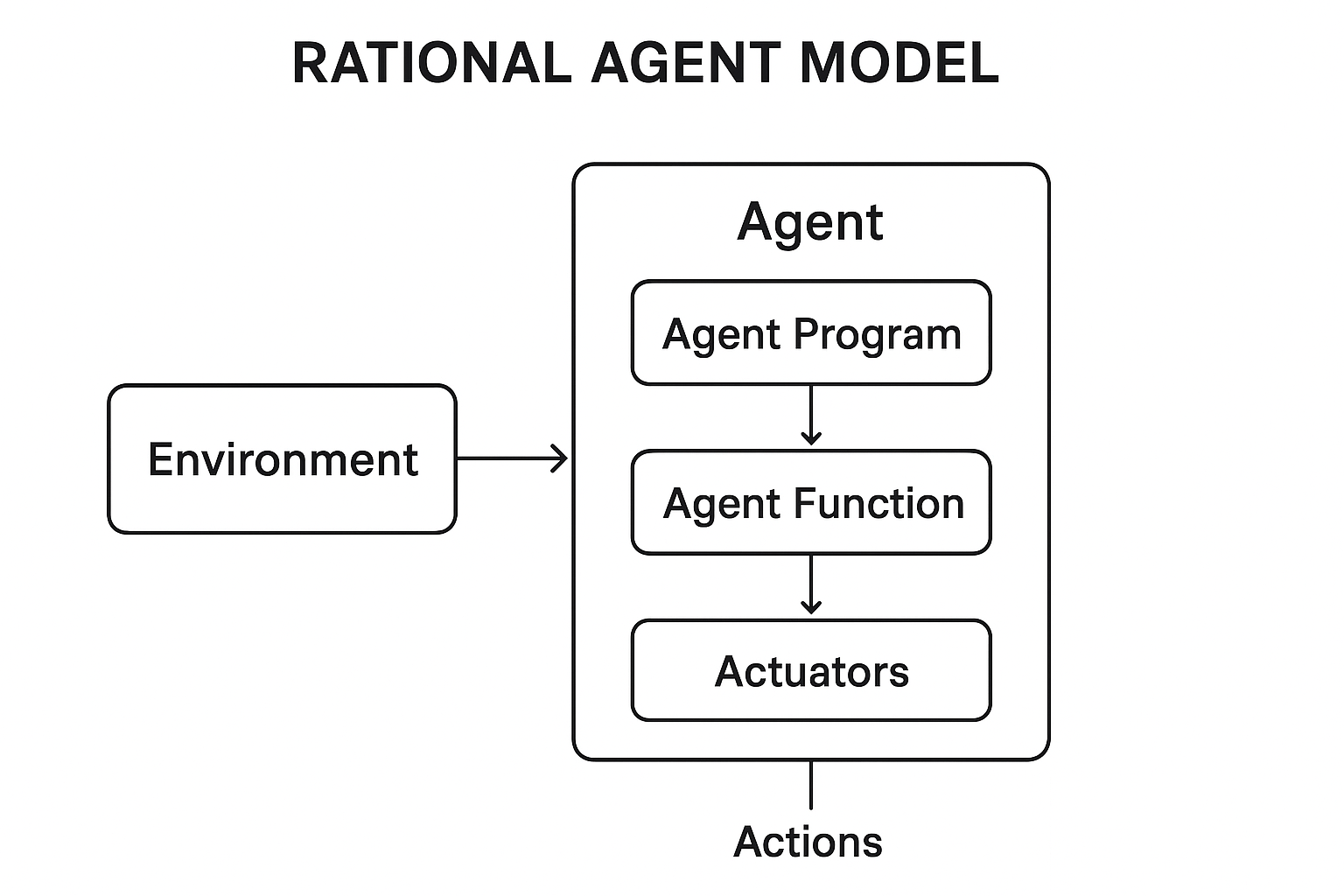
The Rational Agent Approach Is The modern And Most Accepted Framework In AI, Replacing Earlier Ideas Like The Turing Test And Logical Reasoning Approaches.
Definition
A Rational Agent Is An AI System That perceives Its Environment And takes Actions To maximize Its Performance Measure Or Achieve The Best Expected Outcome.
In Simple Words:
A Rational Agent Always Does The Right Thing (the Best Possible Action) Given What It Knows.
Components Of A Rational Agent
-
Percepts
Input Received From The Environment (sensors, Data, Signals) -
Agent Function
Maps Percepts → Actions -
Agent Program
Implementation Of The Agent Function (code Or Algorithm) -
Actuators
Tools To Take Actions (motors, API Calls, Decisions) -
Environment
World In Which The Agent Operates
Types Of Agent Approaches In AI
-
Simple Reflex Agent
-
Acts Only On Current Percepts
-
“If Condition → Then Action”
-
-
Model-Based Reflex Agent
-
Uses internal Memory Of Past States
-
Maintains A Model Of The World
-
-
Goal-Based Agent
-
Acts To achieve A Specific Goal
-
Needs Decision-making And Planning
-
-
Utility-Based Agent
-
Chooses Actions Based On maximum Utility (happiness, Profit, Reward)
-
Used In Reinforcement Learning
-
-
Learning Agent
-
Improves Performance Over Time
-
Uses Feedback, Training Data, And Adaptation
-
Why Rational Agent Approach Is Better?
| Feature | Turing Test | Rational Agent Approach |
|---|---|---|
| Focus | Mimicking Humans | Achieving Optimal Results |
| Subjective | Yes | No (performance Measure) |
| Human-like Intelligence | Required | Not Required |
| Modern AI Relevance | Low | Very High |
| Used In Robotics, ML, RL | Rarely | Always |
Examples Of Rational Agents
-
Self-driving Cars Selecting The Safest Path
-
Google Search Ranking Algorithms
-
Chess-playing AI Choosing Optimal Moves
-
Smart Grid Controllers Adjusting Load Distribution
-
Fraud Detection Systems Deciding Risk Scores
What Is The Rational Agent Approach? (3–4 Lines)
The Rational Agent Approach Defines An AI System As An Agent That Perceives Its Environment And Performs Actions That Maximize Its Expected Performance. It Focuses On Optimal Decision-making Rather Than Human-like Behavior. This Approach Is Widely Used In Modern AI, Robotics, And Machine Learning.
Rational Agent Approach
The Rational Agent Approach Is One Of The Most Fundamental And Modern Frameworks For Understanding Artificial Intelligence. Instead Of Defining AI As A System That “thinks” Or “acts” Like A Human, The Rational Agent Approach Defines AI As A System That acts Rationally—that Is, It Takes The Best Possible Action To Achieve Its Goals Based On What It Knows. This Perspective Forms The Core Of Most Contemporary AI Research And Engineering Because It Is Practical, Flexible, And Mathematically Grounded.
A rational Agent Is Any Entity That perceives Its Environment Through Sensors And acts Upon That Environment Through Actuators. The Goal Of Such An Agent Is To Choose Actions That maximize Its Performance Measure, A Quantitative Metric That Reflects How Well The Agent Is Achieving Its Objectives. Rationality Does Not Guarantee Perfect Correctness; Rather, It Guarantees That The Agent Is Doing the Right Thing Based On The Information Available, The Computational Resources It Has, And The Expected Consequences Of Its Actions. This View Aligns AI With Decision Theory, Control Theory, And Economics.
A Rational Agent Interacts With An environment, Which Can Be Fully Observable Or Partially Observable, Deterministic Or Stochastic, Static Or Dynamic, And Discrete Or Continuous. These Factors Determine The Complexity Of An Agent’s Design. For Example, A Vacuum-cleaner Robot Working In A Small, Predictable Room Can Be Simple, While A Self-driving Car Operating In Unpredictable Traffic Requires Advanced Perception, Learning, And Planning. Regardless Of Complexity, What Makes Both Systems AI Agents Is That They Operate Based On Rational Decision-making Principles.
The Design Of A Rational Agent Typically Includes Several Important Components: a Perception Module, Which Gathers Data From The Environment; a State Representation, Which Interprets And Organizes Perception Data; a Decision-making Or Action-selection Mechanism, Often Based On Rules, Utility Functions, Search Algorithms, Or Machine Learning Models; And an Action Module That Executes Decisions. Importantly, Rational Agents May Also Incorporate learning Mechanisms That Allow Them To Improve Their Performance Over Time. Learning Enables Agents To Adapt When Environments Change Or When The Initial Model Is Incomplete.
One Key Feature Of The Rational Agent Approach Is The Concept Of performance Measures, Which Shift The Focus From Internal Processes To External Outcomes. Unlike The Traditional “thinking Humanly” Approach—which Attempts To Imitate Human Cognitive Processes—the Rational Agent Approach Does Not Require The System To Think Like A Human. Instead, It Only Requires The System To act Optimally In Pursuit Of Defined Goals. This Is Especially Useful In Fields Like Robotics, Game-playing, Autonomous Systems, And Expert Systems, Where Human-style Reasoning Is Not Necessary, But Optimal Decision-making Is Essential.
Another Important Aspect Is autonomy. A Rational Agent Should Operate Independently As Much As Possible, Without Frequent Human Intervention. Autonomy Is Achieved Through Sensing, Reasoning, And Learning, Allowing The Agent To Handle New Situations And Uncertainties. Higher Autonomy Generally Leads To More Rational Behavior Because The Agent Can Make Decisions Tailored To Its Environment Rather Than Following Static Instructions.
In Conclusion, The Rational Agent Approach Provides A Robust And Rigorous Foundation For Artificial Intelligence. By Emphasizing Goal-directed Behavior, Optimal Decision-making, And Interaction With Complex Environments, It Enables The Development Of Flexible, Adaptive, And Intelligent Systems. Most Modern AI Systems—from Chatbots And Recommendation Engines To Robots And Autonomous Vehicles—are Fundamentally Based On This Rational Agent Paradigm.
Tags:
Rational Agent Approach, Define Rational Agent Approach