What Is Turing Testing?
Category: AI | 3rd December 2025, Wednesday
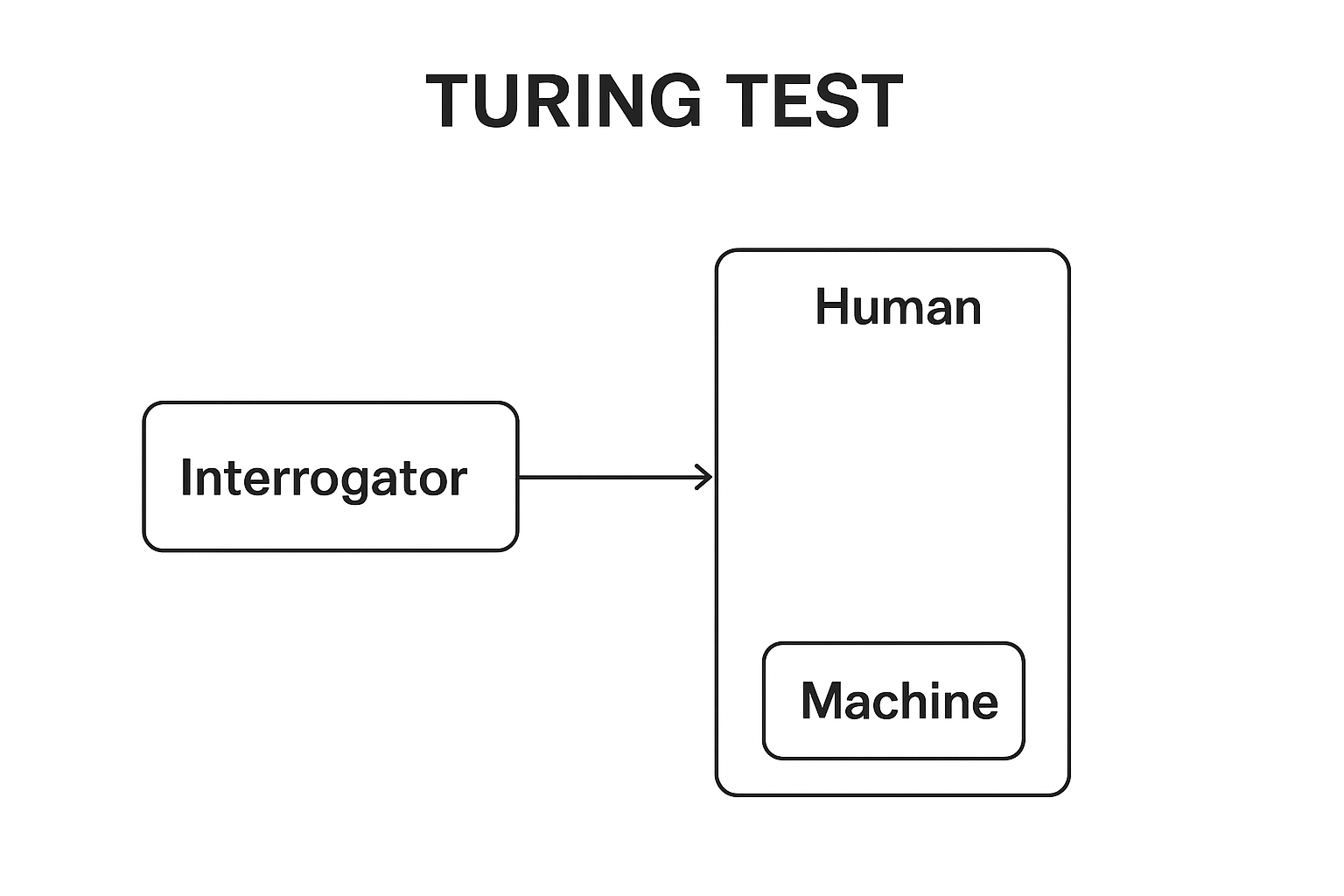
The Turing Test Was Proposed By Alan Turing In 1950 As A Way To Determine Whether A Machine Exhibits human-like Intelligence.
Definition
The Turing Test Is An Evaluation Method In Which A Human Evaluator Interacts With Both A Machine And A Human (through Text Conversations) Without Knowing Which Is Which.
If The Evaluator Cannot Reliably Distinguish The Machine From The Human, The Machine Is Considered intelligent.
Key Ideas
-
Imitation Game
-
The Test Is Based On The Machine’s Ability To imitate Human Conversation.
-
-
Behavioral Test
-
It Measures Intelligence based On External Behavior, Not Internal Mechanisms.
-
-
Language-Based Interaction
-
The Test Uses Natural Language Communication (text-based).
-
-
No Need For Consciousness Or Emotions
-
It Tests Only The ability To Respond Like A Human.
-
Components Of A Turing Test Setup
-
Interrogator (Human Evaluator)
-
Human Participant
-
Machine (AI Program)
-
A Text Terminal Or Chat Interface Where All Communication Happens
Limitations / Criticisms
-
Depends On Deception (machine Pretending To Be Human)
-
Narrow Focus On Language
-
Does Not Evaluate reasoning, knowledge, Or understanding
-
Humans May Be Fooled Easily
-
Machines Can Pass Without Real Intelligence (e.g., Chatbots)
Significance
-
First Scientific Attempt To Define Machine Intelligence
-
Forms The Foundation For Natural Language Processing, Chatbots, And Conversational AI
Turing Test: Examples And Significance In Artificial Intelligence
The Turing Test, Proposed By Alan Turing In 1950, Is One Of The Earliest And Most Influential Methods For Evaluating Machine Intelligence. Turing Argued That Instead Of Asking “Can A Machine Think?”, We Should Ask Whether A Machine Can imitate Human Conversational Behaviour So Convincingly That An Evaluator Cannot Reliably Distinguish It From A Human. The Test Involves Three Participants: A Human Interrogator, A Human Respondent, And A Machine. Communication Takes Place Through Text To Remove Physical Cues. If The Interrogator Cannot Correctly Identify The Machine In A Significant Number Of Trials, The Machine Is Said To Have Passed The Test.
Turing Test Examples Illustrate How AI Systems Attempt To Mimic Human Intelligence:
-
Chatbot Conversations: Early Systems Like ELIZA And PARRY Were Evaluated Through Text-based Questioning. If The Evaluator, After A Short Conversation, Mistook Them For Humans, They Demonstrated Limited Success In Natural Language Imitation. Modern Conversational Agents (e.g., GPT-based Models) Continue To Be Informally Evaluated This Way.
-
Customer Service Simulations: Companies Often Test AI Customer-support Bots By Mixing Them With Human Agents. If Users Cannot Reliably Tell Which Responses Belong To AI, The Bot Is Considered To Exhibit Human-like Communication Skills, Demonstrating Its Ability To Handle Queries, Emotions, And Context.
-
Game-Based Turing Tests: Online Platforms Sometimes Ask Players To Judge Whether Their Opponent Is A Human Or A Bot Based On Behaviour In Games Or Typing Patterns. If The AI’s Behaviour Blends With Human Variability, It Effectively Passes A Domain-specific Turing Test.
-
Reverse Turing Tests (CAPTCHAs): CAPTCHAs Represent A Special Case Where Humans Must Prove They Are Not Machines. Though Opposite In Intention, They Show How Human-like Pattern Recognition Is Still Difficult For Many AI Systems.
The Turing Test Has Major Significance In AI Development. First, It Provides A behavioural Criterion For Intelligence, Shifting Focus From Internal Mechanisms To Observable Performance. This Approach Influenced The Field Of Natural Language Processing (NLP) By Emphasizing Human-like Dialogue, Contextual Reasoning, And Linguistic Fluency. Second, It Served As A conceptual Foundation For Building Conversational Agents, Inspiring Decades Of Research Into Chatbots, Speech Systems, And Human-computer Interaction.
Moreover, The Turing Test Has Important philosophical Implications. It Raises Questions About Whether Intelligence Requires Understanding Or Merely The Ability To Simulate Understanding. Critics Argue That A Machine Could Pass The Test Using Superficial Tricks Without Genuine Reasoning; Nonetheless, The Debate Stimulated Deeper Inquiry Into Consciousness, Cognition, And The Nature Of Thinking.
Despite Limitations—such As Its Narrow Focus On Language And Susceptibility To Deception—the Turing Test Remains A milestone In AI History. It Continues To Be Referenced As A Benchmark For Judging Human-like Behaviour In Machines And Has Shaped The Development Of Modern AI Systems. Its Enduring Relevance Lies Not In Providing A Perfect Test, But In Provoking Scientific Exploration Of What It Truly Means For A Machine To “think”.
50 MCQs On Turing Test (with Answers)
1. Who Proposed The Turing Test?
A. John McCarthy
B. Alan Turing
C. Norbert Wiener
D. Marvin Minsky
Answer: B
2. In Which Year Was The Turing Test Proposed?
A. 1943
B. 1950
C. 1965
D. 1971
Answer: B
3. The Turing Test Appears In Turing’s Paper Titled:
A. Machine Intelligence
B. Evaluating Robots
C. Computing Machinery And Intelligence
D. Intelligent Machines
Answer: C
4. What Question Did Turing Replace With “Can Machines Think?”
A. Can Machines Calculate?
B. Can Machines Feel?
C. Can Machines Imitate Humans?
D. Can Machines Make Decisions?
Answer: C
5. The Turing Test Is Also Known As:
A. The Imitation Game
B. The Simulation Game
C. The Reasoning Game
D. The Cognition Test
Answer: A
6. What Is Evaluated In The Turing Test?
A. Internal Algorithm
B. Physical Movement
C. Human-like Conversational Intelligence
D. Data Storage Capacity
Answer: C
7. The Turing Test Primarily Assesses:
A. Strength
B. Natural Language Processing
C. Robot Motion
D. Memory
Answer: B
8. How Many Participants Are Involved In The Classic Turing Test Setup?
A. Two
B. Three
C. Four
D. Five
Answer: B
9. Who Acts As The Evaluator In A Turing Test?
A. Machine
B. Human
C. Robot
D. Software Agent
Answer: B
10. Communication In A Turing Test Occurs Via:
A. Voice
B. Physical Gestures
C. Text Messages
D. Images
Answer: C
11. A Machine Passes The Turing Test If The Judge:
A. Always Detects The Machine
B. Never Talks To The Machine
C. Fails To Distinguish Between Human And Machine
D. Asks No Questions
Answer: C
12. What Does The Turing Test NOT Require?
A. Machine Appearance
B. Text Conversation
C. A Human Judge
D. A Machine Participant
Answer: A
13. Which Of The Following Chatbots Was An Early Attempt At Turing Test Success?
A. Alexa
B. Bixby
C. ELIZA
D. Watson
Answer: C
14. ELIZA Was Designed By:
A. Turing
B. Joseph Weizenbaum
C. John McCarthy
D. Arthur Samuel
Answer: B
15. PARRY Was Designed To Simulate:
A. A Child
B. A Psychiatrist
C. A Person With Paranoia
D. A Teacher
Answer: C
16. The Turing Test Focuses On:
A. Appearance
B. Behaviour
C. Computation Speed
D. Robotic Arms
Answer: B
17. A Major Criticism Of The Turing Test Is That It:
A. Measures Real Intelligence
B. Measures Problem-solving Ability
C. Measures Imitation, Not True Understanding
D. Requires Huge Hardware
Answer: C
18. The Turing Test Does NOT Evaluate:
A. Reasoning
B. Human-like Responses
C. Physical Perception
D. Language Ability
Answer: C
19. A Reverse Turing Test Example Is:
A. ELIZA
B. CAPTCHA
C. PARRY
D. ChatGPT
Answer: B
20. CAPTCHA Stands For:
A. Computer Analysis Program
B. Completely Automated Public Turing Test To Tell Computers And Humans Apart
C. Computer Automated Processing Tool
D. Central Automated Program Test
Answer: B
21. The Turing Test Belongs To Which AI Domain?
A. Machine Vision
B. NLP
C. Robotics
D. Deep Learning Only
Answer: B
22. The Major Purpose Of A Turing Test Is To Check:
A. Learning Speed
B. Human-like Intelligence
C. Memory
D. Computation Power
Answer: B
23. Modern Chatbots Are Tested Using:
A. Graphical Models
B. Turing-like Text Conversations
C. Sensor Networks
D. Binary Gates
Answer: B
24. The Judge In A Turing Test Is Unaware Of:
A. Machine Algorithm
B. Which Participant Is Machine
C. Chat Duration
D. Type Of Questions
Answer: B
25. The Turing Test Measures:
A. Consciousness
B. Mind
C. Behavioural Equivalence
D. Emotional Intelligence
Answer: C
26. A System That Passes The Turing Test Might Still Lack:
A. Learning
B. Genuine Understanding
C. Text Generation
D. Reasoning Ability
Answer: B
27. The Turing Test Is Limited Mainly Because It:
A. Is Too Expensive
B. Tests Only Language Imitation
C. Requires Robots
D. Requires Neural Networks
Answer: B
28. In The Turing Test, The Machine Attempts To:
A. Perform Calculations
B. Behave Indistinguishably From A Human
C. Show Its Algorithm
D. Imitate Animals
Answer: B
29. A Variation Of The Turing Test Used For Online Security Is:
A. CAPTCHA
B. RSA
C. MD5
D. SHA
Answer: A
30. Which Modern AI Assistant Is Often Compared Using Turing-like Tests?
A. Siri
B. Excel
C. Photoshop
D. PowerPoint
Answer: A
31. Turing’s Main Argument Was To Focus On:
A. Learning Speed
B. Observable Behaviour
C. Hardware
D. Emotions
Answer: B
32. The Turing Test Is Conducted In:
A. Blind Conditions
B. Confined Room
C. Computer-mediated Text
D. Open Conversation In Person
Answer: C
33. The Turing Test Is NOT A Good Measure Of:
A. Language Fluency
B. Human-like Deception
C. Physical Intelligence
D. Text Understanding
Answer: C
34. Machines Can Pass The Turing Test By Using:
A. Emotional Imitation
B. Physical Gestures
C. Supervised Perception
D. Robotic Behaviour
Answer: A
35. The Turing Test Mainly Tests A System's:
A. Syntax
B. Semantic Behaviour
C. Human-like Interaction
D. Internal Architecture
Answer: C
36. Which Argument Challenges The Turing Test’s Validity?
A. “Easy Test” Argument
B. Chinese Room Argument
C. Behavioral Logic Argument
D. Machine Error Argument
Answer: B
37. The Chinese Room Argument Was Given By:
A. Searle
B. Turing
C. McCarthy
D. Minsky
Answer: A
38. Reverse Turing Tests Are Used For:
A. Cybersecurity
B. Speech Recognition
C. Robotics
D. Neural Networks
Answer: A
39. A Chatbot Failing The Turing Test Means:
A. It Lacks Hardware
B. It Cannot Imitate Human Conversation Sufficiently
C. It Cannot Store Data
D. It Cannot Perform Calculations
Answer: B
40. A Machine Passing The Turing Test Implies:
A. Human-like Conversation
B. True Consciousness
C. Emotional Depth
D. Sensory Perception
Answer: A
41. The Turing Test Focuses Only On:
A. External Behaviour
B. Internal Processing
C. Brain-like Structures
D. Mathematical Logic
Answer: A
42. A Modern Extension Of The Turing Test Involves:
A. Speech-based Evaluation
B. Mechanical Parts
C. Hardware Stress Tests
D. Sorting Algorithms
Answer: A
43. A Limitation Of The Turing Test Is That It Can Be:
A. Too Cheap
B. Tricked By Smart Conversation Patterns
C. Difficult For Humans
D. Unrelated To NLP
Answer: B
44. The Turing Test Was Originally Designed To Evaluate:
A. Symbolic Processing
B. Machine Behaviour
C. Logical Reasoning
D. Data Science
Answer: B
45. The Test Ends When:
A. Judge Identifies Both Correctly
B. Machine Reveals Itself
C. Judge Cannot Reliably Differentiate
D. Machine Wins A Game
Answer: C
46. The Turing Test Is Often Criticized For:
A. Being Too Scientific
B. Measuring Superficial Imitation
C. Requiring Emotions
D. Being Too Mathematical
Answer: B
47. Which Of These Is A Real-world Turing-like Application?
A. Chatbot Customer Service Evaluation
B. Sensor Calibration
C. Image Compression
D. Data Warehousing
Answer: A
48. The Turing Test Does Not Check:
A. Creativity
B. Conversation
C. Logic
D. Syntax
Answer: A
49. CAPTCHA Forces:
A. Humans To Act Like Machines
B. Machines To Act Like Humans
C. Machines To Identify Humans
D. Humans To Identify Machines
Answer: D
50. The Turing Test Remains Important Because It:
A. Perfectly Measures Intelligence
B. Provides A Simple Behavioural Benchmark For AI
C. Tests Hardware Power
D. Measures Consciousness
Answer: B
Summary Of The Turing Test:
The Turing Test, Proposed By Alan Turing In 1950, Evaluates A Machine’s Ability To Exhibit Intelligent Behavior Indistinguishable From That Of A Human. In This Test, A Human Evaluator Interacts With Both A Machine And A Human Through Text-based Communication. If The Evaluator Cannot Reliably Determine Which Respondent Is The Machine, The Machine Is Considered To Have Demonstrated Human-like Intelligence. The Test Focuses On Conversational Ability Rather Than Internal Thought Processes. Although Influential In AI History, The Turing Test Has Been Criticized For Emphasizing Imitation Over True Understanding. Still, It Remains A Landmark Concept In Evaluating Artificial Intelligence.
What Is The Turing Test? (3–4 Lines)
The Turing Test, Proposed By Alan Turing, Evaluates A Machine’s Ability To Exhibit Human-like Intelligence. A Human Examiner Interacts With Both A Machine And A Human Through Text. If The Examiner Cannot Reliably Differentiate The Machine From The Human, The Machine Is Said To Have Passed The Test.
Tags:
Turing Test, What Is Turing Test