Active And Passive Attacks In Cryptography: Types, Examples, And Prevention
Category: CRYPTOGRAPHY | 28th September 2026, Monday
Introduction To Cryptographic Attacks
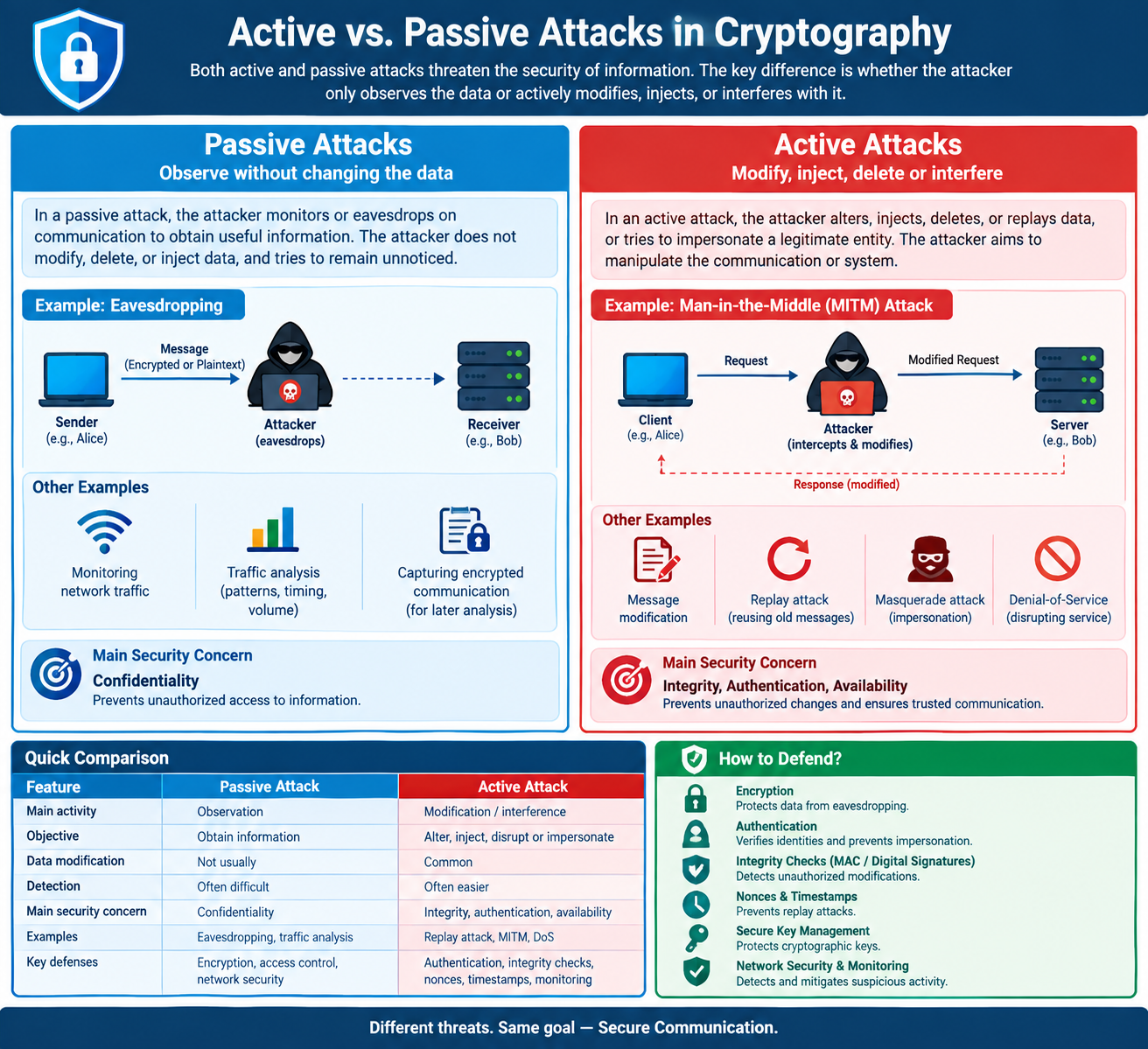
Cryptography Is Designed To Protect Information From Unauthorized Access, Modification, Impersonation, And Other Security Threats. However, Cryptographic Systems Operate In Environments Where Attackers May Attempt To Observe Communications, Manipulate Messages, Steal Credentials, Or Disrupt Services. Cryptographic Attacks Can Broadly Be Understood Through Several Categories, Among Which passive Attacks And active Attacks Are Fundamental. The Primary Difference Is Whether The Attacker Merely Observes Information Or Actively Modifies, Injects, Deletes, Or Disrupts Communication.
Meaning Of A Passive Attack
A passive Attack Occurs When An Attacker Observes Or Monitors Information Without Altering The Data Or Directly Interfering With The Communication Process. The Attacker Attempts To Obtain Useful Information While Remaining Unnoticed. Examples Include Listening To Network Traffic, Observing Communication Patterns, And Analyzing The Timing Or Volume Of Transmitted Information. Strong Encryption Can Significantly Reduce The Usefulness Of Intercepted Content, Although Metadata May Still Reveal Information.
Meaning Of An Active Attack
An active Attack Occurs When An Attacker Modifies, Inserts, Deletes, Replays, Or Otherwise Interferes With Information Or Communication. The Attacker May Attempt To Impersonate A Legitimate Participant, Alter Transactions, Disrupt Services, Or Manipulate A Cryptographic Protocol. Active Attacks Generally Create Changes In System Behavior And Can Therefore Sometimes Be Detected Through Authentication, Integrity Checking, Logging, Intrusion Detection, And Other Security Mechanisms.
Fundamental Difference
The Fundamental Difference Between Passive And Active Attacks Is observation Versus Manipulation. In A Passive Attack, The Attacker Attempts To Learn Information Without Changing The Communication. In An Active Attack, The Attacker Attempts To Influence The Communication Or System. For Example, Secretly Capturing Encrypted Network Traffic Is Passive, While Changing A Transmitted Transaction Before It Reaches Its Destination Is Active.
Passive Attacks And Confidentiality
Passive Attacks Primarily Threaten confidentiality. Confidentiality Means That Information Should Be Accessible Only To Authorized Entities. If An Attacker Intercepts Sensitive Communication, Confidential Information May Be Exposed. Encryption Is One Of The Principal Defenses Against This Type Of Threat. Properly Implemented Encryption Can Make Intercepted Ciphertext Computationally Impractical To Understand Without The Appropriate Cryptographic Key.
Active Attacks And Integrity
Active Attacks Frequently Threaten integrity Because The Attacker Attempts To Modify Or Manipulate Information. For Example, An Attacker Could Attempt To Change A Digital Message While It Is Being Transmitted. Cryptographic Integrity Mechanisms Such As MACs And Digital Signatures Help Recipients Determine Whether Data Has Been Altered. Secure Protocols Also Use Authentication Mechanisms To Reduce The Possibility Of Unauthorized Manipulation.
Eavesdropping As A Passive Attack
Eavesdropping Is A Classic Passive Attack. In This Scenario, An Attacker Monitors Communication Between Legitimate Parties Without Necessarily Changing The Transmitted Information. Wireless Networks, Poorly Protected Communication Channels, And Improperly Configured Systems May Provide Opportunities For Observation. Encryption Can Protect Message Content, While Secure Network Architecture And Appropriate Access Controls Can Reduce Unauthorized Access To Communication Channels.
Traffic Analysis
Traffic Analysis Is Another Important Passive Attack. Even When Message Contents Are Encrypted, An Attacker May Observe Metadata Such As Communication Frequency, Packet Sizes, Timing, Endpoints, And Traffic Volume. This Information Can Sometimes Reveal Patterns About System Behavior. Therefore, Confidentiality Does Not Always Mean That Every Aspect Of Communication Is Hidden. Some Systems Use Techniques Such As Padding, Traffic Shaping, Or Mixing To Reduce Information Leakage From Communication Patterns.
Interception Of Encrypted Communication
An Attacker May Capture Encrypted Communication And Store It For Later Analysis. The Attacker Might Not Immediately Know The Plaintext, But The Ciphertext Could Potentially Become Useful If Weaknesses Are Later Discovered Or Cryptographic Keys Are Compromised. This Is Particularly Relevant To The Concept Of harvest Now, Decrypt Later, Where Encrypted Information Is Collected Today With The Intention Of Attempting Decryption In The Future If Technology Or Cryptanalytic Capabilities Improve.
Passive Attacks Are Difficult To Detect
One Major Characteristic Of Passive Attacks Is That They Can Be Difficult To Detect. Since The Attacker Does Not Modify The Communication, The Sender And Receiver May Continue To Operate Normally. Network Monitoring May Detect Unusual Traffic Patterns, But Detecting Observation Alone Can Be Challenging. Consequently, Preventive Controls Such As Encryption, Secure Authentication, Network Segmentation, And Physical Security Are Particularly Important.
Active Attacks And Message Modification
In A Message-modification Attack, An Attacker Attempts To Alter Information While It Is Being Transmitted Or Processed. For Example, A Message Containing Transaction Information Could Potentially Be Modified If The Communication Protocol Does Not Adequately Protect Integrity. Cryptographic Authentication Mechanisms Are Designed To Allow The Recipient To Determine Whether The Message Was Generated By An Authorized Party And Whether It Has Been Modified.
Replay Attack
A replay Attack Occurs When An Attacker Captures A Valid Communication And Later Retransmits It To Cause An Unintended Action. The Attacker Does Not Necessarily Need To Understand The Original Message. If A System Accepts An Old Valid Message As A New Request, The Attacker May Be Able To Repeat An Operation. Cryptographic Protocols Can Use Nonces, Timestamps, Sequence Numbers, Counters, And Session Identifiers To Help Detect And Reject Previously Used Messages.
Masquerade Attack
A masquerade Attack Occurs When An Attacker Attempts To Impersonate An Authorized User, Device, Server, Or Other Entity. The Attacker May Use Stolen Credentials, Compromised Keys, Forged Authentication Information, Or Weaknesses In An Authentication Protocol. Digital Signatures, Certificates, Multifactor Authentication, Secure Key Management, And Challenge-response Mechanisms Can Help Establish The Authenticity Of Communicating Entities.
Man-in-the-Middle Attack
A Man-in-the-Middle (MITM) Attack Occurs When An Attacker Positions Themselves Between Two Communicating Parties And Attempts To Intercept Or Manipulate Their Communication. The Attacker May Try To Establish Separate Communication Sessions With Each Party. Encryption By Itself Is Not Always Sufficient If The Parties Cannot Authenticate The Keys Or Endpoints. Protocols Such As TLS Use Certificates And Authentication Mechanisms To Reduce This Risk.
Denial-of-Service Attack
A Denial-of-Service (DoS) Attack Attempts To Make A Service, Network, Application, Or System Unavailable To Legitimate Users. Although DoS Attacks Are Broader Than Cryptography Itself, They Are Important In Cryptographic Security Because Secure Systems Must Also Maintain Availability. An Attacker May Generate Excessive Requests, Consume Computational Resources, Or Exploit Protocol Weaknesses. Rate Limiting, Filtering, Redundancy, And Resilient Architecture Can Help Mitigate Such Attacks.
Distributed Denial-of-Service
A Distributed Denial-of-Service (DDoS) Attack Involves Multiple Sources Generating Malicious Or Excessive Traffic Toward A Target. The Distributed Nature Makes Mitigation More Difficult Than Attacks Originating From A Single Source. Cryptographic Authentication Does Not By Itself Solve DDoS Problems. Instead, Systems Generally Require Network-level Defenses, Traffic Filtering, Rate Controls, Content Distribution, Load Balancing, And Specialized Mitigation Services.
Cryptographic Goals And Attack Types
Cryptographic Security Is Often Described Using Several Major Objectives: confidentiality, Integrity, Authentication, And Non-repudiation. Passive Attacks Primarily Challenge Confidentiality, Whereas Active Attacks Can Challenge Integrity, Authentication, And Availability. This Distinction Is Useful When Designing Security Controls. A System May Therefore Require Multiple Cryptographic Mechanisms Rather Than Relying Solely On Encryption.
Encryption Against Passive Attacks
Encryption Is A Major Defense Against Passive Interception. When Plaintext Is Transformed Into Ciphertext Using A Secure Algorithm And Key, An Attacker Who Captures The Communication Should Not Be Able To Recover The Plaintext Efficiently Without The Required Key. Modern Systems Use Algorithms Such As AES Or ChaCha20 For Efficient Data Encryption. However, Encryption Must Be Correctly Implemented And Accompanied By Secure Key Management.
Authentication Against Active Attacks
Authentication Mechanisms Help Defend Against Active Attacks By Establishing Whether A User, Device, Or Service Is Legitimate. Digital Signatures, MACs, Certificates, And Authentication Protocols Can Provide Cryptographic Evidence About Message Origin Or Possession Of A Secret. Without Authentication, An Attacker May Be Able To Inject Fraudulent Messages Or Impersonate Another Participant Even If The Communication Is Encrypted.
Integrity Protection
Integrity Protection Ensures That Unauthorized Modifications Can Be Detected. A Cryptographic Hash Alone Does Not Necessarily Provide Authentication Because Anyone Who Can Modify A Message May Also Be Able To Calculate A New Hash. Therefore, Authenticated Mechanisms Such As HMAC Or Digital Signatures Are Commonly Used When The System Needs Protection Against Active Modification By Attackers.
Role Of Message Authentication Codes
A Message Authentication Code (MAC) Is Generated From A Message And A Shared Secret Key. The Sender Generates The MAC, And The Receiver Uses The Shared Key To Verify It. If An Attacker Modifies The Message Without Knowing The Secret Key, The Attacker Should Not Be Able To Generate A Valid MAC For The Modified Message. HMAC Is A Widely Used Construction Based On Cryptographic Hash Functions.
Role Of Digital Signatures
Digital Signatures Provide Authentication And Integrity Properties Using Asymmetric Cryptography. A Signer Uses A Private Key To Create A Signature, While A Verifier Uses The Corresponding Public Key To Verify It. Digital Signatures Are Widely Used For Software Signing, Electronic Documents, Certificates, Secure Protocols, And Other Applications Where The Origin And Integrity Of Information Need To Be Established.
Role Of Nonces
A nonce Is A Value Intended To Be Used Only Once Within A Particular Context. Nonces Are Especially Useful In Preventing Replay Attacks. A Protocol Can Require Each Request To Contain A Fresh Nonce And Reject Requests Containing Previously Used Values. The Exact Design Of Nonce Generation And Validation Is Critical Because Predictable, Reused, Or Improperly Managed Nonces Can Weaken Protocol Security.
Role Of Timestamps
Timestamps Can Help Systems Identify Outdated Messages. A Protocol May Accept A Message Only If Its Timestamp Falls Within An Acceptable Time Window. This Can Reduce The Effectiveness Of Replay Attacks. However, Timestamp-based Mechanisms Require Reasonably Synchronized Clocks And Must Account For Network Delays. Therefore, Timestamps Are Normally Used As Part Of A Broader Authentication Protocol Rather Than As The Sole Security Mechanism.
Key Management And Attack Prevention
Key Management Is Critical For Defending Against Both Passive And Active Attacks. If An Encryption Key Is Stolen, An Attacker May Decrypt Protected Information. If An Authentication Key Is Compromised, An Attacker May Potentially Create Fraudulent Authenticated Messages. Secure Key Generation, Storage, Distribution, Rotation, Revocation, And Destruction Are Therefore Essential Components Of Cryptographic Security.
Passive Attacks On Wireless Networks
Wireless Communication Can Be Particularly Exposed To Passive Observation Because Signals Travel Through The Surrounding Environment. Attackers Within Suitable Range May Attempt To Capture Wireless Traffic. Modern Wireless Security Protocols Use Encryption And Authentication To Protect Communication. However, Organizations Should Also Use Strong Authentication, Secure Configurations, Updated Protocols, And Appropriate Network Segmentation.
Active Attacks On Wireless Networks
Wireless Networks Can Also Face Active Threats Such As Unauthorized Association, Packet Manipulation, Spoofing, And Denial-of-service Activity. Cryptographic Authentication Can Help Prevent Unauthorized Participation, While Monitoring Can Identify Suspicious Behavior. Proper Configuration Of Wireless Infrastructure, Secure Authentication Protocols, And Timely Software Updates Are Important For Reducing Active Attack Opportunities.
Passive Attacks In Web Communication
Web Users May Be Exposed To Passive Interception When Communication Is Not Adequately Protected. For Example, Unencrypted HTTP Traffic Can Potentially Be Observed By Entities Capable Of Monitoring The Communication Path. HTTPS Uses TLS To Protect Web Traffic Against Unauthorized Observation And Manipulation. Correct Certificate Validation And Secure TLS Configuration Are Essential Components Of Web Security.
Active Attacks In Web Communication
Active Attacks Against Web Applications Can Involve Message Manipulation, Session Attacks, Credential Theft, Or Attempts To Impersonate Users And Services. Cryptography Contributes To Protection Through TLS, Secure Cookies, Authentication Mechanisms, Password Hashing, And Digital Signatures. However, Cryptography Is Only One Layer Of Web Security; Application Security, Access Control, Input Validation, And Secure Software Development Are Also Necessary.
Comparison Of Passive And Active Attacks
The Differences Can Be Summarized As Follows:
| Feature | Passive Attack | Active Attack |
|---|---|---|
| Main Activity | Observation | Modification Or Interference |
| Primary Objective | Obtain Information | Alter, Inject, Disrupt, Or Impersonate |
| Data Modification | Normally Absent | Common |
| Detection | Often Difficult | Often Comparatively Easier |
| Main Security Concern | Confidentiality | Integrity, Authentication, Availability |
| Example | Eavesdropping | Replay Or Message Modification |
| Main Defenses | Encryption | Authentication And Integrity Protection |
Why Passive Attacks Matter
Passive Attacks Can Expose Valuable Information Even When An Attacker Never Changes A Single Byte Of Transmitted Data. Communication Patterns, Confidential Messages, Credentials, Business Information, And Personal Information May Have Significant Value. Consequently, Organizations Must Protect Communication Channels Even When They Believe Attackers Cannot Manipulate The Network. Encryption, Secure Transport Protocols, And Careful Metadata Protection Can Reduce Passive Information Leakage.
Why Active Attacks Matter
Active Attacks Can Directly Influence The Behavior Of Systems And Users. An Attacker Who Successfully Modifies A Transaction, Impersonates A Legitimate Service, Or Replays An Authorization Message May Cause Financial, Operational, Or Security Consequences. Authentication, Integrity Verification, Replay Protection, Authorization, Monitoring, And Incident Response Therefore Play Important Roles In Defending Against Active Attacks.
Defense-in-Depth
No Single Cryptographic Mechanism Can Defend Against Every Possible Attack. A Secure Architecture Normally Uses defense In Depth, Combining Encryption, Authentication, Integrity Protection, Secure Key Management, Access Controls, Network Security, Logging, Monitoring, Patch Management, And Secure Software Development. This Layered Approach Reduces Dependence On Any Single Security Mechanism.
Cryptographic Protocol Design
A Cryptographic Algorithm May Be Mathematically Strong While The Overall Protocol Remains Vulnerable. Security Designers Must Consider Key Exchange, Authentication, Message Ordering, Randomness, Nonce Management, Error Handling, Certificate Validation, Session Termination, And Replay Prevention. Many Real-world Vulnerabilities Arise From Incorrect Protocol Implementation Or Configuration Rather Than From Breaking The Underlying Mathematical Algorithm.
Role Of Security Monitoring
Security Monitoring Can Help Identify Active Attacks And Suspicious Activity. Logs Can Record Authentication Failures, Unusual Traffic, Repeated Requests, Unexpected Changes, And Other Indicators. Intrusion Detection And Prevention Systems Can Analyze Network Or Host Activity. Passive Attacks May Be Harder To Identify Because They Can Leave Fewer Direct Traces, Making Preventive Cryptographic Controls Especially Important.
Cryptography Is Not A Complete Security Solution
Cryptography Is A Foundational Cybersecurity Technology, But It Cannot Solve Every Security Problem. An Organization Can Use Strong Encryption And Still Experience Compromise Because Of Stolen Credentials, Vulnerable Applications, Insecure Endpoints, Poor Access Controls, Social Engineering, Or Compromised Keys. Cryptography Must Therefore Be Integrated Into A Broader Security Architecture Involving People, Processes, Technologies, And Continuous Risk Management.
Example Of Passive Attack
Consider A User Accessing A Website Over An Inadequately Protected Communication Channel. An Attacker Monitoring The Network May Capture Transmitted Information Without Modifying It. This Represents A Passive Attack. If Sensitive Information Is Encrypted Using A Properly Implemented Secure Protocol, The Attacker May Still Observe Some Network Metadata, But Recovering The Protected Content Should Be Computationally Impractical Under The Intended Security Assumptions.
Example Of Active Attack
Consider A Communication Protocol In Which A Legitimate Transaction Is Transmitted Between A Client And A Server. An Attacker Who Intercepts The Transaction May Attempt To Modify Its Contents And Forward The Altered Message. This Is An Active Attack. A Properly Designed Authenticated Protocol Can Detect Modification Because The Attacker Should Not Be Able To Generate A Valid Authentication Tag Or Digital Signature For Unauthorized Changes.
Importance In Modern Cybersecurity
Understanding Active And Passive Attacks Is Essential For Cybersecurity Professionals, Network Administrators, Software Developers, Researchers, And Students. It Helps Them Identify Appropriate Security Controls For Different Threats. Passive Threats Require Strong Confidentiality And Information-leakage Protection, While Active Threats Require Authentication, Integrity Protection, Replay Resistance, Authorization, And Availability Mechanisms. Modern Systems Generally Need Protection Against Both Categories Simultaneously.
Conclusion
Active And Passive Attacks Represent Two Fundamental Categories Of Security Threats In Communication And Cryptographic Systems. Passive Attacks Primarily Involve Observing Information Without Altering It, While active Attacks Involve Modifying, Injecting, Replaying, Deleting, Impersonating, Or Disrupting Communication. Encryption Is Particularly Important For Confidentiality Against Passive Observation, Whereas MACs, Digital Signatures, Authentication Protocols, Nonces, Timestamps, And Secure Session Mechanisms Help Protect Against Active Manipulation. Understanding These Distinctions Provides A Strong Foundation For Studying Advanced Subjects Such As Network Security, TLS, PKI, Digital Signatures, Secure Communication Protocols, Blockchain Security, And Post-quantum Cryptography.
Tags:
Active Vs Passive Attacks, Active Attacks, Passive Attacks, Importance In Modern Cybersecurity,