Basic Concept Of Cryptography (Purpose Of Cryptography, Plaintext, Ciphertext, Encryption, Symmetric-Key Cryptography)
Category: CRYPTOGRAPHY | 28th September 2026, Monday
Introduction To Cryptography
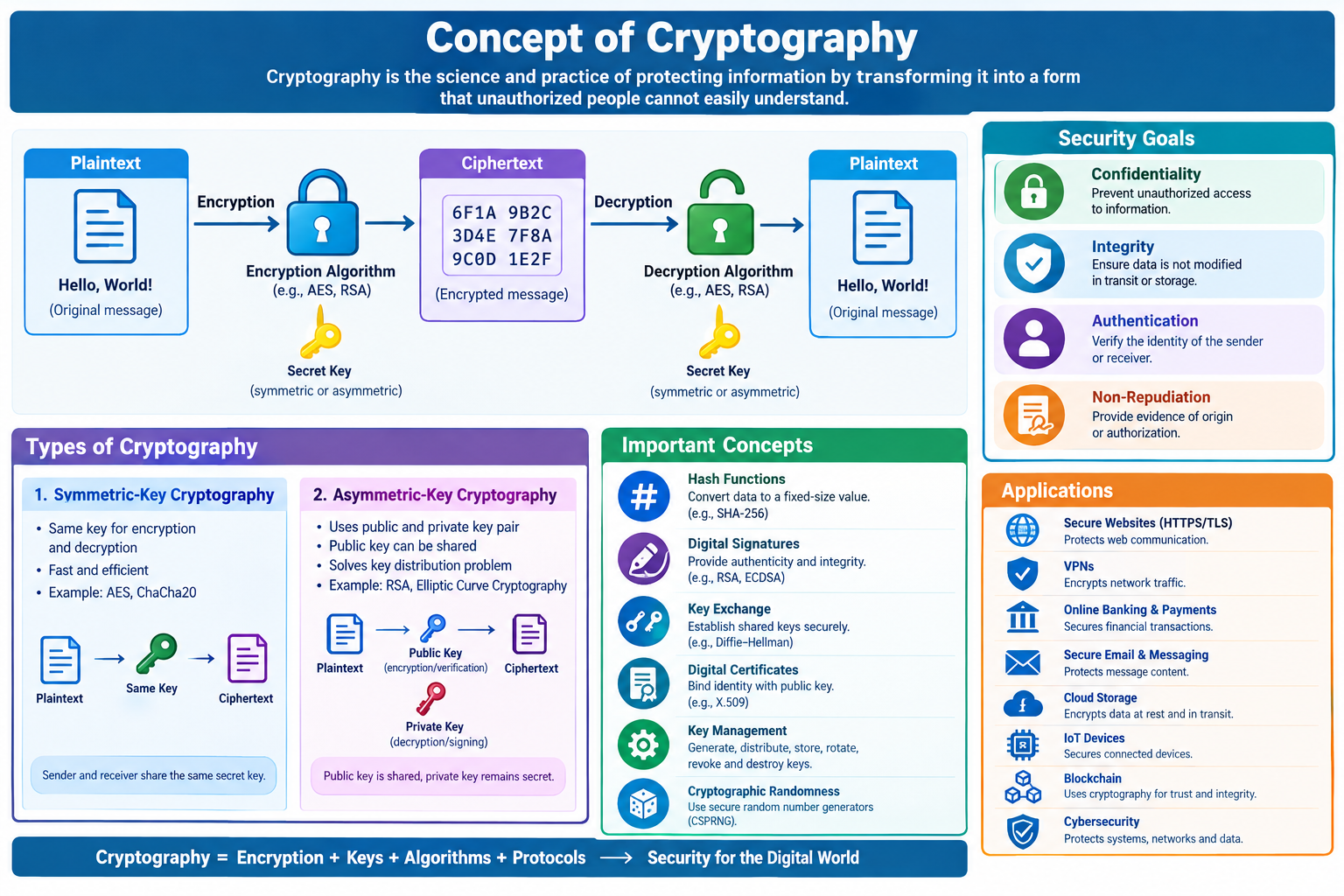
Cryptography Is The Science And Practice Of Protecting Information By Transforming It Into A Form That Unauthorized People Cannot Easily Understand. The Word Cryptography Originates From Greek Words Meaning “hidden Writing.” In Modern Computer Networks, Cryptography Is A Fundamental Technology For Protecting Digital Information During Storage, Processing, And Transmission. It Is Used In Online Banking, Secure Messaging, Digital Payments, Cloud Computing, E-commerce, Military Communication, Cybersecurity, And Many Other Applications.
Purpose Of Cryptography
The Primary Purpose Of Cryptography Is To Provide Security To Information And Communication Systems. When Information Travels Through An Insecure Network Such As The Internet, Attackers May Attempt To Intercept, Modify, Or Destroy It. Cryptographic Mechanisms Help Reduce These Risks By Providing Confidentiality, Integrity, Authentication, And Non-repudiation. These Properties Form The Foundation Of Secure Digital Communication And Are Commonly Associated With The Objectives Of Information Security.
Plaintext
The Original Information That Needs To Be Protected Is Called plaintext Or Cleartext. Plaintext May Be A Text Message, Password, Email, Image, Database Record, Financial Transaction, Or Any Other Digital Information. For Example, If A User Wants To Send The Message “HELLO,” That Message Represents The Plaintext. Cryptography Applies A Mathematical Transformation To Plaintext To Produce Protected Information That Can Be Transmitted Or Stored Securely.
Ciphertext
The Protected Output Produced From Plaintext Through Encryption Is Called ciphertext. Unlike Plaintext, Ciphertext Should Not Reveal The Original Information To An Unauthorized Observer. For Example, The Plaintext “HELLO” Could Become A Seemingly Meaningless Sequence After Encryption. A Properly Designed Modern Cryptographic Algorithm Makes It Computationally Impractical For An Attacker To Recover The Plaintext Without The Appropriate Key.
Encryption
Encryption Is The Process Of Converting Plaintext Into Ciphertext Using A Cryptographic Algorithm And A Key. Mathematically, Encryption Can Be Represented As:
C = E(K, P)
where P Represents Plaintext, K Represents The Cryptographic Key, E Represents The Encryption Algorithm, And C Represents Ciphertext. Encryption Is Widely Used To Protect Sensitive Information Against Unauthorized Access During Transmission And Storage.
Decryption
Decryption Is The Reverse Process Of Encryption. It Converts Ciphertext Back Into The Original Plaintext Using An Appropriate Key And Cryptographic Algorithm. It Can Be Represented As:
P = D(K, C)
where C Is Ciphertext, K Is The Key, D Is The Decryption Process, And P Is The Recovered Plaintext. Only An Authorized Recipient Possessing The Necessary Key Should Be Able To Successfully Decrypt Protected Information.
Cryptographic Keys
A cryptographic Key Is A Value Used By A Cryptographic Algorithm To Control The Transformation Of Data. Keys Are Central To Modern Cryptography. Even If An Attacker Knows The Algorithm, Security Should Remain Dependent On Protecting The Key Rather Than Keeping The Algorithm Secret. Key Length And Key Management Are Important Factors In Determining The Practical Security Of A Cryptographic System.
Symmetric-Key Cryptography
Symmetric-key Cryptography Uses The Same Secret Key, Or Closely Related Secret Keys, For Encryption And Decryption. The Sender And Receiver Must Securely Possess The Required Secret Key. Examples Of Symmetric Encryption Algorithms Include AES (Advanced Encryption Standard) And ChaCha20. Symmetric Cryptography Is Generally Efficient And Is Therefore Suitable For Encrypting Large Quantities Of Data.
Advantages Of Symmetric Cryptography
A Major Advantage Of Symmetric Cryptography Is Its High Performance. Encryption And Decryption Can Generally Be Performed Efficiently, Making Symmetric Algorithms Suitable For Files, Databases, Network Traffic, Storage Devices, And Real-time Communications. The Main Challenge Is key Distribution: Communicating Parties Need A Secure Way To Obtain And Protect The Shared Secret Key.
Asymmetric-Key Cryptography
Asymmetric Cryptography, Also Called Public-key Cryptography, Uses A Pair Of Mathematically Related Keys: A public Key And A private Key. The Public Key Can Generally Be Distributed Openly, While The Private Key Must Be Protected. Algorithms And Systems Based On Public-key Cryptography Include RSA, Elliptic-curve Cryptography, And Modern Elliptic-curve Signature And Key-agreement Schemes.
Public Key
A public Key Is Designed To Be Distributed To Other Parties. Depending On The Cryptographic Operation, Someone Can Use A Recipient's Public Key To Encrypt Information For That Recipient Or Verify A Digital Signature Created With The Corresponding Private Key. Because The Public Key Is Not Intended To Be Secret, It Helps Solve Some Of The Key-distribution Challenges Associated With Symmetric Cryptography.
Private Key
A private Key Is Confidential Information Associated With A Public Key. Its Security Is Extremely Important. In Digital Signatures, The Private Key Is Used To Create A Signature, While The Corresponding Public Key Can Be Used To Verify It. If An Attacker Obtains A Private Key, The Attacker May Be Able To Impersonate Its Owner Or Decrypt Information In Systems That Use That Key For Decryption.
Cryptographic Hash Functions
A cryptographic Hash Function Converts Input Data Of Arbitrary Length Into A Fixed-length Value Called A Hash Or Message Digest. Hash Functions Are Designed To Have Properties Such As One-way Computation And Resistance To Finding Collisions. Common Modern Examples Include SHA-256 And The SHA-3 Family. Hash Functions Are Important For Integrity Verification, Digital Signatures, Password-storage Systems, And Many Security Protocols.
Hashing Versus Encryption
Hashing And Encryption Are Different Concepts. Encryption Is Designed To Be Reversible When The Appropriate Key Is Available, Whereas Cryptographic Hashing Is Generally Designed As A One-way Transformation. For Example, An Encrypted File Can Normally Be Decrypted Using The Appropriate Key. A SHA-256 Hash, However, Is Not Intended To Be “decrypted” To Recover The Original Input.
Confidentiality
Confidentiality Means Preventing Unauthorized Individuals Or Systems From Accessing Information. Encryption Is One Of The Principal Mechanisms Used To Achieve Confidentiality. For Example, HTTPS Uses Cryptographic Mechanisms To Protect Data Exchanged Between A Web Browser And A Website. Confidentiality Is Particularly Important For Passwords, Financial Information, Personal Information, Intellectual Property, And Confidential Business Communication.
Integrity
Integrity Means Ensuring That Information Has Not Been Improperly Modified. Cryptographic Hashes, Message Authentication Codes, And Digital Signatures Can Help Detect Unauthorized Changes. For Example, A Software Publisher Can Provide A Cryptographic Hash For A Downloaded File. A User Can Calculate The Hash Of The Received File And Compare The Values To Detect Whether The File Has Changed.
Authentication
Authentication Is The Process Of Establishing The Identity Of A Communicating Party Or Verifying The Origin Of Information. Cryptography Supports Authentication Through Mechanisms Such As Digital Signatures, Message Authentication Codes, Certificates, And Cryptographic Challenge-response Protocols. Authentication Helps Systems Distinguish Legitimate Users, Servers, Devices, And Services From Unauthorized Entities.
Non-Repudiation
Non-repudiation Refers To Mechanisms That Provide Evidence Supporting The Origin Or Authorization Of A Digital Action, Particularly Through Digital Signatures And Associated Key-management Systems. In Appropriate Contexts, A Valid Digital Signature Can Provide Evidence That A Particular Private Key Was Used To Sign Information. Legal And Operational Interpretations Of Non-repudiation Depend On The Surrounding System And Applicable Laws.
Digital Signatures
A digital Signature Is A Cryptographic Mechanism Used To Provide Authenticity And Integrity For Digital Information. Typically, The Signer Generates A Signature Using A Private Key, While Others Use The Corresponding Public Key To Verify It. Digital Signatures Are Widely Used In Software Distribution, Electronic Documents, Secure Email, Certificates, Financial Systems, And Various Authentication Protocols.
Message Authentication Code
A Message Authentication Code (MAC) Is A Cryptographic Value Generated From A Message And A Shared Secret Key. It Allows A Recipient Possessing The Shared Key To Verify That The Message Was Generated By Someone Who Knows The Key And That The Message Was Not Modified. Examples Include HMAC Constructions Based On Cryptographic Hash Functions. MACs Are Widely Used In Secure Communication Protocols.
Cryptographic Algorithms
A Cryptographic Algorithm Is A Mathematical Procedure Used To Perform A Security Operation. Algorithms Can Be Designed For Encryption, Decryption, Hashing, Authentication, Key Exchange, Or Digital Signatures. Examples Include AES For Symmetric Encryption, RSA For Public-key Cryptography, SHA-256 For Hashing, And Elliptic-curve Algorithms For Various Public-key Operations. Modern Security Depends On Carefully Analyzed Algorithms Rather Than Proprietary Secrecy.
Caesar Cipher
The Caesar Cipher Is A Simple Historical Substitution Cipher In Which Letters Are Shifted By A Fixed Number Of Positions. For Example, Shifting Every Letter By Three Positions Transforms A Into D, B Into E, And So Forth. Although Useful For Understanding The Basic Idea Of Encryption, The Caesar Cipher Is Not Secure For Modern Applications Because Its Small Key Space Makes It Easy To Break.
Substitution And Transposition
Classical Cryptography Includes Techniques Such As substitution And transposition. Substitution Replaces Symbols With Other Symbols, While Transposition Changes Their Positions. These Methods Demonstrate Fundamental Cryptographic Concepts, But They Generally Lack The Security Required For Contemporary Computer Systems. Modern Cryptographic Algorithms Use Sophisticated Mathematical Structures And Are Designed To Withstand Extensive Cryptanalysis.
Key Management
Key Management Involves Generating, Distributing, Storing, Rotating, Revoking, And Destroying Cryptographic Keys. It Is One Of The Most Important Aspects Of Practical Cryptography. A Strong Algorithm Cannot Protect A System If Its Keys Are Poorly Managed. Organizations May Use Hardware Security Modules, Key-management Systems, Certificates, Access Controls, And Secure Key-storage Mechanisms To Protect Sensitive Cryptographic Keys.
Key Exchange
Key Exchange Allows Communicating Parties To Establish Cryptographic Keys Over A Communication Channel. One Historically Important Example Is The Diffie–Hellman Key Exchange, Which Allows Parties To Derive A Shared Secret Without Directly Transmitting That Secret. Modern Protocols Use Secure Variants And Authenticated Mechanisms To Protect Against Attacks Such As Man-in-the-middle Attacks.
Digital Certificates
A digital Certificate Associates An Identity Or Domain With A Public Key And Is Digitally Signed By A Trusted Certificate Authority In Common Public-key Infrastructures. Certificates Are Important Components Of Public Key Infrastructure (PKI). Web Browsers Use Certificates As Part Of Establishing Trust In HTTPS Connections. Certificate Validation Involves Checking Information Such As The Certificate Chain, Validity Period, And Applicable Domain Or Identity Information.
Public Key Infrastructure
Public Key Infrastructure (PKI) Is A Collection Of Technologies, Policies, Procedures, And Systems Used To Manage Public-key Cryptography And Digital Certificates. A Typical PKI Can Involve Certificate Authorities, Registration Authorities, Certificate Repositories, Certificate Policies, And Revocation Mechanisms. PKI Enables Scalable Trust Relationships For Applications Such As Secure Websites, Digital Signatures, Enterprise Authentication, And Encrypted Communication.
Cryptography In HTTPS
Cryptography Plays A Central Role In HTTPS, Which Protects HTTP Communication Using Transport Layer Security (TLS). During A TLS Connection, Cryptographic Mechanisms Authenticate The Server, Establish Session Keys, And Protect Application Data. Modern TLS Typically Uses Public-key Techniques For Authentication And Key Establishment While Using Efficient Symmetric Cryptography To Protect The Actual Data Exchanged During The Session.
Cryptography In Secure Messaging
Secure Messaging Applications Use Cryptographic Mechanisms To Protect Messages From Unauthorized Access And Modification. Depending On The Protocol, Encryption Can Be Performed Using Session Keys And May Incorporate Public-key Cryptography For Authentication And Key Establishment. Some Systems Use end-to-end Encryption, Where Message Content Is Intended To Be Readable Only By The Communicating Endpoints.
Cryptography In Digital Payments
Cryptography Is Fundamental To Digital Payment Systems. Payment Platforms Use Cryptographic Protocols To Protect Transaction Information, Authenticate Systems And Users, Verify Messages, And Protect Sensitive Credentials. Digital Signatures, Encryption, Hashing, Secure Key Management, And Tokenization Can All Contribute To Payment Security. The Exact Mechanisms Depend On The Payment Network, Application, Device, And Protocol.
Cryptography And Password Security
Cryptography Also Contributes To Password Security, But Passwords Should Generally Not Be Stored Using Ordinary Reversible Encryption. Instead, Password-storage Systems Use Dedicated Password-hashing Or Password-based Key-derivation Algorithms, Such As Argon2, scrypt, Or PBKDF2, Together With Unique Salts. These Mechanisms Are Deliberately Designed To Make Large-scale Password Guessing More Expensive For Attackers.
Cryptanalysis
Cryptanalysis Is The Study Of Techniques For Analyzing Cryptographic Systems And Attempting To Recover Protected Information Or Keys Without Authorized Access. Cryptanalysts Examine Algorithms, Protocols, Implementations, And Possible Weaknesses. Cryptanalysis Is Important Because Cryptographic Systems Must Be Evaluated Against Realistic Attack Models. Security Researchers Use Cryptanalysis To Identify Weaknesses Before Attackers Can Exploit Them.
Brute-Force Attack
A brute-force Attack Attempts To Try Possible Keys Until The Correct Key Is Discovered. The Difficulty Of Brute-force Attacks Depends Heavily On The Effective Key Space And Implementation. Increasing An Encryption Key From A Small Size To A Sufficiently Large Modern Key Size Can Dramatically Increase The Number Of Possible Combinations. However, Key Length Alone Does Not Guarantee Security If The Algorithm Or Implementation Has Other Weaknesses.
Man-in-the-Middle Attack
A Man-in-the-Middle (MITM) Attack Occurs When An Attacker Positions Themselves Between Communicating Parties And Attempts To Intercept Or Manipulate Their Communication. Encryption Alone Does Not Necessarily Prevent MITM Attacks If The Communicating Parties Cannot Authenticate Each Other. Protocols Such As TLS Therefore Combine Encryption With Authentication Mechanisms, Including Digital Certificates, To Establish Trusted Communication.
Cryptographic Randomness
Secure Cryptography Requires High-quality Randomness For Many Operations, Including Key Generation, Initialization Values, Nonces, Salts, And Other Security Parameters. Predictable Random Values Can Seriously Weaken Otherwise Strong Cryptographic Algorithms. Therefore, Security-sensitive Systems Use cryptographically Secure Random Number Generators (CSPRNGs) Rather Than Ordinary Pseudo-random Functions Intended For Simulations Or General Programming.
Kerckhoffs's Principle
A Fundamental Principle Of Modern Cryptography Is That The Security Of A System Should Depend On The Secrecy Of Its Keys Rather Than The Secrecy Of Its Algorithm. This Concept Is Commonly Associated With Kerckhoffs's Principle. Publicly Analyzed Algorithms Can Be Subjected To Extensive Examination By Researchers. Keeping Algorithms Secret Does Not Provide A Reliable Substitute For Proper Key Management And Cryptographic Design.
Cryptographic Protocols
Cryptography Is Not Limited To Individual Algorithms. Cryptographic Protocols Define How Cryptographic Mechanisms Are Combined To Achieve Security Objectives. TLS, Secure Email Protocols, Authentication Protocols, And Various VPN Technologies Use Multiple Cryptographic Components. A Protocol Can Become Insecure Even When It Uses Strong Individual Algorithms If Authentication, Key Management, Randomness, Implementation, Or Protocol Logic Is Incorrectly Designed.
Post-Quantum Cryptography
The Development Of Large-scale Quantum Computers Has Motivated Research Into Post-Quantum Cryptography (PQC). Some Widely Used Public-key Algorithms, Particularly Those Based On Integer Factorization And Certain Discrete-logarithm Problems, Could Be Vulnerable To Sufficiently Powerful Quantum Computers. PQC Develops Cryptographic Algorithms Intended To Resist Attacks From Both Classical And Quantum Computers. This Makes Cryptographic Migration An Important Long-term Cybersecurity Consideration.
Applications Of Cryptography
Cryptography Is Used Across Almost Every Area Of Modern Computing. Applications Include Secure Websites, VPNs, Wi-Fi Security, Electronic Banking, Digital Signatures, Secure Email, Cloud Storage, Blockchain Systems, Software Authentication, Identity Management, Mobile Applications, IoT Devices, Military Systems, Healthcare Information Systems, And Enterprise Networks. Cryptography Therefore Forms A Foundational Component Of Modern Cybersecurity Architecture.
Conclusion
The Basic Concept Of Cryptography Revolves Around Protecting Information Through Mathematical Techniques Involving Encryption, Decryption, Keys, Hashing, Authentication, Digital Signatures, And Secure Protocols. Its Major Security Objectives Include confidentiality, Integrity, Authentication, And Support For Non-repudiation. Modern Cryptography Combines Symmetric And Asymmetric Techniques With Carefully Designed Protocols And Key-management Practices. Understanding These Fundamentals Provides A Strong Foundation For Advanced Topics Such As TLS, PKI, Blockchain Cryptography, Quantum Cryptography, Post-quantum Cryptography, And Cryptographic Applications In Cybersecurity.
Tags:
Purpose Of Cryptography, Plaintext, Ciphertext, Encryption, Symmetric-Key Cryptography, Basic Concept Of Cryptography