Cryptography: Security Threats, Security Services, And Security Mechanisms
Category: CRYPTOGRAPHY | 30th September 2026, Wednesday
Introduction
Information Security Is The Discipline Of Protecting Data, Systems, And Communications From Unauthorized Access, Alteration, Disruption, Or Destruction. As Organizations And Individuals Rely On Networks For Banking, Commerce, Healthcare, Education, And Government, The Value Of The Information Moving Through Those Networks Has Grown, And So Has The Incentive To Attack It. Security Is Therefore A Basic Requirement Of Modern Computing.
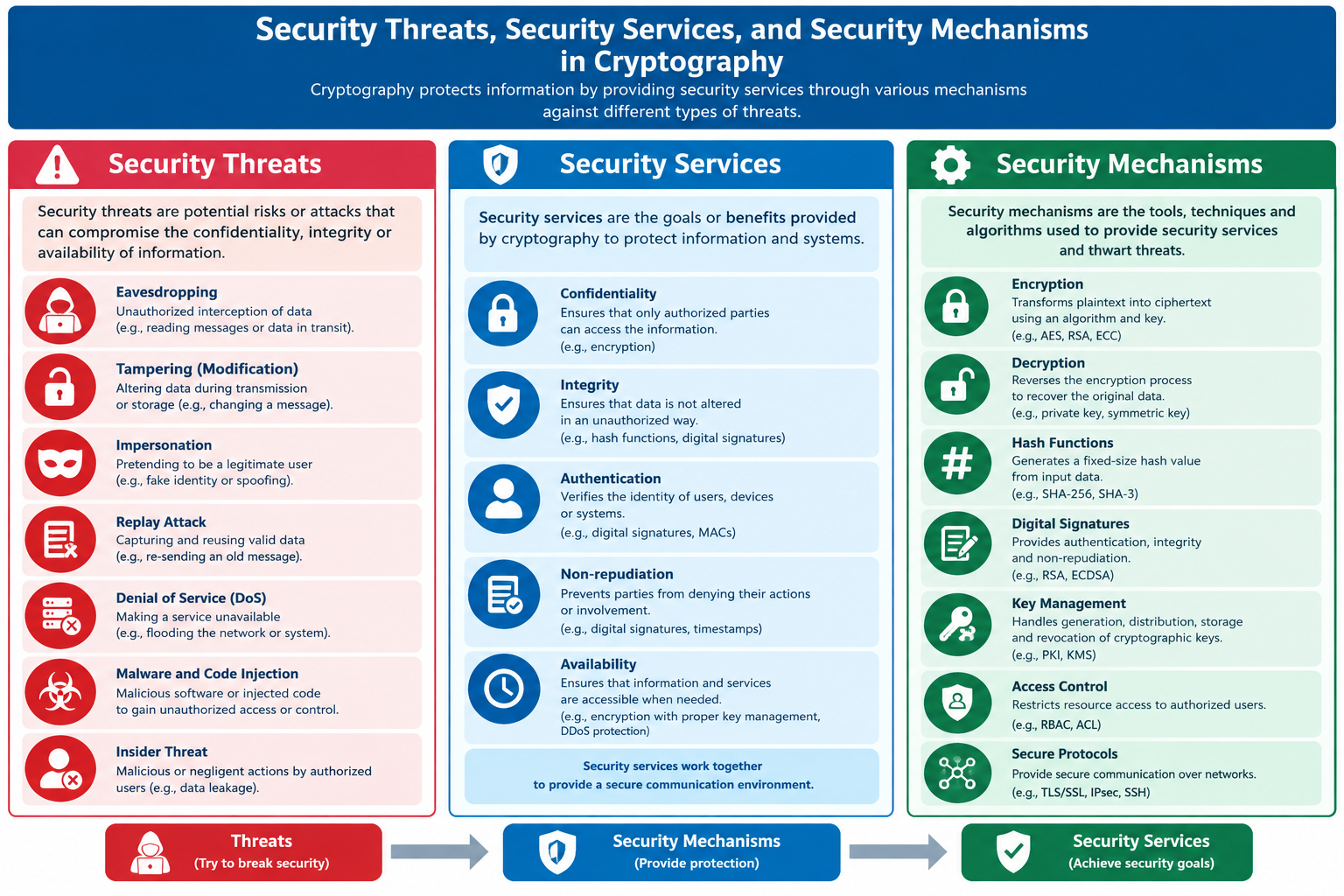
A Useful Way To Study The Subject Is The Framework In ITU-T Recommendation X.800 And The Related OSI Security Architecture. It Separates The Field Into Three Connected Ideas: Security Threats And Attacks, Security Services, And Security Mechanisms. A Threat Is A Potential Danger, An Attack Is The Realization Of That Danger, A Service Is A Protection Goal The System Must Deliver, And A Mechanism Is The Technical Tool Used To Deliver It.
These Three Concepts Form A Chain. Threats Define What Must Be Defended Against, Services State What Protection Is Required, And Mechanisms Explain How That Protection Is Achieved. Studying Them Together Shows Why No Single Tool Secures A System And Why Layered Defense Is The Accepted Approach. The Sections Below Examine Each Concept In Turn And Then Show How They Relate.
Security Threats
A Security Threat Is Any Circumstance Or Event With The Potential To Harm A System By Breaching Confidentiality, Integrity, Or Availability. Threats May Be Deliberate, Such As A Hacker Stealing Credentials, Or Accidental, Such As An Employee Misconfiguring A Server. They May Also Come From Natural Events Like Floods And Fires. Understanding The Source And Nature Of A Threat Is The First Step In Choosing An Appropriate Defense.
Security Professionals Often Distinguish A Threat From A Vulnerability And A Risk. A Vulnerability Is A Weakness, Such As Unpatched Software Or A Weak Password Policy. A Threat Is The Actor Or Event That Could Exploit That Weakness. Risk Is The Likelihood And Impact Of The Exploitation Actually Happening. A Threat Without A Matching Vulnerability Is Harmless, Which Is Why Patching And Hardening Are So Effective.
Threats Are Commonly Grouped By Their Source. External Threats Come From Outside The Organization, Including Criminals, Hacktivists, Competitors, And State-sponsored Groups. Internal Threats Come From Employees, Contractors, Or Partners Who Already Hold Some Legitimate Access. Insiders Are Particularly Dangerous Because They Know The Systems, Understand Where Valuable Data Lives, And Can Often Bypass Perimeter Defenses That Are Built To Stop Outsiders.
The Most Fundamental Classification Divides Attacks Into Passive And Active. This Distinction, Used Throughout X.800, Is Based On Whether The Attacker Merely Observes A System Or Actually Interferes With It. Passive Attacks Are Hard To Detect But Easier To Prevent, While Active Attacks Are Easier To Detect But Harder To Prevent Completely. The Two Categories Call For Different Defensive Strategies.
Passive Attacks
A Passive Attack Attempts To Learn Or Use Information From A System Without Affecting System Resources. The Attacker Does Not Modify Data, Inject Messages, Or Disrupt Services. Because Nothing Changes, The Victim Usually Has No Idea The Attack Occurred. The Goal Is Eavesdropping Or Monitoring Of Transmissions, And The Harm Is The Loss Of Confidentiality Rather Than Corruption Of Data.
The First Form Of Passive Attack Is The Release Of Message Contents. When A Telephone Conversation, An Email, Or A File Transfer Travels Across A Network, Anyone With Access To The Transmission Path May Read It. An Attacker Who Captures Packets On A Shared Wireless Network Can View Unprotected Messages Directly. Encryption Is The Principal Defense, Because It Renders Intercepted Content Unreadable To Anyone Without The Key.
The Second Form Is Traffic Analysis. Even When Message Contents Are Encrypted, An Observer Can Still Study Patterns Such As The Source And Destination Of Messages, Their Frequency, And Their Length. From This Metadata An Attacker Can Infer Who Is Communicating, When An Important Event Might Be Occurring, Or How Large A Transaction Is. Countermeasures Include Padding Messages And Generating Dummy Traffic To Hide Real Patterns.
Active Attacks
An Active Attack Involves Modification Of The Data Stream Or The Creation Of False Streams. Unlike Passive Attacks, Active Attacks Alter System State And Can Be Detected Once Their Effects Are Noticed. They Threaten Integrity, Availability, And Authenticity. Since The Attack Surface Is Broad, Defending Against Active Attacks Typically Requires Detection And Recovery Capabilities In Addition To Preventive Measures.
Masquerade, Also Called Impersonation Or Spoofing, Occurs When One Entity Pretends To Be Another. An Attacker Might Capture Valid Authentication Data And Use It To Gain Privileges Belonging To A Legitimate User. Phishing Sites That Imitate A Bank's Login Page Are A Familiar Example. Strong Authentication, Digital Certificates, And Multi-factor Verification Help Systems Confirm That A Party Really Is Who It Claims To Be.
Replay Involves Capturing A Legitimate Data Unit And Retransmitting It Later To Produce An Unauthorized Effect. For Instance, An Attacker Could Record A Valid Fund-transfer Request And Send It Again To Repeat The Payment. The Message Itself Is Genuine, So Simple Integrity Checks Do Not Catch It. Timestamps, Sequence Numbers, And One-time Nonces Let The Receiver Reject Old Or Duplicated Messages.
Modification Of Messages Means That Some Portion Of A Legitimate Message Is Altered, Delayed, Or Reordered To Produce An Unauthorized Result. A Message Meaning "allow John Smith To Read Confidential Accounts" Might Be Changed To "allow Fred Brown To Read Confidential Accounts." Message Authentication Codes And Digital Signatures Protect Against This Threat Because Any Change To The Content Causes Verification To Fail.
Denial Of Service Prevents Or Inhibits The Normal Use Or Management Of Communication Facilities. An Attacker May Flood A Server With More Requests Than It Can Handle, Or Disrupt An Entire Network By Overloading It. Distributed Denial-of-service Attacks Use Thousands Of Compromised Machines To Amplify The Effect. Defenses Include Rate Limiting, Traffic Filtering, Redundancy, And Content Distribution Networks That Absorb Large Volumes Of Traffic.
Other Common Threats
Malicious Software, Or Malware, Is One Of The Most Widespread Threats. It Includes Viruses That Attach To Legitimate Files, Worms That Spread On Their Own Across Networks, Trojans That Disguise Themselves As Useful Programs, Ransomware That Encrypts Data For Extortion, And Spyware That Quietly Collects Information. Antivirus Tools, Application Whitelisting, Regular Patching, And User Awareness All Contribute To Reducing Malware Exposure.
Social Engineering Exploits Human Psychology Rather Than Technical Flaws. Attackers Persuade People To Reveal Passwords, Click Harmful Links, Or Grant Physical Access. Phishing Emails, Pretexting Phone Calls, And Tailgating Into Secure Buildings Are Typical Techniques. Because The Target Is A Person, Training And Clear Procedures Matter As Much As Technology, And Organizations Should Encourage Employees To Verify Unusual Requests.
Injection And Application-layer Attacks Target Weaknesses In Software. SQL Injection Inserts Malicious Database Commands Through Input Fields, While Cross-site Scripting Runs Attacker-controlled Scripts In A Victim's Browser. Buffer Overflows Can Let An Attacker Execute Arbitrary Code. Secure Coding Practices, Input Validation, Parameterized Queries, And Regular Security Testing Are The Main Protections Against This Class Of Threat.
Security Services
A Security Service Is A Processing Or Communication Capability That Enhances The Security Of Data Processing Systems And Information Transfers. X.800 Defines Services As The Protections A System Should Provide, And They Are Meant To Counter The Attacks Described Above. Each Service Is Implemented Using One Or More Security Mechanisms, And Choosing The Right Combination Depends On The Sensitivity Of The Data And The Environment.
X.800 Divides Security Services Into Five Broad Categories: Authentication, Access Control, Data Confidentiality, Data Integrity, And Nonrepudiation. Many Texts Add Availability As A Sixth, Since A System That Cannot Be Reached Provides No Value. Together These Services Map Closely To The Classic CIA Triad Of Confidentiality, Integrity, And Availability, Extended With Accountability And Verified Identity.
Authentication Assures That A Communication Or Entity Is Genuine. In A Single Message Context, Such As A Warning Or Alarm, It Assures The Recipient That The Message Comes From The Claimed Source. In An Ongoing Interaction, It Assures That The Two Parties Are Authentic And That A Third Party Cannot Masquerade As Either. X.800 Distinguishes Peer Entity Authentication From Data Origin Authentication.
Peer Entity Authentication Provides Confidence, At The Time Of Use, In The Identity Of The Entity Connected At The Other End Of A Link. It Is Used At Connection Establishment Or During Data Transfer To Guard Against Masquerade And Replay. Data Origin Authentication Confirms That The Source Of A Received Data Unit Is As Claimed, But It Does Not Protect Against Duplication Or Modification Of Data Units.
Access Control Is The Ability To Limit And Control Access To Host Systems And Applications Through Communication Links. To Achieve This, Each Entity Trying To Gain Access Must First Be Identified And Authenticated So That Access Rights Can Be Tailored To The Individual. Access Control Determines Who May Read, Write, Execute, Or Delete Specific Resources And Prevents Unauthorized Use Of Any Resource.
Data Confidentiality Is The Protection Of Transmitted Data From Passive Attacks. Several Levels Exist. The Broadest Protects All User Data Transmitted Between Two Users Over A Period Of Time, So A Single Virtual Circuit Protects Everything Sent Across It. Narrower Forms Protect Individual Messages Or Specific Fields Within A Message. Connection Confidentiality And Connectionless Confidentiality Are The Standard Variants Defined In The Architecture.
Selective-field Confidentiality Protects Particular Fields Within A Message Or User Data. For Example, A Payment Transaction May Need To Hide The Card Number While Leaving Other Fields Readable For Routing. Traffic-flow Confidentiality Goes Further By Protecting The Information That Might Be Derived From Observing Traffic Patterns, So That An Attacker Cannot Learn Source, Destination, Frequency, Or Length. This Directly Counters Traffic Analysis.
Data Integrity Assures That Received Data Are Exactly As Sent By An Authorized Entity, With No Modification, Insertion, Deletion, Or Replay. Integrity Can Apply To A Stream Of Messages, A Single Message, Or Selected Fields. A Connection-oriented Integrity Service Deals With A Stream And Also Addresses Message Reordering And Replay, Whereas A Connectionless Integrity Service Handles Individual Messages And Usually Only Detects Modification.
Integrity Services Can Also Differ In Whether They Offer Recovery. Some Only Detect That A Violation Occurred And Report It, Leaving Recovery To Other Software Or Human Intervention. Others Can Automatically Restore The Correct Data. Detection-only Integrity Is Common Because Full Automatic Recovery Is Complex, And Many Designs Simply Reject The Damaged Message And Request Retransmission From The Sender.
Nonrepudiation Prevents Either Sender Or Receiver From Denying A Transmitted Message. When A Message Is Sent, The Receiver Can Prove That The Alleged Sender Sent It, Which Is Nonrepudiation Of Origin. When A Message Is Received, The Sender Can Prove That The Alleged Receiver Received It, Which Is Nonrepudiation Of Receipt. This Service Is Essential To Electronic Contracts, Financial Transactions, And Any Setting With Legal Accountability.
Availability Is The Property Of A System Being Accessible And Usable On Demand By An Authorized Entity. X.800 Treats It As A Property Associated With Various Services Rather Than A Separate Service, But Its Importance Is Undeniable. Availability Services Counter Denial-of-service Attacks And Include Authentication, Access Control, Backup Systems, Redundancy, And Failover So That Legitimate Users Can Reach Resources When Needed.
Security Mechanisms
A Security Mechanism Is A Process, Device, Or Technique Designed To Detect, Prevent, Or Recover From A Security Attack. Services Describe What Protection Is Required, While Mechanisms Describe How It Is Achieved. X.800 Splits Mechanisms Into Specific Mechanisms, Which Are Implemented In A Particular Protocol Layer, And Pervasive Mechanisms, Which Are Not Tied To Any Single Layer Or Service.
Encipherment, Or Encryption, Is The Use Of Mathematical Algorithms To Transform Data Into A Form That Is Not Readily Intelligible. The Transformation Depends On An Algorithm And On One Or More Keys. Symmetric Ciphers Such As AES Use A Shared Secret Key And Are Efficient For Bulk Data. Asymmetric Ciphers Such As RSA And Elliptic-curve Systems Use Key Pairs, Which Simplifies Key Distribution And Enables Digital Signatures.
The Digital Signature Is A Mechanism Consisting Of Data Appended To A Data Unit, Or A Cryptographic Transformation Of It, That Lets A Recipient Verify The Source And Integrity Of The Data And Protects Against Forgery. The Signer Uses A Private Key, And Anyone Can Verify With The Matching Public Key. Digital Signatures Therefore Support Authentication, Integrity, And Nonrepudiation Together, Which Explains Their Wide Use In Software Distribution And Legal Documents.
Access Control Mechanisms Enforce The Rights Of Entities To Resources. They Include Passwords, Access Control Lists, Capability Tokens, Role-based Models, And Labels That Indicate The Sensitivity Of Data And The Clearance Of Users. Operating Systems, Databases, And Network Devices All Embed Such Mechanisms. Their Design Must Follow The Principle Of Least Privilege, Giving Each User Only The Permissions Needed For Their Tasks.
Data Integrity Mechanisms Include Checksums, Cryptographic Hash Functions, And Message Authentication Codes. A Hash Function Such As SHA-256 Produces A Fixed-length Digest That Changes Drastically If The Input Changes Even Slightly. A Message Authentication Code Combines A Hash Or Cipher With A Secret Key So That Only Parties Holding The Key Can Generate A Valid Tag. These Techniques Detect Accidental Corruption And Deliberate Tampering.
Authentication Exchange Is A Mechanism Intended To Ensure The Identity Of An Entity By Means Of Information Exchange. It May Use Passwords, Cryptographic Challenge-response Protocols, Biometrics, Hardware Tokens, Or Combinations In Multi-factor Schemes. Protocols Such As Kerberos And TLS Handshakes Incorporate Authentication Exchanges. Timestamps And Nonces Are Added So That Captured Exchanges Cannot Be Replayed By An Adversary.
Traffic Padding Is The Insertion Of Bits Into Gaps In A Data Stream To Frustrate Traffic Analysis Attempts. By Keeping A Constant Flow Of Data, Whether Real Or Dummy, The System Prevents Observers From Distinguishing Periods Of Activity From Periods Of Silence. This Is Expensive In Bandwidth, So It Is Used Mainly In High-security Settings Such As Military And Diplomatic Communications.
Routing Control Enables Selection Of Particular Physically Secure Routes For Certain Data And Allows Routing Changes, Especially When A Breach Of Security Is Suspected. Sensitive Traffic May Be Forced To Travel Only Over Trusted Links, Avoiding Networks That Are Deemed Insecure. End Systems May Also Refuse To Transmit Specific Data Through Parts Of The Network That Lack Adequate Protection.
Notarization Is The Use Of A Trusted Third Party To Assure Certain Properties Of A Data Exchange, Such As Its Origin, Time, Or Destination. The Notary Is Trusted By All Communicating Parties And Holds The Information Needed To Settle Disputes. Modern Equivalents Include Certificate Authorities And Timestamping Services, Which Vouch For The Binding Between An Identity And A Public Key Or For The Existence Of A Document At A Given Moment.
Pervasive Mechanisms Support The Overall Security Posture Rather Than A Single Service. Trusted Functionality Refers To Hardware Or Software That Is Regarded As Correct With Respect To Some Criteria, Such As A Security Policy. A Security Label Marks The Sensitivity Of A Resource, Security Audit Trail Records Events For Later Review, Event Detection Identifies Security-relevant Occurrences, And Security Recovery Handles Requests From Mechanisms Such As Event Handling And Management Functions To Restore Normal Operation.
Security Audit And Logging Deserve Special Attention. An Audit Trail Is An Independent Review And Examination Of System Records And Activities To Test Adequacy Of Controls, Ensure Compliance With Policy, And Detect Breaches. Logs From Firewalls, Servers, And Applications Allow Investigators To Reconstruct Incidents. Intrusion Detection And Prevention Systems Build On This By Analyzing Events In Real Time And Alerting Or Blocking Suspicious Behavior.
Network-level Mechanisms Provide Further Layers Of Defense. Firewalls Filter Traffic Based On Rules About Addresses, Ports, And Protocols, Creating A Boundary Between Trusted And Untrusted Networks. Virtual Private Networks Encrypt Traffic Across Public Infrastructure, And Protocols Such As IPsec And TLS Secure Communications At The Network And Transport Layers. Together These Tools Implement Confidentiality, Integrity, And Authentication In Everyday Use.
Relationship Between Threats, Services, And Mechanisms
The Three Concepts Fit Together In A Straightforward Mapping. Eavesdropping Is Countered By The Confidentiality Service, Implemented Mainly With Encryption. Masquerade Is Countered By Authentication, Implemented Through Authentication Exchanges And Digital Signatures. Modification Is Countered By The Integrity Service, Using Hashes And Message Authentication Codes. Repudiation Is Countered By Nonrepudiation, Using Digital Signatures And Notarization. Denial Of Service Is Countered By Availability Measures.
This Mapping Shows Why Mechanisms Often Support Several Services. Encryption Alone Can Contribute To Confidentiality, Authentication, And Integrity Depending On How It Is Applied. A Digital Signature Covers Authentication, Integrity, And Nonrepudiation At Once. Conversely, One Service May Need Several Mechanisms. Access Control, For Example, Depends On Authentication Exchanges, Policy Databases, Labels, And Audit Trails Working In Concert Rather Than On Any Single Technique.
Effective Security Also Requires Good Management. Mechanisms Rely On Keys, Passwords, Certificates, And Configurations That Must Be Generated, Distributed, Stored, Rotated, And Revoked Correctly. A Strong Algorithm With Poor Key Management Provides Little Protection. Policies, Procedures, Employee Training, And Regular Risk Assessment Complement Technical Controls, And A Mature Program Treats Security As A Continuing Process Rather Than A One-time Installation.
The Guiding Design Philosophy Is Defense In Depth. Instead Of Trusting One Barrier, Organizations Layer Physical Security, Network Controls, Host Protections, Application Safeguards, And Human Procedures, So That A Failure In One Layer Does Not Immediately Lead To Compromise. Each Layer Applies Appropriate Services And Mechanisms, And The Overlap Provides Resilience Against Attackers Who Succeed In Bypassing Any Individual Control.
Conclusion
Security Threats, Services, And Mechanisms Together Form The Conceptual Foundation Of Information Security. Threats, Divided Into Passive And Active Attacks, Describe What Can Go Wrong. Services Such As Authentication, Access Control, Confidentiality, Integrity, Nonrepudiation, And Availability Describe What Protection Must Be Delivered. Mechanisms Such As Encryption, Digital Signatures, Hashing, And Audit Trails Describe How That Protection Is Realized In Practice.
As Technology Evolves Through Cloud Computing, Mobile Devices, And The Internet Of Things, New Threats Will Continue To Emerge, But The Framework Remains Valid. Practitioners Should Identify Likely Threats, Decide Which Services Are Required, And Select Mechanisms That Provide Them At Acceptable Cost. Doing So, Along With Sound Management And User Awareness, Is The Most Reliable Path To Trustworthy Systems.
Tags:
Security Threats, Security Services, And Security Mechanisms, Security Threats Services, And Mechanisms