Stream Ciphers: One-Time Pad And RC4
Category: CRYPTOGRAPHY | 5th October 2026, Monday
Introduction To Stream Ciphers
A stream Cipher Is A Symmetric-key Encryption Technique That Encrypts Plaintext One Bit, One Byte, Or Sometimes A Larger Unit At A Time By Combining The Plaintext With A Generated keystream. Unlike A Block Cipher, Which Processes Fixed-size Blocks Such As 64 Or 128 Bits, A Stream Cipher Conceptually Processes Data As A Continuous Sequence. The Basic Encryption Operation Is Commonly An XOR Between The Plaintext And The Keystream. Stream Ciphers Are Particularly Useful When Data Arrives Continuously Or When Low Latency Is Important.
Basic Principle Of Stream Cipher
The Fundamental Principle Can Be Expressed Mathematically As:
Ci = Pi ⊕ Ki
where Pi represents The Plaintext Element, Ki represents The Corresponding Keystream Element, And Ci represents Ciphertext.
Decryption Uses The Same Operation:
Pi = Ci ⊕ Ki
This Works Because XOR Has The Property:
A ⊕ B ⊕ B = A
Therefore, If The Sender And Receiver Possess The Same Keystream, The Ciphertext Can Be Converted Back Into Plaintext.
Keystream
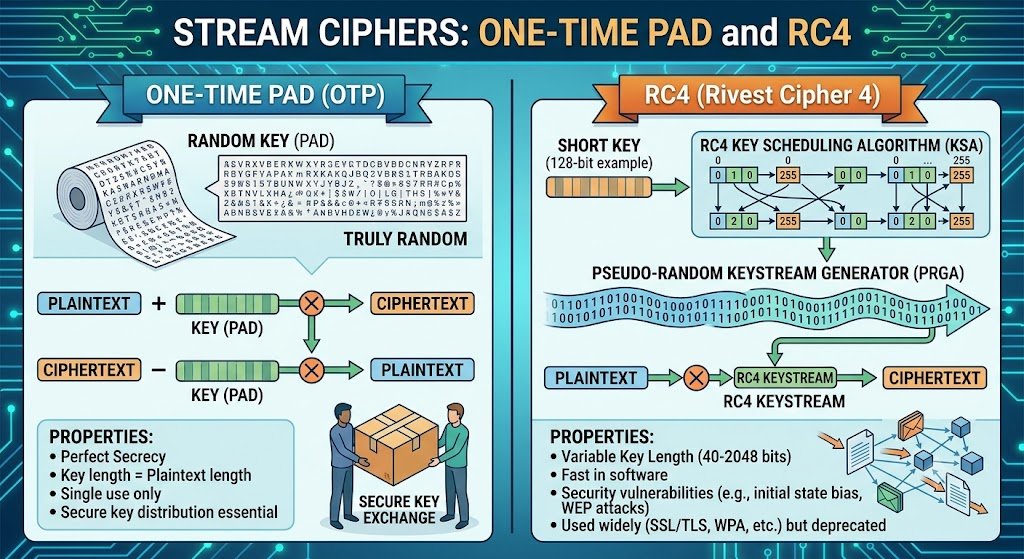
The keystream Is A Sequence Of Bits Or Bytes Generated From A Secret Key. Its Security Is Extremely Important Because Weaknesses In Keystream Generation Can Directly Compromise The Encryption. An Ideal Keystream Should Be Unpredictable And Should Not Reveal Useful Relationships Between Plaintext, Ciphertext, And Key. The One-Time Pad Represents The Theoretical Ideal, While RC4 Represents A Practical Historical Stream Cipher That Generates A Pseudorandom Keystream.
Stream Cipher Versus Block Cipher
Stream And Block Ciphers Differ Mainly In How They Process Data. A Stream Cipher Processes Data Sequentially, Whereas A Block Cipher Processes Fixed-size Blocks. Stream Ciphers Can Be Efficient For Real-time Applications Because Encryption Can Begin Immediately Without Waiting For A Complete Block. Block Ciphers, However, Are Widely Used In Modern Security Protocols, Particularly With Authenticated Encryption Modes. AES Is An Example Of A Block Cipher, While RC4 Is A Historical Example Of A Stream Cipher.
One-Time Pad
The One-Time Pad (OTP) Is A Special And Theoretically Perfect Form Of Stream Encryption. It Was Described By Gilbert Vernam And Later Mathematically Formalized In Terms Of Perfect Secrecy. In An OTP, The Secret Key Is A Truly Random Sequence That Is Exactly As Long As The Plaintext. Each Plaintext Bit Is XORed With One Unique Random Key Bit. If The OTP Requirements Are Followed Perfectly, The Resulting Ciphertext Provides perfect Secrecy.
OTP Encryption
For Binary Data, OTP Encryption Can Be Written As:
C = P ⊕ K
Suppose The Plaintext Is:
P = 10110010
and The Randomly Generated Key Is:
K = 01101101
Then:
C = 10110010 ⊕ 01101101
which Produces:
C = 11011111
The Receiver Applies XOR Again With The Same Key To Recover The Plaintext.
OTP Decryption
Decryption Is:
P = C ⊕ K
Using The Previous Example:
C = 11011111
and:
K = 01101101
Therefore:
11011111 ⊕ 01101101 = 10110010
The Original Plaintext Is Recovered. The Mathematical Simplicity Of OTP Is One Of Its Important Characteristics, But Securely Generating, Distributing, Storing, And Destroying The Enormous Random Keys Required By OTP Makes Practical Deployment Difficult.
Requirement Of True Randomness
A Critical Requirement Of The One-Time Pad Is That The Key Must Be truly Random. A Pseudorandom Sequence Generated By An Ordinary Deterministic Algorithm Does Not Automatically Provide Perfect Secrecy. If An Attacker Can Determine Or Predict The Key-generation Process, The Theoretical Security Guarantee Disappears. Therefore, OTP Requires High-quality Physical Or Cryptographically Appropriate Random Sources And Secure Key Management.
Key Length In One-Time Pad
The Key Must Be At Least As Long As The Message Being Encrypted. For A 1 MB Message, Approximately 1 MB Of Key Material Is Required. For A 1 GB Message, Approximately 1 GB Of Random Key Material Is Required. This Requirement Is One Of The Major Practical Disadvantages Of OTP. Modern Cryptographic Systems Instead Use Relatively Short Secret Keys With Secure Pseudorandom Algorithms To Generate Much Longer Cryptographic Keystreams.
Why OTP Provides Perfect Secrecy
The One-Time Pad Has A Unique Theoretical Property Called perfect Secrecy. Given Only The Ciphertext And Assuming The OTP Conditions Are Satisfied, An Attacker Gains No Information About The Plaintext. For A Ciphertext, Many Different Plaintexts Are Theoretically Possible, Each Corresponding To An Appropriate Key Of The Same Length. Since Every Possible Key Is Equally Likely, The Ciphertext Alone Does Not Identify The Original Plaintext.
Shannon's Perfect Secrecy
Claude Shannon Provided A Formal Mathematical Treatment Of Perfect Secrecy In Information Theory. An Encryption System Has Perfect Secrecy When Observing The Ciphertext Does Not Change The Probability Distribution Of The Plaintext. Informally, The Attacker Learns Nothing About The Message From The Ciphertext Alone. The OTP Is The Classic Example Of A System Achieving This Property When Its Key Is Truly Random, Secret, Equal In Length To The Message, And Never Reused.
OTP Key Distribution Problem
Although OTP Is Theoretically Secure, key Distribution Is Its Major Practical Challenge. The Sender And Receiver Must Possess Identical Random Key Material Before Communication Occurs. If The Message Is Extremely Large, The Key Must Also Be Extremely Large. Securely Transferring Such Key Material Can Be More Difficult Than Transferring The Message Itself. This Is Why OTP Is Generally Limited To Specialized Environments Where Secure Key Distribution Is Feasible.
OTP Key Reuse
The Phrase one-time Is Fundamental. The Same OTP Key Must Never Be Reused For Two Different Messages.
Suppose:
C1 =P1 ⊕ K
and:
C2 = P2 ⊕ K
An Attacker Can Calculate:
C1 ⊕ C2 = P1 ⊕ P2
The Key Cancels Out. This Can Reveal Relationships Between The Two Plaintexts And May Allow Recovery Of The Messages If Additional Information Is Available. Therefore, Reusing An OTP Key Destroys Its Perfect-secrecy Property.
OTP Advantages
The Major Advantage Of OTP Is Its information-theoretic Security. Properly Implemented OTP Does Not Become Insecure Merely Because An Attacker Has Unlimited Computational Power. It Is Also Conceptually Simple, Requiring Only XOR For Binary Encryption. OTP Does Not Depend On The Computational Difficulty Of Factoring, Discrete Logarithms, Or Other Mathematical Problems. These Characteristics Make It An Important Theoretical Foundation Of Cryptography.
OTP Disadvantages
OTP Has Significant Practical Disadvantages. The Key Must Be Truly Random, Equal In Length To The Plaintext, Securely Distributed, Kept Secret, Never Reused, And Securely Destroyed After Use. Large-scale Key Management Becomes Extremely Expensive. If The Key Is Generated Using Predictable Randomness Or Reused Accidentally, The Security Guarantee Can Fail Dramatically. Consequently, OTP Is Not Normally Suitable For Ordinary Internet Encryption.
Applications Of One-Time Pad
OTP Has Historically Been Associated With Highly Sensitive Communications, Including Diplomatic And Intelligence Communications. Secure Key Material Can Be Distributed In Advance Through Physically Protected Channels. OTP Principles Are Also Useful In Understanding Secure Randomization, Information-theoretic Security, And Secret-sharing Concepts. In Ordinary Computer Networks, However, Computationally Secure Encryption Algorithms Are Much More Practical.
RC4 Introduction
RC4 (Rivest Cipher 4) Is A Historically Important synchronous Stream Cipher Designed By Ron Rivest In 1987. It Was Initially Proprietary But Later Became Widely Known And Was Used In Numerous Commercial Systems. RC4 Generates A Pseudorandom Stream Of Bytes And XORs That Stream With Plaintext. Unlike OTP, RC4 Does Not Require A Key As Long As The Message Because A Shorter Secret Key Initializes A Deterministic Keystream Generator.
RC4 Characteristics
RC4 Operates Primarily On Bytes And Maintains An Internal State Consisting Of A Permutation Of The Values From 0 Through 255. Its Internal State Contains 256 Bytes, And The Algorithm Uses A Secret Key Of Variable Length. RC4 Became Popular Because Its Implementation Was Relatively Simple And Fast In Software. However, Weaknesses Discovered Over Time Demonstrated That RC4 Should Not Be Used In Modern Secure Systems.
RC4 Architecture
RC4 Can Be Divided Conceptually Into Two Major Components:
-
Key-Scheduling Algorithm (KSA)
-
Pseudo-Random Generation Algorithm (PRGA)
The KSA Initializes And Scrambles The Internal Permutation Using The Secret Key. The PRGA Then Continuously Modifies This State And Produces One Keystream Byte At A Time. The Generated Bytes Are XORed With Plaintext Bytes To Produce Ciphertext.
RC4 Key-Scheduling Algorithm
The RC4 KSA Initializes The State Array:
S[0], S[1] ,..., S[255]
Initially:
S[i]=i
for 0 ≤ I < 256.
Another Array Is Created By Repeating The Key Across 256 Positions. The KSA Then Repeatedly Updates An Index And Swaps Elements Of The Permutation. The Purpose Is To Create A Key-dependent Permutation That Becomes The Basis Of The Subsequent Keystream.
KSA Conceptual Process
A Simplified Description Of KSA Is:
-
Initialize S with Values 0 Through 255.
-
Repeat The Secret Key As Necessary.
-
Set An Index j=0.
-
For Each i from 0 Through 255, Update j.
-
Swap S[i] and S[j].
The Resulting Permutation Is Dependent On The Secret Key. However, This Permutation Is Not Guaranteed To Have The Statistical Properties Of A Truly Random Permutation, Which Contributes To Some Of RC4's Vulnerabilities.
RC4 Pseudo-Random Generation Algorithm
After KSA Completes, RC4 Uses The PRGA To Generate Keystream Bytes. It Maintains Two Indices, Traditionally Called ii And jj. For Every Output Byte, The Algorithm Increments ii, Updates jj, Swaps Two Entries In The State Array, And Selects An Output Value From The Resulting Permutation.
A Simplified Form Is:
i = (i + 1) Mod 256
j = (j + S[i]) Mod 256
Then S[i] and S[j] are Exchanged, And A Keystream Byte Is Selected From The State.
RC4 Encryption
Once A Keystream Byte Zi has Been Generated, RC4 Encrypts A Plaintext Byte Pi using:
Ci = Pi ⊕ Zi
Decryption Uses Exactly The Same Operation:
Pi = Ci ⊕ Zi
This Is Possible Because XOR Is Reversible. The Receiver Must Initialize RC4 With The Same Secret Key And Reproduce The Same Keystream In The Same Sequence.
Example Of RC4 Operation
Consider A Simplified Byte-level Example. Suppose A Keystream Byte Is:
Z = 10101100
and The Plaintext Byte Is:
P = 11001010
Then:
C = 11001010 ⊕ 10101100
giving:
C = 01100110
The Receiver Computes:
01100110 ⊕ 10101100= 11001010
Thus, The Plaintext Is Recovered.
RC4 And Initialization
A Stream Cipher Must Ensure That The Same Keystream Is Not Accidentally Reused With Different Plaintext. In Practical Systems, A Secret Key Was Often Combined With Additional Initialization Information. The Design Of This Initialization Process Is Extremely Important. Poor Key/nonce Management Can Result In Keystream Reuse And Can Expose Relationships Between Plaintext Messages.
RC4 Biases
One Of The Major Discoveries About RC4 Was That Its Keystream Does Not Behave Like An Ideal Random Sequence. Certain Output Bytes Exhibit statistical Biases. These Biases Can Be Exploited In Particular Attack Scenarios, Especially When Large Quantities Of Encrypted Traffic Are Available. Researchers Demonstrated That RC4's Early Keystream Bytes And Later Statistical Properties Could Leak Information About Plaintext.
RC4 And WEP
RC4 Was Famously Used In Wired Equivalent Privacy (WEP) For Wireless Networks. WEP Combined RC4 With A Relatively Short Initialization Vector And Had Serious Design Weaknesses. Attackers Could Collect Large Quantities Of Traffic And Exploit Weaknesses In The Initialization And Key-management Design To Recover Information About The Secret Key. The Failure Of WEP Demonstrated That Selecting A Stream Cipher Alone Does Not Guarantee A Secure Protocol.
RC4 In SSL/TLS
RC4 Was Also Historically Used In SSL/TLS Cipher Suites. For Some Time, It Was Considered Attractive Because It Avoided Certain Weaknesses Associated With Older Block-cipher Modes And Could Provide Good Software Performance. However, Research Into RC4 Biases Eventually Demonstrated Practical Security Concerns. Modern TLS Implementations Have Therefore Removed RC4 Support, And Current Systems Use Stronger Authenticated Encryption Algorithms.
RC4 Attacks
RC4 Has Been Affected By Several Categories Of Attacks, Including Attacks Exploiting Weak Initialization, Statistical Biases, Key Recovery Conditions, And Protocol-specific Weaknesses. The Important Lesson Is That Cryptographic Security Depends Not Only On The Basic Algorithm But Also On Its Key Scheduling, Initialization, Nonce Management, Protocol Design, And Implementation. RC4 Illustrates How An Algorithm That Was Once Widely Trusted Can Become Unsuitable As Cryptanalysis Advances.
OTP Versus RC4
The Fundamental Difference Between OTP And RC4 Is The Nature Of Their Keys And Security Guarantees. OTP Uses A Truly Random Key Equal In Length To The Plaintext And Can Provide Perfect Secrecy. RC4 Uses A Relatively Short Secret Key To Generate A Much Longer Pseudorandom Keystream. OTP's Security Is Information-theoretic Under Its Assumptions, Whereas RC4's Security Was Computational And Ultimately Proved Inadequate.
| Feature | One-Time Pad | RC4 |
|---|---|---|
| Type | Stream Cipher | Stream Cipher |
| Keystream | Truly Random | Pseudorandom |
| Key Length | Equal To Message | Much Shorter Than Message |
| Perfect Secrecy | Yes, If Correctly Used | No |
| Key Reuse | Never Allowed | Keystream Reuse Is Dangerous |
| Modern Use | Specialized | Deprecated |
| Main Issue | Key Management | Cryptographic Weaknesses |
Stream Cipher Security Requirements
A Secure Stream Cipher Should Produce A Keystream That Is Computationally Unpredictable And Resistant To Statistical Analysis. The Secret Key Should Be Protected, And Each Encryption Session Should Use Appropriate Nonce Or Initialization Parameters. Reusing The Same Keystream For Different Plaintexts Is Particularly Dangerous. Modern Designs Therefore Pay Considerable Attention To Secure Initialization And Authenticated Encryption Rather Than Relying Solely On Confidentiality.
Advantages Of Stream Ciphers
Stream Ciphers Can Offer Low-latency Encryption And Efficient Processing. They Do Not Necessarily Require Padding Because Data Can Be Processed One Byte Or Bit At A Time. They Can Be Useful In Communication Environments Where Information Arrives Continuously. They Can Also Be Computationally Efficient And Have Relatively Small Implementation Overhead. However, These Advantages Depend Heavily On The Quality Of The Stream-cipher Construction.
Disadvantages Of Stream Ciphers
A Major Risk Is keystream Reuse. If The Same Keystream Is Used To Encrypt Two Messages, XORing The Ciphertexts Can Expose The XOR Of The Plaintexts. Another Challenge Is Secure Initialization And Nonce Management. Some Older Stream Ciphers Also Suffer From Statistical Biases Or Weaknesses In Their Key-generation Mechanisms. Therefore, Modern Cryptographic Engineering Must Carefully Combine Encryption With Integrity Protection.
Stream Ciphers And Authentication
Encryption Alone Does Not Necessarily Guarantee Data Integrity Or Authenticity. An Attacker May Modify Ciphertext Bits And Cause Predictable Changes In The Resulting Plaintext. Modern Cryptographic Systems Therefore Generally Use authenticated Encryption, Which Provides Confidentiality And Integrity Together. Algorithms Such As AES-GCM And ChaCha20-Poly1305 Are Common Modern Choices, Depending On The Application And Protocol.
RC4 Versus Modern Stream Encryption
RC4 Should Not Be Confused With Modern Stream-encryption Designs Such As ChaCha20. ChaCha20 Was Designed With Modern Cryptanalytic Knowledge And Is Commonly Used Together With Poly1305 For Authenticated Encryption. RC4 Is Now Considered Obsolete And Should Not Be Selected For New Security Implementations. Its Historical Importance Remains Considerable Because It Demonstrates Both The Advantages And Dangers Of Lightweight Stream-cipher Design.
Error Propagation
Stream Ciphers Generally Have Different Error Characteristics From Block Cipher Modes. In A Simple XOR-based Stream Cipher, An Altered Ciphertext Bit Typically Causes The Corresponding Plaintext Bit To Be Altered After Decryption, While Other Bits Can Remain Unaffected. This Property Can Be Useful In Some Communication Environments, But Without Authentication An Attacker May Deliberately Modify Ciphertext. Therefore, Integrity Mechanisms Are Essential In Secure Modern Implementations.
Applications And Historical Importance
Stream-cipher Concepts Have Been Applied To Wireless Communication, Network Protocols, Multimedia Transmission, Embedded Systems, And Secure Communications. OTP Has Special Importance In High-security Environments Where Pre-distributed Random Keys Are Practical. RC4 Was Historically Used In Protocols And Applications Including WEP And Older SSL/TLS Deployments. Both Demonstrate Different Approaches To Generating And Using Keystreams.
Educational Importance For PG Students
At The Postgraduate Level, Studying OTP And RC4 Provides An Important Foundation For Understanding Symmetric Cryptography. OTP Introduces Perfect Secrecy, Entropy, Randomness, Key Management, And Information-theoretic Security. RC4 Introduces Pseudorandom Generation, State Machines, Key Scheduling, Statistical Bias, Cryptanalysis, And Protocol-level Vulnerabilities. Together, They Demonstrate Why Cryptographic Security Depends On Both Mathematical Design And Correct Implementation.
Key Security Lessons
Several Important Security Lessons Emerge From These Two Algorithms. First, randomness Quality Is Fundamental To Cryptography. Second, Keys And Initialization Values Must Be Managed Correctly. Third, A Key Or Keystream Must Not Be Reused Inappropriately. Fourth, An Algorithm That Was Considered Secure In The Past May Become Vulnerable As Cryptanalysis And Computing Capabilities Advance. Finally, Confidentiality Should Normally Be Combined With Authentication And Integrity Protection.
Conclusion
Stream Ciphers Encrypt Data By Combining Plaintext With A Generated Sequence Of Cryptographic Bits Or Bytes Called A Keystream. The One-Time Pad Represents The Theoretical Ideal Because It Can Provide Perfect Secrecy When Its Key Is Truly Random, As Long As The Message, Secret, Never Reused, And Securely Distributed. RC4, In Contrast, Generated A Pseudorandom Keystream From A Comparatively Short Key And Became One Of The Most Widely Deployed Stream Ciphers In The History Of Computing.
However, Weaknesses In Its Keystream Generation And Practical Attacks Against Protocols Using It Led To Its Deprecation. For Postgraduate Study, OTP And RC4 Are Especially Valuable Because They Illustrate The Evolution From Theoretically Perfect Encryption To Practical Pseudorandom Stream Generation And, Ultimately, To Modern Authenticated Encryption Designs.
Tags:
Stream Ciphers, One-Time Pad, RC4, Stream Ciphers And Authentication, RC4 In SSL/TLS, RC4 And WEP