Transposition Ciphers: Rail Fence And Row Transposition Techniques
Category: CRYPTOGRAPHY | 2nd October 2026, Friday
Introduction To Transposition Ciphers
A Transposition Cipher Is A Classical Cryptographic Technique In Which The Characters Of A Plaintext Message Are Rearranged According To A Specific Rule To Produce Ciphertext. Unlike Substitution Ciphers, Transposition Does Not Replace Plaintext Characters With Different Characters. Instead, It Changes Their Positions. The Same Letters That Appear In The Original Message Remain Present In The Ciphertext, But Their Order Is Altered. Transposition Ciphers Are Among The Earliest Techniques Studied In Cryptography And Provide An Important Foundation For Understanding How Rearrangement Can Contribute To Information Security.
Basic Principle Of Transposition
The Fundamental Principle Of A Transposition Cipher Is Permutation. A Plaintext Message Is Divided Or Arranged According To A Particular Pattern, And Its Characters Are Then Read In A Different Order. For Example, The Plaintext HELLO Might Be Rearranged According To A Particular Permutation To Produce A Different Sequence Of The Same Five Letters. Since No Characters Are Substituted, The Frequency Of Individual Letters Remains Unchanged. The Security Of The Cipher Therefore Depends Primarily On How Difficult It Is For An Attacker To Discover The Rearrangement Pattern Or Key.
Transposition Versus Substitution
Transposition And Substitution Are Two Major Categories Of Classical Cryptography. In Substitution, A Plaintext Symbol Is Replaced By Another Symbol, While In Transposition, The Original Symbols Are Retained But Their Positions Are Changed. For Example, Substitution Might Transform HELLO Into KHOOR, Whereas Transposition Might Rearrange The Letters Of HELLO Into Another Sequence. Both Approaches Can Be Combined In Cryptographic Systems. Classical Cryptography Often Used Combinations Of Substitution And Transposition To Create More Complicated Ciphertext.
Historical Importance Of Transposition
Transposition Techniques Have A Long History In Military And Diplomatic Communications. One Famous Historical Example Is The Spartan Scytale, Traditionally Described As A Method In Which A Strip Of Material Was Wrapped Around A Rod And Information Was Written Across It. When Unwrapped, The Characters Appeared In An Apparently Scrambled Order. The Recipient Could Reconstruct The Message Using A Rod Of The Appropriate Size. Although Simple By Modern Standards, Such Techniques Demonstrate The Early Importance Of Rearranging Information To Hide Its Meaning.
Mathematical View Of Transposition
From A Mathematical Perspective, A Transposition Cipher Can Be Understood As A Permutation Of Plaintext Positions. Suppose A Message Contains A Sequence Of Characters Represented As P1,P2,P3,…,PnP_1, P_2, P_3, \ldots, P_n. A Transposition Cipher Rearranges These Positions According To A Permutation. The Ciphertext Therefore Contains The Same Characters But In A Different Order. If The Permutation Is Known, Decryption Is Straightforward. The Cryptographic Challenge Is Preventing An Attacker From Discovering The Permutation Or Key.
Encryption Process
During Encryption, The Sender First Prepares The Plaintext According To The Rules Of The Particular Cipher. Spaces And Punctuation May Be Removed Or Preserved Depending On The Implementation. The Resulting Plaintext Is Then Arranged Into A Specific Structure, Such As Multiple Rails Or A Rectangular Table. Characters Are Subsequently Read According To A Different Pattern To Generate Ciphertext. The General Process Can Be Represented As:
Plaintext → Rearrangement Rule + Key → Ciphertext
The Receiver Applies The Inverse Arrangement To Reconstruct The Plaintext.
Decryption Process
Decryption Reverses The Permutation Applied During Encryption. The Receiver Must Know The Key Or Structural Information Required To Determine Where Ciphertext Characters Belong In The Original Message. Once The Characters Are Positioned Correctly, They Can Be Read In The Original Order. A Major Feature Of Transposition Ciphers Is That Decryption Does Not Require Replacing Characters. It Requires Recovering Their Original Positions. Therefore, The Same Alphabet And Character Frequencies Are Preserved Throughout The Process.
Rail Fence Cipher
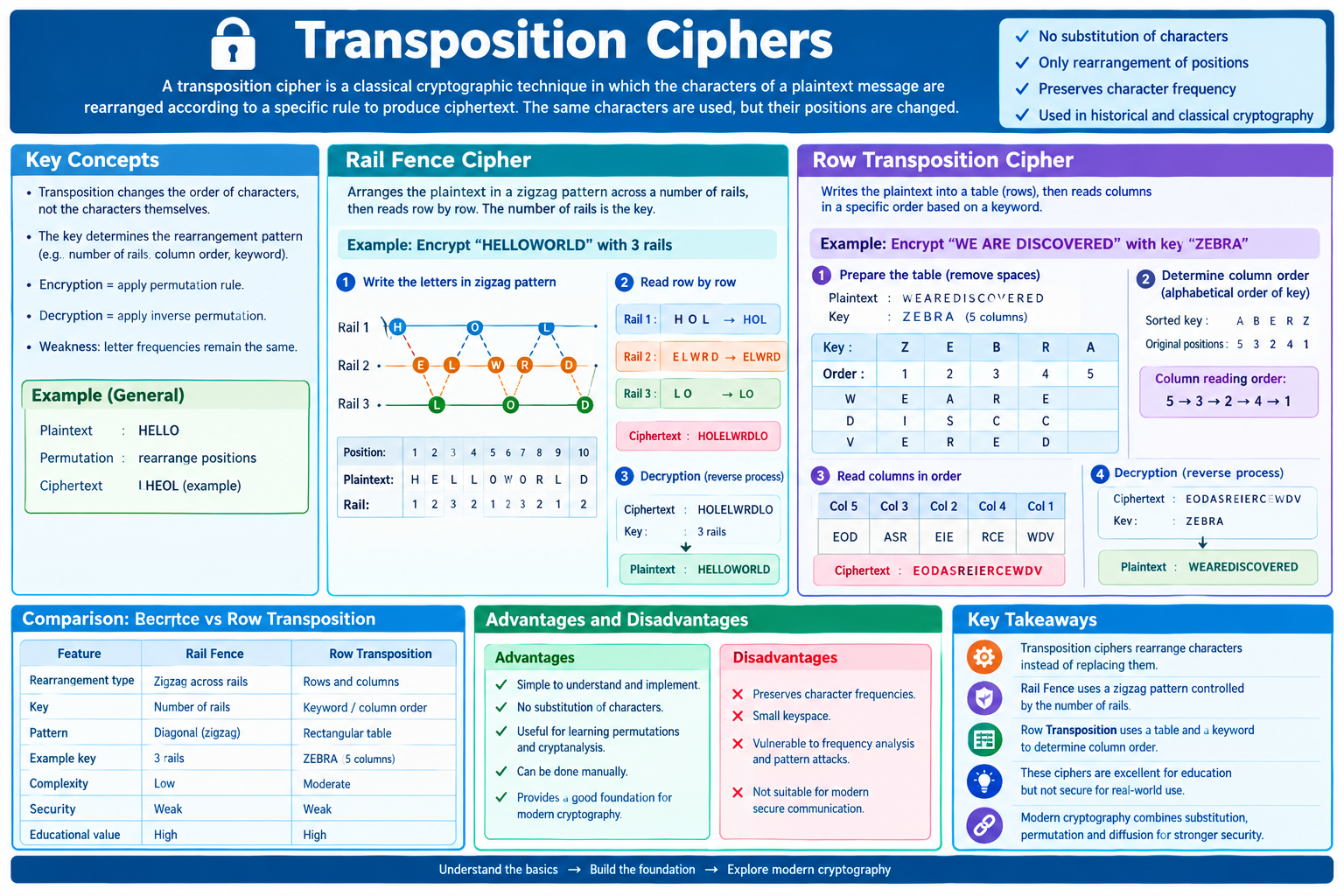
The Rail Fence Cipher Is One Of The Simplest And Most Well-known Transposition Ciphers. It Arranges Plaintext Characters In A Zigzag Pattern Across A Specified Number Of Rows, Called Rails. After The Plaintext Has Been Written In The Zigzag Pattern, The Characters Are Read Row By Row To Generate The Ciphertext. The Number Of Rails Acts As The Key. Because Of Its Simple Structure, The Rail Fence Cipher Is Particularly Useful For Introducing Students To Transposition Concepts.
Working Of The Rail Fence Cipher
In A Rail Fence Cipher, The Encryption Process Begins At The Top Rail. Characters Are Written Downward Through The Rails Until The Bottom Rail Is Reached. The Direction Then Reverses, And Characters Are Written Upward Until The Top Rail Is Reached. This Zigzag Movement Continues Until Every Plaintext Character Has Been Placed. Finally, The Characters Are Read From The First Rail To The Last Rail. The Resulting Sequence Is The Ciphertext.
Complete Rail Fence Encryption Example
Consider The Plaintext:
Plaintext: HELLOWORLD
Key: 3 Rails
First, Write The Letters In A Zigzag Pattern Across Three Rails:
Rail 1: H       O       L
Rail 2:   E   L   W   R   D
Rail 3:     L       O
The Letters Have Been Placed As Follows:
Position:  1 2 3 4 5 6 7 8 9 10
Plaintext: H E L L O W O R L D
Rail:      1 2 3 2 1 2 3 2 1 2
Now Read The Characters Row By Row. Rail 1 Gives HOL. Rail 2 Gives ELWRD. Rail 3 Gives LO. Combining Them Produces:
Ciphertext = HOLELWRDLO
Thus:
HELLOWORLD → HOLELWRDLO
This Is A Complete Rail Fence Encryption Using Three Rails.
Step-by-Step Rail Fence Encryption
The Previous Example Can Also Be Understood As A Sequence Of Steps. Step 1 Is To Select The Number Of Rails, Which Is 3. Step 2 Is To Start With The First Letter H On Rail 1. Step 3 Is To Move Downward And Place E On Rail 2 And L On Rail 3. Step 4 Is To Reverse Direction And Place The Next L On Rail 2 And O On Rail 1. The Process Continues Until Every Letter Is Placed. Finally, The First Row Is Read Completely, Followed By The Second And Third Rows. This Produces HOLELWRDLO.
Complete Rail Fence Decryption Example
Suppose The Ciphertext Is:
Ciphertext: HOLELWRDLO
Key: 3 Rails
First, Determine The Zigzag Rail Pattern For Ten Characters:
Position: 1 2 3 4 5 6 7 8 9 10
Rail:     1 2 3 2 1 2 3 2 1 2
There Are Three Positions On Rail 1, Five Positions On Rail 2, And Two Positions On Rail 3.
Therefore, Divide The Ciphertext As Follows:
Rail 1: H O L
Rail 2: E L W R D
Rail 3: L O
Now Read The Rails According To The Original Zigzag Pattern:
Rail 1 → H
Rail 2 → E
Rail 3 → L
Rail 2 → L
Rail 1 → O
Rail 2 → W
Rail 3 → O
Rail 2 → R
Rail 1 → L
Rail 2 → D
The Recovered Plaintext Is:
HELLOWORLD
Therefore:
HOLELWRDLO → HELLOWORLD
Rail Fence Key
The Key In A Rail Fence Cipher Is Generally The Number Of Rails. A Two-rail Cipher Produces A Relatively Simple Rearrangement, While Three Or More Rails Create More Complicated Patterns. Increasing The Number Of Rails Changes The Permutation Of Characters. However, Simply Increasing The Number Of Rails Does Not Make The Cipher Secure Against Modern Cryptanalysis. The Number Of Practical Rail Configurations Remains Small Compared With The Keyspaces Of Modern Cryptographic Algorithms.
Advantages Of Rail Fence Cipher
The Rail Fence Cipher Is Simple, Intuitive, And Easy To Implement. It Requires Little Mathematical Computation And Can Be Performed Manually. It Is Also Useful For Demonstrating The Concept Of Permutation In Cryptography. From A Programming Perspective, It Provides A Relatively Straightforward Exercise Involving Arrays, Strings, Indexing, And Patterns. These Characteristics Make Rail Fence Particularly Suitable For Introductory Cryptography Courses And Cybersecurity Laboratory Exercises.
Limitations Of Rail Fence Cipher
The Rail Fence Cipher Has Significant Security Limitations. The Keyspace Is Relatively Small Because The Principal Key Is The Number Of Rails. An Attacker Can Test Possible Rail Counts And Examine The Resulting Plaintexts. In Addition, The Cipher Preserves Letter Frequencies And All Original Characters. It Does Not Provide Modern Cryptographic Confidentiality. Consequently, Rail Fence Should Be Regarded As A Classical Educational Cipher Rather Than A Method Suitable For Protecting Sensitive Modern Information.
Row Transposition Cipher
The Row Transposition Cipher Is Another Important Classical Transposition Technique. It Generally Involves Writing Plaintext Into Rows Under A Sequence Of Columns And Then Reading Those Columns According To A Key-defined Order. Unlike The Rail Fence Cipher, Which Uses A Zigzag Path, Row Transposition Typically Uses A Rectangular Arrangement And A Column Ordering Determined By A Keyword Or Numerical Key. This Produces A More Flexible Permutation Of The Plaintext Characters.
Basic Structure Of Row Transposition
In A Typical Row Transposition Cipher, The Sender Selects A Keyword. The Keyword Determines The Number And Ordering Of Columns. The Plaintext Is Written Horizontally Across The Rows Of The Resulting Table. The Columns Are Then Assigned An Order Based On The Alphabetical Ordering Of The Key Characters. The Ciphertext Is Generated By Reading The Columns According To That Order. The Receiver Reverses This Process To Recover The Plaintext.
Complete Row Transposition Encryption Example
Consider The Plaintext:
Plaintext: WE ARE DISCOVERED
For Simplicity, Remove Spaces:
WEAREDISCOVERED
Choose The Keyword:
Key: ZEBRA
The Key Contains Five Letters, So Create Five Columns:
     Z  E  B  R  A
     1  2  3  4  5
Now Write The Plaintext From Left To Right Across The Rows:
     Z  E  B  R  A
     ----------------
     W  E  A  R  E
     D  I  S  C  O
     V  E  R  E  D
There Are Three Complete Rows Because The Plaintext Contains 15 Characters.
Numbering The Row Transposition Key
Next, Arrange The Keyword Letters Alphabetically. The Keyword Is:
Z E B R AAlphabetically, The Letters Appear In This Order:
A B E R ZTheir Original Column Positions Are:
A → Column 5
B → Column 3
E → Column 2
R → Column 4
Z → Column 1
Therefore, The Column-reading Order Is:
5 → 3 → 2 → 4 → 1
This Ordering Is The Key Step In Row Transposition Encryption.
Reading The Columns
Now Read The Columns According To The Order 5, 3, 2, 4, 1.
Column 5 Is:
E
O
D
Therefore:
Column 5 = EOD
Column 3 Is:
A
S
R
Therefore:
Column 3 = ASR
Column 2 Is:
E
I
E
Therefore:
Column 2 = EIE
Column 4 Is:
R
C
E
Therefore:
Column 4 = RCE
Column 1 Is:
W
D
V
Therefore:
Column 1 = WDV
Final Row Transposition Ciphertext
Concatenate The Column Strings In The Correct Order:
EOD + ASR + EIE + RCE + WDVTherefore:
Ciphertext = EODASREIERCEWDV
The Complete Encryption Can Be Summarized As:
Plaintext:
WEAREDISCOVERED

Key:
ZEBRA

Column Order:
5 3 2 4 1

Ciphertext:
EODASREIERCEWDV
This Demonstrates Exactly How The Original Message Is Converted Into Ciphertext Using The Row Transposition Technique.
Complete Row Transposition Decryption Example
Now Suppose The Receiver Receives:
Ciphertext: EODASREIERCEWDV
and Knows That The Key Is:
ZEBRA
The Receiver First Determines That The Key Has Five Columns. The Ciphertext Contains 15 Characters, So The Table Will Contain Three Rows And Five Columns.
The Column Order Remains:
5 → 3 → 2 → 4 → 1
The Ciphertext Is Divided Into Five Groups Of Three Characters:
EOD | ASR | EIE | RCE | WDVEach Group Belongs To The Corresponding Column In The Key-reading Order.
Placing Ciphertext Into The Table
Place The Groups Into Their Original Columns:
Column 5 → E O D
Column 3 → A S R
Column 2 → E I E
Column 4 → R C E
Column 1 → W D V
Now Restore Them To Their Original Column Positions:
     Z  E  B  R  A
     ----------------
     W  E  A  R  E
     D  I  S  C  O
     V  E  R  E  D
The Table Has Now Been Reconstructed.
Reading The Rows During Decryption
Read The Reconstructed Table From Left To Right And From Top To Bottom:
W E A R E
D I S C O
V E R E D
Combining The Rows Gives:
WEAREDISCOVERED
Spaces Can Then Be Restored According To The Context:
WE ARE DISCOVERED
Thus, The Complete Decryption Is:
EODASREIERCEWDV → WEAREDISCOVERED
Handling Padding In Row Transposition
Padding May Be Required When The Plaintext Does Not Contain Enough Characters To Fill The Final Row Completely. Suppose A Six-column Table Is Being Used But The Final Row Contains Only Four Characters. Two Padding Characters, Often X, May Be Added To Complete The Row. For Example, A Plaintext Might Become:
MESSAGE...
ABCDEF
GHIJKL
MNOPXX
The Padding Characters Allow The Table To Remain Rectangular. During Decryption, The Receiver Removes The Padding When Its Presence Is Known. The Exact Padding Convention Should Be Agreed Upon By The Communicating Parties.
Row Transposition With A Numerical Key
Row Transposition Can Also Use A Numerical Key Instead Of A Word. For Example, A Key Might Be Represented By The Sequence:
3 1 4 2
This Means The Columns Are Read According To The Specified Numerical Order. The Plaintext Is Written Into Four Columns, And The Columns Are Extracted According To The Key. Numerical Keys Can Make The Process Straightforward For Computer Implementations Because The Column Ordering Is Explicitly Defined.
Rail Fence Versus Row Transposition
Rail Fence And Row Transposition Both Rearrange Plaintext Characters, But Their Mechanisms Differ. Rail Fence Uses A Zigzag Traversal Across A Specified Number Of Rails. Row Transposition Uses A Rectangular Table And A Keyword-controlled Column Order. Rail Fence Therefore Emphasizes Geometric Rearrangement, While Row Transposition Emphasizes Key-based Column Permutation. Both Techniques Preserve The Original Characters And Can Be Understood Mathematically As Permutations Of Plaintext Positions.
Frequency Characteristics
A Major Weakness Of Transposition Ciphers Is That Character Frequencies Remain Unchanged. If The Plaintext Contains A High Number Of The Letter E, The Ciphertext Will Also Contain The Same Number Of E Characters. This Means Frequency Analysis Can Still Provide Information About The Underlying Language. Although The Positions Of Characters Are Changed, The Statistical Distribution Of Individual Symbols Is Preserved. Consequently, Transposition Alone Generally Does Not Provide Sufficient Security Against Modern Cryptanalysis.
Cryptanalysis Of Transposition Ciphers
Cryptanalysts Can Attack Transposition Ciphers Using Several Approaches. They May Attempt Different Key Sizes, Examine Probable Word Patterns, Analyze Character Frequencies, Or Use Statistical Language Models. For Rail Fence, Testing Different Rail Counts Is Relatively Easy. For Row Transposition, Attackers May Investigate Possible Key Lengths And Column Arrangements. Computational Algorithms Can Automate These Searches And Evaluate Candidate Plaintexts Based On Language Statistics.
Brute-Force Attacks
Brute-force Analysis Involves Testing Possible Keys Or Arrangements. Rail Fence Is Especially Vulnerable Because The Number Of Practical Rail Counts Is Small. Row Transposition Can Have A Larger Number Of Possible Column Arrangements, Particularly When The Key Length Increases. Nevertheless, Modern Computing And Language-based Scoring Methods Can Make Many Classical Transposition Systems Vulnerable. The Security Of A Cryptographic Technique Must Therefore Be Evaluated Against Realistic Computational Capabilities.
Advantages Of Transposition Ciphers
Transposition Ciphers Have Several Educational And Historical Advantages. They Are Relatively Simple To Understand And Demonstrate How Rearrangement Can Conceal A Message. They Require No Replacement Alphabet And Can Often Be Performed Manually. They Also Introduce Important Concepts Such As Permutations, Keys, Column Ordering, Padding, Encryption, Decryption, And Cryptanalysis. These Concepts Form Useful Foundations For Students Studying Classical And Modern Cryptography.
Disadvantages Of Transposition Ciphers
The Main Disadvantage Is Their Limited Security. Since The Characters Themselves Are Not Changed, Statistical Information About The Plaintext Remains Visible. Many Classical Transposition Systems Also Have Relatively Manageable Keyspaces. With Modern Computational Resources, Attackers Can Systematically Test Possible Arrangements. Therefore, Rail Fence And Basic Row Transposition Should Not Be Used For Protecting Confidential Passwords, Financial Information, Personal Data, Military Information, Or Other Sensitive Modern Communications.
Combination With Substitution
Historically, Cryptographers Recognized That Substitution And Transposition Have Complementary Properties. Substitution Changes Symbols While Transposition Changes Their Positions. Combining The Two Can Make Cryptanalysis More Difficult Than Using Either Technique Alone. Modern Block Ciphers Use Related Principles Extensively. Modern Symmetric Cryptography Combines Nonlinear Substitutions, Permutations, Mixing Operations, And Key-dependent Transformations To Create Strong Diffusion And Confusion.
Relationship With Modern Cryptography
Although Rail Fence And Row Transposition Are Insecure By Modern Standards, The Underlying Idea Of Permutation Remains Relevant. Modern Cryptographic Algorithms Use Permutations And Diffusion Mechanisms To Spread Plaintext Information Across Ciphertext. The Difference Is That Modern Systems Combine These Operations With Strong Mathematical Constructions, Large Keyspaces, Nonlinear Transformations, And Carefully Analyzed Security Properties. Classical Transposition Therefore Provides A Conceptual Bridge Between Historical Cryptography And Modern Cryptographic Engineering.
Programming Transposition Ciphers
Transposition Ciphers Are Useful Programming Exercises In Languages Such As Python, Java, C, C++, And PHP. A Rail Fence Implementation Can Use A List Representing Each Rail And A Direction Variable Indicating Whether The Algorithm Is Moving Downward Or Upward. A Row Transposition Implementation Can Use A Two-dimensional Array Or Matrix. Programming These Algorithms Helps Students Understand String Manipulation, Arrays, Indexing, Sorting, Permutations, And Reversible Transformations.
Rail Fence Algorithm In Python
A Python Implementation Of Rail Fence Encryption Can Iterate Through Each Plaintext Character While Maintaining The Current Rail And Movement Direction. When The Algorithm Reaches The Top Or Bottom Rail, It Reverses Direction. Characters Are Stored In Separate Rail Lists And Finally Concatenated. Decryption Is Slightly More Complicated Because The Program Must First Determine How Many Characters Belong To Each Rail Before Reconstructing The Zigzag Sequence. This Makes Rail Fence A Useful Exercise In Algorithmic Thinking.
Row Transposition Algorithm In Python
A Row Transposition Program Can Create A Matrix Based On The Length Of The Key. The Plaintext Is Placed Into Rows, And The Key Characters Are Sorted To Determine The Column-reading Order. Encryption Then Concatenates Characters Column By Column According To That Order. For Decryption, The Ciphertext Is Divided Into Appropriate Column Segments And Placed Back Into Their Original Column Positions. Reading The Reconstructed Matrix Row By Row Produces The Plaintext.
Applications In Cybersecurity Education
Transposition Ciphers Are Frequently Useful In Cybersecurity And Cryptography Education. Students Can Implement Encryption And Decryption Algorithms, Compare Keyspaces, Analyze Weaknesses, And Perform Cryptanalysis Experiments. They Can Also Compare Transposition With Substitution And Modern Symmetric Encryption. Such Laboratory Activities Help Learners Understand Why Security Depends On Carefully Designed Algorithms Rather Than Simply Making Information Appear Scrambled.
Security Considerations And Comparison
Rail Fence And Row Transposition Are Valuable For Learning But Should Not Be Used As Standalone Security Mechanisms For Real-world Sensitive Information. Rail Fence Uses A Zigzag Pattern And A Rail-count Key, While Row Transposition Uses A Table And A Column-order Key. Both Preserve The Original Characters And Therefore Retain Character-frequency Information. Modern Applications Should Instead Use Standardized, Peer-reviewed Cryptographic Algorithms Such As AES Or Authenticated Encryption Schemes Such As AES-GCM Or ChaCha20-Poly1305.
Conclusion
Transposition Ciphers Are Fundamental Classical Cryptographic Techniques That Conceal Information By Rearranging The Positions Of Plaintext Characters Rather Than Replacing Them. The Rail Fence Cipher Uses A Zigzag Arrangement Across Multiple Rails, While The Row Transposition Cipher Uses A Table And Key-controlled Column Ordering. A Complete Rail Fence Example Demonstrates How HELLOWORLD Becomes HOLELWRDLO Using Three Rails, While A Complete Row Transposition Example Demonstrates How WEAREDISCOVERED Becomes EODASREIERCEWDV Using The Key ZEBRA.
These Techniques Introduce Important Concepts Such As Permutation, Keys, Encryption, Decryption, Padding, Frequency Analysis, And Cryptanalysis. Although They Are Not Suitable For Modern Secure Communication, They Remain Important In Cryptography Education Because They Demonstrate How Early Cryptographic Systems Attempted To Protect Information And Provide A Foundation For Understanding More Sophisticated Encryption Techniques.
Tags:
Transposition Ciphers, Rail Fence And Row Transposition Techniques, Transposition Versus Substitution