10/100/1000BASE-T In The Physical Layer: Complete Guide To Fast Ethernet And Gigabit Ethernet
Category: NETWORKING | 26th August 2026, Wednesday
Introduction
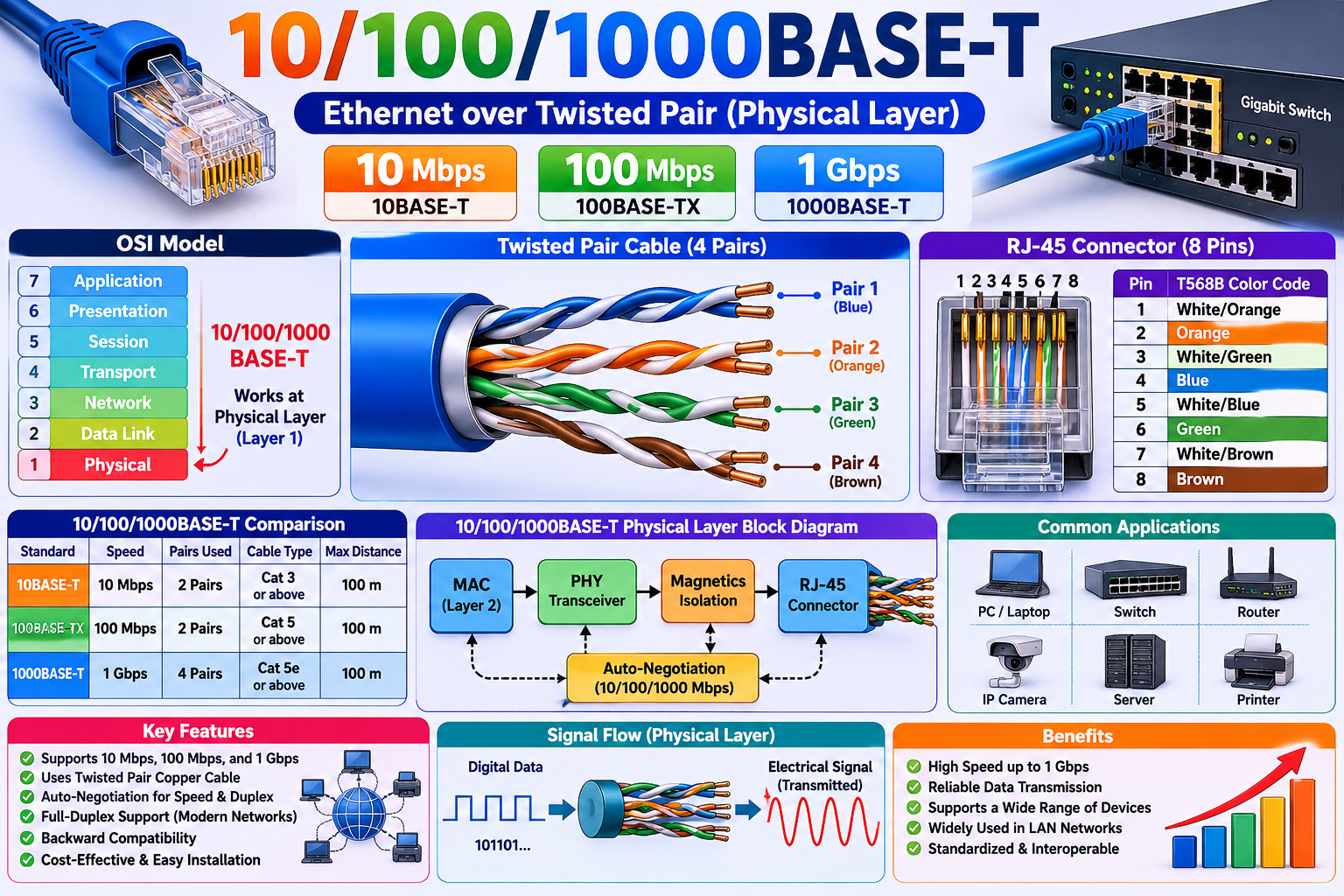
10/100/1000BASE-T Is One Of The Most Widely Used Ethernet Technologies For Connecting Computers, Servers, Switches, Routers, Access Points, IP Cameras, Printers, And Other Network Devices Over Copper Twisted-pair Cables. It Is Commonly Associated With Ethernet Physical-layer Communication And Supports Three Major Data Rates: 10 Mbps, 100 Mbps, And 1000 Mbps (1 Gbps). Because A Single Ethernet Interface Can Automatically Operate At Different Speeds Depending On The Capabilities Of The Connected Devices And The Quality Of The Cable, 10/100/1000BASE-T Provides An Important Combination Of Backward Compatibility, Flexibility, Performance, And Cost Efficiency.
The Term 10/100/1000BASE-T Can Be Understood By Breaking It Into Several Parts. 10/100/1000 Represents The Supported Transmission Speeds, BASE Indicates Baseband Transmission, And T Indicates Twisted-pair Copper Cabling. The Technology Belongs To The Ethernet Family And Operates Primarily At The Physical Layer (Layer 1) Of The OSI Model, While Ethernet Framing And MAC Addressing Are Associated With The Data Link Layer.
10BASE-T, 100BASE-TX, And 1000BASE-T Represent Important Generations In The Development Of Copper Ethernet. 10BASE-T Provided 10 Mbps Communication, Fast Ethernet Increased The Speed To 100 Mbps, And Gigabit Ethernet Increased It Further To 1 Gbps. Modern Network Interfaces Frequently Support All Three Speeds, Making 10/100/1000BASE-T A Common Specification For Ethernet Ports.
What Is 10/100/1000BASE-T?
10/100/1000BASE-T Is An Ethernet Physical-layer Implementation That Enables Network Communication Using Copper Twisted-pair Cable At 10 Mbps, 100 Mbps, Or 1 Gbps. It Is Designed To Provide Compatibility Among Different Generations Of Ethernet Equipment.
A Network Interface Supporting 10/100/1000BASE-T Can Communicate With A Corresponding Ethernet Switch Or Another Compatible Device And Determine The Highest Mutually Supported Speed. This Process Is Generally Accomplished Through auto-negotiation.
For Example, If A Computer Has A Gigabit Ethernet Interface But Is Connected To An Older 100 Mbps Ethernet Switch, The Interface Can Operate At 100 Mbps, Assuming The Physical Connection And Configuration Support It. Similarly, A Device May Operate At 10 Mbps When Connected To Equipment That Supports Only 10BASE-T.
This Backward Compatibility Makes 10/100/1000BASE-T Particularly Useful In Enterprise Networks, Educational Institutions, Homes, Laboratories, Offices, And Data Communication Environments.
Meaning Of 10/100/1000BASE-T
The Terminology Provides Information About The Characteristics Of The Ethernet Connection.
10 Means 10 Mbps Ethernet.
100 Means 100 Mbps Ethernet.
1000 Means 1000 Mbps, Or 1 Gbps, Ethernet.
BASE Means Baseband Transmission, Where The Ethernet Signal Occupies The Communication Medium Without Using Traditional Broadband Frequency-channel Division.
T Represents Twisted-pair Copper Cable.
Therefore, 10/100/1000BASE-T Essentially Means Ethernet Over Twisted-pair Copper Supporting Transmission Rates Of 10 Mbps, 100 Mbps, And 1000 Mbps.
10BASE-T
10BASE-T Was An Important Ethernet Standard That Made Ethernet Networking Practical Over Inexpensive Twisted-pair Cabling. It Provides A Nominal Data Rate Of 10 Mbps And Traditionally Operates Over Two Pairs Of Copper Wires.
10BASE-T Uses Twisted-pair Cable And Has A Maximum Commonly Specified Segment Length Of Approximately 100 Meters. The Cable Can Connect An Ethernet Device Such As A Computer To A Hub Or Switch.
One Of The Major Advantages Of 10BASE-T Was Its Use Of Familiar Structured Cabling. Instead Of Requiring Specialized Coaxial Ethernet Cabling, Organizations Could Deploy Twisted-pair Cables Through Buildings.
Although 10 Mbps Ethernet Is Now Largely Obsolete For High-performance Networks, Understanding 10BASE-T Is Important Because It Represents An Earlier Stage In Ethernet Evolution And Explains The Backward Compatibility Found In Many Ethernet Interfaces.
100BASE-TX
100BASE-TX, Commonly Called Fast Ethernet, Increased Ethernet Speed From 10 Mbps To 100 Mbps. It Became Widely Deployed In Enterprise And Campus Networks Before Gigabit Ethernet Became Dominant.
100BASE-TX Generally Uses Two Twisted Pairs: One Pair For Transmission And Another For Reception. It Commonly Operates Over Category 5 Or Better Twisted-pair Cabling And Supports Distances Up To Approximately 100 Meters For A Standard Ethernet Link.
Compared With 10BASE-T, Fast Ethernet Significantly Improved Network Performance. File Transfers, Web Applications, Centralized Databases, Multimedia Applications, And Client-server Communication Benefited From The Increased Bandwidth.
Although Modern Networks Increasingly Use Gigabit Ethernet Or Faster Technologies, 100BASE-TX Remains Important When Dealing With Legacy Equipment, Embedded Systems, Industrial Devices, And Older Network Infrastructure.
1000BASE-T
1000BASE-T Is The Gigabit Ethernet Implementation Designed For Twisted-pair Copper Cabling. It Provides A Nominal Data Rate Of 1 Gbps, Making It Substantially Faster Than Fast Ethernet.
One Of The Most Significant Characteristics Of 1000BASE-T Is That It Uses all Four Twisted Pairs In A Typical Category 5e Or Better Copper Cable. Data Is Transmitted Simultaneously Over The Four Pairs Using Sophisticated Signaling And Digital Signal Processing.
Unlike 100BASE-TX, Which Traditionally Uses Separate Pairs For Transmission And Reception, 1000BASE-T Uses Bidirectional Transmission Over Each Pair. Consequently, The Physical Layer Must Employ Advanced Techniques To Separate Transmitted And Received Signals.
1000BASE-T Was An Important Milestone Because It Allowed Organizations To Achieve Gigabit Ethernet Speeds While Continuing To Use Copper Structured Cabling.
Physical Layer Operation
The Physical Layer Is Responsible For Transmitting Raw Bits Across A Physical Communication Medium. In An Ethernet Network, This Layer Converts Digital Information Into Electrical Signals Suitable For Transmission Through Copper Cable.
For 10/100/1000BASE-T, Several Functions Are Involved:
-
Physical Signaling
-
Encoding And Decoding
-
Signal Transmission And Reception
-
Clock Recovery
-
Auto-negotiation
-
Link Detection
-
Error-related Physical Signaling Mechanisms
-
Electrical Interface Management
The Physical Layer Works Closely With The Ethernet MAC Layer. The MAC Layer Provides Ethernet Frames, While The Physical Layer Converts The Resulting Bit Stream Into Electrical Signals And Places Them Onto The Copper Medium.
A Simplified Communication Path Can Be Represented As:
Application → Transport Layer → Network Layer → Data Link Layer → Physical Layer → Copper Cable → Physical Layer → Data Link Layer → Network Layer → Transport Layer → Application
At The Physical Layer, The Primary Concern Is Not IP Addresses Or Ethernet MAC Addresses But The Reliable Transmission And Reception Of Electrical Signals.
Twisted-Pair Cabling
Twisted-pair Cable Is Fundamental To 10/100/1000BASE-T Networking. A Typical Ethernet Copper Cable Contains Four Twisted Pairs, Giving A Total Of Eight Conductors.
The Individual Wires Are Twisted Together To Reduce Electromagnetic Interference And Improve Signal Integrity. Twisting Also Helps Reduce Crosstalk Between Pairs.
Common Cable Categories Include:
-
Category 3
-
Category 5
-
Category 5e
-
Category 6
-
Category 6A
The Required Cable Category Depends On The Ethernet Technology And Installation Requirements. 1000BASE-T Is Commonly Deployed Over Category 5e Or Better Cabling, Although Higher-category Cabling May Be Selected For Improved Performance, Future Expansion, And Reduced Interference.
Cable Quality, Connector Quality, Installation Practices, Cable Length, Electromagnetic Interference, And Termination Quality Can All Affect Ethernet Performance.
RJ-45 Connector
10/100/1000BASE-T Ethernet Connections Commonly Use The Familiar 8P8C Modular Connector, Often Called An RJ-45 Connector In Everyday Networking Terminology.
The Connector Provides Eight Contact Positions Corresponding To The Four Twisted Pairs In The Cable.
Two Common Wiring Arrangements Are T568A And T568B. Both Define How The Eight Conductors Are Arranged Within The Connector.
A Correctly Terminated Ethernet Cable Is Important Because Incorrect Wiring Can Cause Link Failures, Reduced Performance, Or Negotiation Problems.
Modern Ethernet Equipment Generally Supports Auto-MDI/MDI-X, Which Allows Devices To Automatically Detect The Wiring Relationship And Adjust Accordingly. This Reduced The Historical Need To Use Different Straight-through And Crossover Cables For Different Device Combinations.
Auto-Negotiation
Auto-negotiation Is One Of The Most Important Features Of Modern Ethernet Interfaces.
When Two Compatible Ethernet Devices Are Connected, They Exchange Information To Determine Supported Capabilities.
The Devices Can Negotiate Parameters Such As:
-
Supported Ethernet Speeds
-
Duplex Modes
-
Flow-control Capabilities
-
Other Link Characteristics
For A 10/100/1000BASE-T Interface, The Devices May Determine Whether The Connection Should Operate At 10 Mbps, 100 Mbps, Or 1 Gbps.
For Example, Suppose A Computer Supports 10/100/1000 Mbps And A Switch Port Supports 10/100/1000 Mbps. The Devices Will Normally Establish A Gigabit Ethernet Link If The Physical Conditions And Configurations Allow It.
If The Switch Supports Only 100 Mbps, The Connection Can Fall Back To 100 Mbps.
Auto-negotiation Therefore Improves Interoperability Between Different Generations Of Ethernet Equipment.
Duplex Communication
Ethernet Communication Can Operate Using Different Duplex Modes Depending On The Technology And Configuration.
Half-duplex Communication Means That Transmission And Reception Cannot Occur Simultaneously On The Same Communication Channel. It Was Particularly Relevant To Older Ethernet Networks Using Hubs.
Full-duplex Communication Allows Simultaneous Transmission And Reception. Modern Switched Ethernet Networks Overwhelmingly Use Full-duplex Operation.
Gigabit Ethernet Over Twisted Pair Is Designed For Full-duplex Switched Operation In Contemporary Deployments.
Full-duplex Operation Eliminates The Traditional Collision-based Operation Associated With Shared Ethernet Media And Allows Devices To Transmit And Receive Simultaneously.
Encoding And Signaling
The Physical Layer Does Not Simply Place Binary 0s And 1s Directly Onto A Copper Cable. Ethernet Physical Layers Use Specific Signaling And Encoding Techniques To Represent Information Electrically.
Different Ethernet Speeds Use Different Physical-layer Mechanisms.
10BASE-T Uses Relatively Simple Signaling Compared With Gigabit Ethernet.
100BASE-TX Uses Techniques Associated With Fast Ethernet, Including 4B/5B Encoding And MLT-3 Signaling.
1000BASE-T Uses Substantially More Sophisticated Signaling. It Employs Techniques Including PAM-5 (five-level Pulse Amplitude Modulation), Sophisticated Equalization, Echo Cancellation, And Digital Signal Processing.
The Purpose Of These Mechanisms Is To Transmit High-speed Data Reliably Through Copper Cable While Dealing With Attenuation, Noise, Crosstalk, Reflections, And Other Physical Impairments.
1000BASE-T And Four-Pair Transmission
One Of The Most Important Technical Features Of 1000BASE-T Is Its Use Of All Four Twisted Pairs.
Each Pair Simultaneously Carries Signals In Both Directions. This Creates Several Physical-layer Challenges.
The Receiver Must Distinguish The Desired Incoming Signal From The Locally Transmitted Signal. This Requires echo Cancellation And Advanced Signal-processing Techniques.
The System Must Also Deal With near-end Crosstalk (NEXT) And far-end Crosstalk (FEXT). Equalization Techniques Help Compensate For Signal Degradation Caused By The Physical Channel.
The Use Of Four Pairs Allows 1000BASE-T To Achieve 1 Gbps Over Conventional Copper Structured Cabling Within Its Specified Channel Characteristics.
Transmission Distance
A Major Advantage Of Twisted-pair Ethernet Is Its Practical Building-scale Transmission Distance.
For Typical 10BASE-T, 100BASE-TX, And 1000BASE-T Installations, The Commonly Referenced Maximum Copper Link Distance Is Approximately 100 Meters, Depending On The Specific Cabling And Channel Configuration.
This Distance Is Generally Divided Into A Permanent-link Portion And Patch-cable Allowances In Structured Cabling Systems.
For Longer Distances, Organizations Can Use Technologies Such As Fiber-optic Ethernet Or Appropriate Network Extension Solutions.
Bandwidth And Performance
The Theoretical Nominal Rates Of The Three Technologies Are:
| Ethernet Technology | Nominal Speed | Typical Medium |
|---|---|---|
| 10BASE-T | 10 Mbps | Twisted-pair Copper |
| 100BASE-TX | 100 Mbps | Twisted-pair Copper |
| 1000BASE-T | 1 Gbps | Four-pair Twisted-pair Copper |
It Is Important To Understand That The Physical-layer Line Rate Is Not Identical To Application-level Throughput.
Protocol Overhead, Ethernet Frame Headers, IP And Transport-layer Headers, Operating-system Behavior, Storage Performance, Congestion, Network-device Processing, And Other Factors Can Reduce The Actual Application Throughput.
Therefore, A 1 Gbps Ethernet Connection Does Not Necessarily Mean That A File Will Transfer At Exactly 1,000 Mbps Of Useful Application Data.
Advantages Of 10/100/1000BASE-T
10/100/1000BASE-T Provides Several Important Advantages.
Backward Compatibility
A Major Benefit Is Compatibility Across Multiple Ethernet Generations. A Single Interface Can Support 10 Mbps, 100 Mbps, And 1 Gbps Operation.
Cost Effectiveness
Copper Twisted-pair Cabling Is Relatively Inexpensive And Widely Available. Organizations Can Use Existing Structured Cabling Instead Of Deploying Fiber For Every Desktop Connection.
Easy Installation
Ethernet Twisted-pair Cabling Is Relatively Easy To Install, Terminate, Test, And Maintain.
High Performance
Gigabit Ethernet Provides Sufficient Bandwidth For Many Desktop, Office, Education, Multimedia, Server, And Internet-access Applications.
Wide Availability
10/100/1000 Ethernet Interfaces Are Common In Computers, Switches, Routers, Access Points, Industrial Devices, Printers, Surveillance Systems, And Embedded Equipment.
Automatic Speed Negotiation
Auto-negotiation Allows Compatible Devices To Select An Appropriate Operating Mode Automatically.
Limitations Of 10/100/1000BASE-T
Despite Its Advantages, Copper Gigabit Ethernet Has Limitations.
The Most Obvious Limitation Is The Distance Of A Standard Copper Ethernet Link. For Longer Distances, Fiber Optic Networking Is Generally More Appropriate.
Copper Cable Is Also Susceptible To Electromagnetic Interference, Although Twisted-pair Construction And Proper Installation Substantially Reduce Its Impact.
Another Limitation Is That 1 Gbps May Not Provide Enough Capacity For High-density Servers, Modern Data Centers, Large-scale Virtualization, High-performance Storage, Or Aggregation Links. In These Environments, 2.5, 5, 10, 25, 40, 100 Gbps, And Higher-speed Ethernet Technologies May Be Used.
10/100/1000BASE-T Vs Fiber Ethernet
Copper And Fiber Ethernet Serve Different Requirements.
Copper Ethernet Offers Relatively Low-cost Connections, Convenient Installation, And Compatibility With Common Network Devices. Fiber Ethernet Offers Much Greater Transmission Distances, Strong Resistance To Electromagnetic Interference, And Very High Bandwidth.
Copper Is Often Preferred For Desktop And Local-area Connections, Whereas Fiber Is Frequently Used For Building-to-building Links, Backbone Connections, Data Centers, And Long-distance Communication.
The Choice Depends On Distance, Bandwidth Requirements, Environmental Conditions, Budget, And Future Network Expansion.
Applications Of 10/100/1000BASE-T
10/100/1000BASE-T Is Used In A Wide Range Of Networking Environments.
Home Networks
Home Computers, Smart TVs, Gaming Systems, Network Storage Devices, And Routers Can Use Gigabit Ethernet For Fast Local Communication.
Enterprise Networks
Businesses Use Gigabit Ethernet For Desktop Computers, Printers, IP Phones, Wireless Access Points, And Network Servers.
Educational Institutions
Schools, Colleges, Universities, And Laboratories Use Ethernet Connections For Computer Labs, Administrative Systems, Servers, And Access Points.
Small And Medium-Sized Businesses
SMBs Can Deploy Gigabit Ethernet Switches To Connect Employees, Servers, Storage Systems, And Network Appliances Without Requiring Expensive Infrastructure.
IP Surveillance
Network Cameras Can Use Ethernet Connections For Data Transmission And, In Suitable Systems, Power Over Ethernet Can Provide Electrical Power Through The Same Cable.
Industrial Networks
Industrial Computers, Controllers, Monitoring Systems, And Specialized Devices May Use Copper Ethernet Where Environmental And Distance Requirements Permit.
Relationship With Power Over Ethernet
10/100/1000BASE-T Can Also Be Used In Networks Implementing Power Over Ethernet (PoE) Technologies. PoE Allows Compatible Network Infrastructure To Carry Both Data And Electrical Power Through Ethernet Cabling.
PoE Is Commonly Used For:
-
IP Cameras
-
Wireless Access Points
-
VoIP Phones
-
IoT Devices
-
Network Sensors
-
Access-control Devices
The Data Transmission Technology And The Power-delivery Technology Are Related But Should Not Be Considered Identical. Ethernet Defines Communication, While PoE Adds Electrical Power Delivery According To Applicable Standards.
Troubleshooting 10/100/1000BASE-T
When A Gigabit Ethernet Connection Fails To Operate At The Expected Speed, Several Physical Factors Should Be Investigated.
First, Check The Cable Category And Physical Condition. Damaged Cables, Poor-quality Connectors, Incorrect Termination, And Excessive Bending Can Affect Performance.
Second, Check Whether The Network Interface And Switch Port Support Gigabit Ethernet.
Third, Examine The Negotiated Speed And Duplex Settings On Both Devices.
Fourth, Inspect The Cable Installation For Excessive Electromagnetic Interference Or Poor Termination.
Fifth, Replace The Cable With A Known-good Cable And Test Again.
Network Administrators Can Also Examine Switch Statistics For Errors, Dropped Packets, CRC Errors, Collisions, And Other Indicators Of Physical-layer Problems.
Security Considerations
10/100/1000BASE-T Itself Primarily Defines Physical Communication And Does Not Provide Complete Network Security.
Security Must Therefore Be Implemented At Higher Layers And Through Network Infrastructure.
Organizations Can Use Measures Such As:
-
Network Segmentation
-
VLANs
-
Port Security
-
802.1X Authentication
-
Access-control Policies
-
Firewalls
-
Intrusion Detection And Prevention
-
Secure Management Protocols
-
Monitoring And Logging
Physical Security Is Also Important. Unauthorized Access To Ethernet Ports Can Provide An Attacker With A Potential Network Connection. Therefore, Unused Switch Ports Should Be Appropriately Disabled Or Controlled In Security-sensitive Environments.
Future Of Copper Ethernet
Although Gigabit Ethernet Remains Highly Relevant, Networking Continues To Evolve. Modern Organizations Increasingly Require Higher Bandwidth Because Of Cloud Computing, Virtualization, Artificial Intelligence, High-resolution Video, Large Datasets, Internet Of Things Deployments, And High-performance Storage.
Technologies Such As 2.5GBASE-T, 5GBASE-T, And 10GBASE-T Extend The Concept Of High-speed Ethernet Over Twisted-pair Copper.
However, 10/100/1000BASE-T Remains Important Because Of Its Broad Installed Base, Compatibility, Affordability, And Adequate Performance For Many Conventional LAN Applications.
Conclusion
10/100/1000BASE-T Is A Fundamental Ethernet Technology In The Physical Layer That Supports 10 Mbps, 100 Mbps, And 1 Gbps Communication Over Twisted-pair Copper Cabling. It Represents The Evolution From Traditional 10 Mbps Ethernet Through Fast Ethernet To Gigabit Ethernet While Maintaining Backward Compatibility.
10BASE-T Introduced Practical Ethernet Connectivity Using Twisted-pair Cable, 100BASE-TX Increased The Speed To 100 Mbps, And 1000BASE-T Delivered Gigabit Ethernet Using All Four Twisted Pairs With Advanced Signaling And Digital Signal-processing Techniques.
The Technology Remains Highly Useful Because It Combines Performance, Affordability, Scalability, And Widespread Hardware Support. Its Operation Depends On Physical-layer Concepts Including Electrical Signaling, Encoding, Auto-negotiation, Duplex Communication, Cable Characteristics, Connector Termination, And Signal Integrity.
For Students, Network Engineers, Researchers, And IT Professionals, Understanding 10/100/1000BASE-T Provides A Strong Foundation For Studying Ethernet, LAN Architecture, Physical-layer Communication, Structured Cabling, And Modern High-speed Networking. Even As 10 Gigabit Ethernet And Faster Technologies Continue To Expand, 10/100/1000BASE-T Remains One Of The Most Important And Widely Encountered Ethernet Technologies In Local-area Networks.
Keywords
10/100/1000BASE-T, 10/100/1000BASE-T Physical Layer, 1000BASE-T, Gigabit Ethernet, 10BASE-T, 100BASE-TX, Fast Ethernet, Ethernet Physical Layer, Twisted Pair Ethernet, Ethernet Cable, Gigabit Ethernet Physical Layer, Ethernet Networking, 1 Gbps Ethernet, Ethernet PHY, Auto-negotiation, RJ-45 Ethernet, Cat5e Gigabit Ethernet, Copper Ethernet, LAN Physical Layer, Ethernet Transmission.
Tags:
10/100/1000BASE-T, 10/100/1000BASE-T Physical Layer, 1000BASE-T, Gigabit Ethernet, 10BASE-T, 100BASE-TX, Fast Ethernet, Ethernet Physical Layer, Twisted Pair Ethernet, Ethernet Cable, Gigabit Ethernet