ASCII (American Standard Code For Information Interchange)
Category: NETWORKING | 14th November 2026, Saturday
Introduction To ASCII
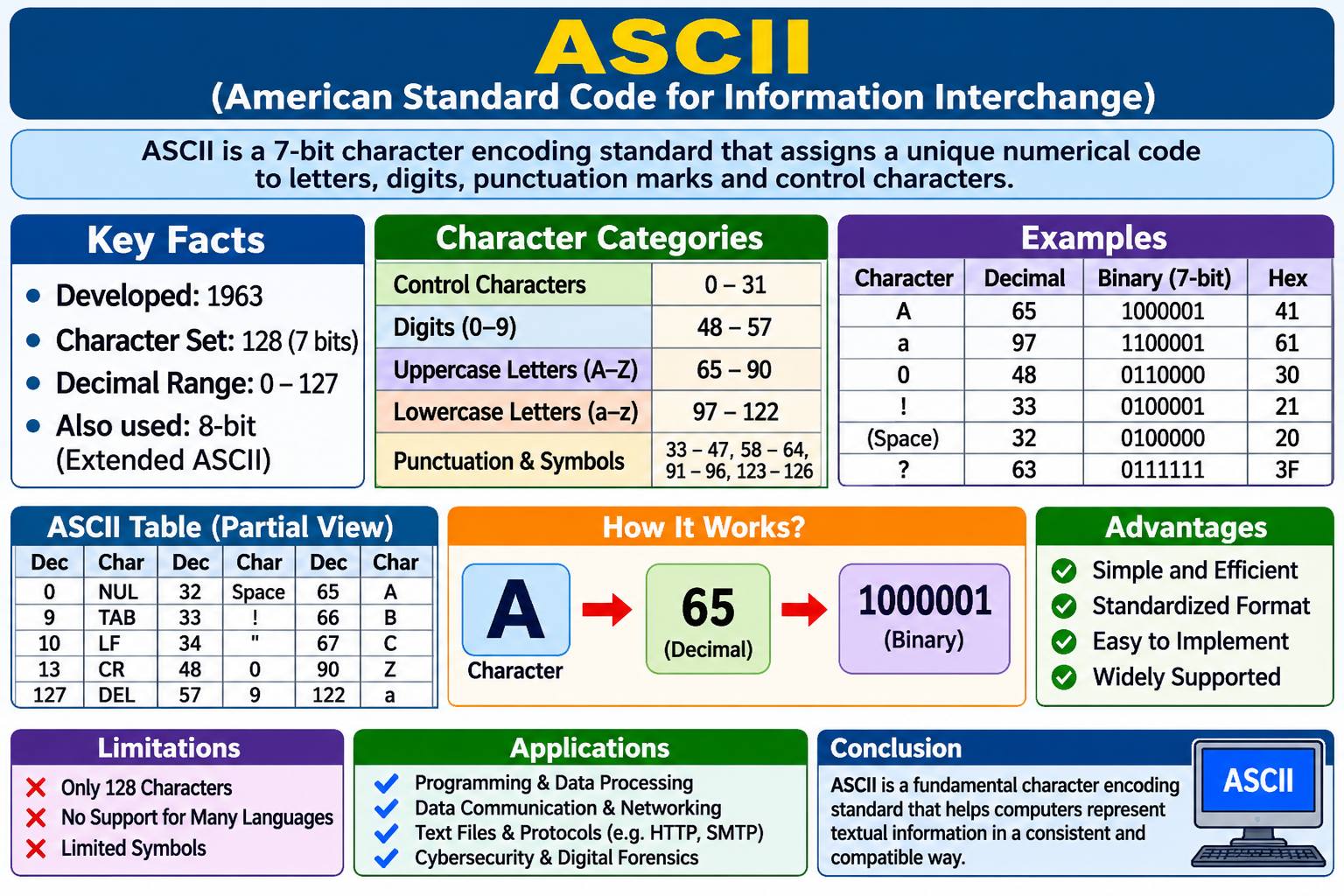
ASCII Stands For American Standard Code For Information Interchange. It Is One Of The Most Fundamental Character Encoding Standards Used In Computers And Digital Communication Systems. ASCII Provides A Standardized Method Of Representing Letters, Numbers, Punctuation Marks, And Special Control Characters In A Computer-readable Format. Since Computers Fundamentally Process And Store Information Using Binary Digits (0 And 1), Character Encoding Systems Are Necessary To Convert Human-readable Characters Into Numerical Representations That Computers Can Understand And Process. ASCII Was Developed To Establish A Common Standard For Representing Textual Information Across Different Computer Systems, Communication Devices, And Electronic Equipment.
Before The Development Of ASCII, Different Computer Manufacturers Used Their Own Character Representation Systems. As A Result, Exchanging Text Between Different Computers Was Difficult Because The Same Character Could Have Different Numerical Representations On Different Machines. ASCII Addressed This Problem By Introducing A Standardized Character Encoding Scheme.
It Enabled Computers And Communication Devices To Exchange Textual Information Using A Common Set Of Numerical Codes. Today, ASCII Remains An Important Concept In Computer Science, Programming Languages, Networking, Data Communication, Information Security, And Digital Storage.
History And Development Of ASCII
The Development Of ASCII Began During The Late 1950s And Early 1960s When Computer Manufacturers And Communication Engineers Recognized The Need For A Universal Character Encoding Standard. At That Time, Computers Were Increasingly Being Used For Business Processing, Scientific Calculations, Data Storage, And Communication. However, Different Systems Used Incompatible Character Encoding Formats, Making Information Exchange Complicated. The American Standards Association (ASA), Now Known As The American National Standards Institute (ANSI), Worked Toward Establishing A Standardized Character Representation System.
ASCII Was Officially Published In 1963 As A Seven-bit Character Encoding Standard. It Was Designed Primarily For Communication Between Computers, Teleprinters, Terminals, And Other Electronic Devices. The Original ASCII Standard Contained 128 Different Character Codes, Ranging From Decimal 0 To Decimal 127. Later Revisions Improved Certain Character Definitions And Expanded The Standard's Practical Use.
ASCII Became Widely Adopted In Computing Systems Because Of Its Simplicity, Efficiency, And Compatibility With Early Communication Technologies. Although Modern Computing Systems Use More Advanced Character Encoding Standards, ASCII Continues To Influence The Design Of Modern Text-processing Technologies.
Basic Concept Of ASCII Encoding
The Basic Concept Of ASCII Is To Assign A Unique Numerical Value To Each Supported Character. Every Letter, Digit, Punctuation Mark, And Control Character Has A Corresponding Decimal Number. Computers Convert These Numerical Values Into Binary Representations Before Storing Or Transmitting Them. For Example, The Uppercase Letter A Has The Decimal ASCII Value 65, While The Lowercase Letter A Has The Decimal Value 97. Similarly, The Digit 0 Has The Decimal ASCII Value 48.
When A User Types A Character Using A Keyboard, The Computer's Operating System Or Application Receives A Character Value And Represents It According To The Applicable Character Encoding. In ASCII, The Character Is Represented Using Seven Binary Bits.
These Bits Can Represent 128 Unique Combinations Because Seven Binary Positions Provide \(2^7 = 128\) Possible Values. Therefore, ASCII Supports 128 Characters, Including Alphabetic Characters, Numerical Digits, Punctuation Marks, And Control Instructions. This Numerical Representation Allows Computers To Process Textual Information Efficiently.
Seven-Bit ASCII Character Representation
Standard ASCII Uses Seven Bits To Represent Each Character. A Bit Is The Smallest Unit Of Digital Information And Can Contain Either A Binary 0 Or A Binary 1. Seven Bits Can Represent 128 Different Combinations, Beginning With 0000000 And Ending With 1111111. Each Combination Corresponds To A Specific ASCII Character Or Control Function.
For Example, The Uppercase Letter A Is Represented By The Binary Sequence 1000001, Which Is Equivalent To Decimal 65. The Uppercase Letter B Is Represented By 1000010, Equivalent To Decimal 66. The Uppercase Letter C Is Represented By 1000011, Equivalent To Decimal 67. These Values Demonstrate That ASCII Assigns Sequential Numerical Codes To Many Alphabetic Characters.
The Seven-bit Structure Makes ASCII Relatively Compact And Suitable For Early Computer Communication Systems. Although Modern Computers Generally Process Data In Eight-bit Bytes, The Original ASCII Character Set Itself Remains A Seven-bit Standard.
ASCII Character Set And Its Classification
The ASCII Character Set Contains 128 Characters Divided Into Different Categories According To Their Functions. These Categories Include Control Characters, Uppercase Alphabetic Characters, Lowercase Alphabetic Characters, Numerical Digits, Punctuation Symbols, And Special Characters.
The First Category Contains Control Characters With Decimal Values From 0 To 31. These Characters Were Designed To Control Communication And Text-processing Operations Rather Than Display Ordinary Text. The Second Category Includes Printable Characters Such As Punctuation Marks, Numbers, And Special Symbols. Uppercase English Letters Occupy Decimal Values 65 To 90, While Lowercase English Letters Occupy Decimal Values 97 To 122.
Numerical Digits Occupy Decimal Values 48 To 57. The Remaining Printable Values Represent Spaces, Punctuation Marks, And Other Symbols. The Final ASCII Value, Decimal 127, Represents The Delete Control Character. This Classification Makes ASCII Easy To Understand And Implement In Computer Systems.
Control Characters In ASCII
Control Characters Are Special ASCII Codes That Perform Particular Operations During Data Transmission And Text Processing. Unlike Ordinary Printable Characters, Control Characters Generally Do Not Represent Visible Symbols On A Screen. Instead, They Provide Instructions To Communication Devices, Terminals, Printers, And Software Applications.
Some Important ASCII Control Characters Include NUL (Null), BEL (Bell), BS (Backspace), HT (Horizontal Tab), LF (Line Feed), VT (Vertical Tab), FF (Form Feed), CR (Carriage Return), ESC (Escape), And DEL (Delete). For Example, The Line Feed Character Moves The Cursor To The Next Line, While The Carriage Return Character Moves The Cursor To The Beginning Of The Current Line.
The Backspace Character Moves The Cursor Backward Or Requests Deletion Behavior In Certain Environments. The Escape Character Is Used In Various Control Sequences. Historically, These Characters Were Especially Important In Teleprinters And Serial Communication Systems. Today, Several ASCII Control Characters Remain Relevant In Text Files, Programming, Terminal Operations, And Network Protocols.
Printable Characters In ASCII
Printable ASCII Characters Are Those Characters That Can Normally Be Displayed As Visible Symbols On A Computer Screen, Terminal, Or Printer. They Include English Alphabetic Letters, Numerical Digits, Punctuation Marks, Mathematical Symbols, And Other Commonly Used Characters.
The Printable ASCII Range Extends From Decimal 32 To Decimal 126. Decimal 32 Represents The Space Character, Which Is Used To Separate Words And Other Textual Elements. Decimal Values 33 To 47 Include Symbols Such As Exclamation Marks, Quotation Marks, Number Signs, Dollar Signs, Percentage Signs, And Parentheses. Decimal Values 48 To 57 Represent Numerical Digits From 0 To 9.
Decimal Values 65 To 90 Represent Uppercase English Letters, And Decimal Values 97 To 122 Represent Lowercase English Letters. The Remaining Printable Characters Include Brackets, Braces, Mathematical Operators, Punctuation Marks, And The Tilde Symbol. Printable ASCII Is Widely Used In Programming Languages, Text Editors, Command-line Interfaces, And Data Communication Systems.
ASCII Decimal, Binary, And Hexadecimal Representation
ASCII Characters Can Be Represented Using Different Numerical Systems, Including Decimal, Binary, And Hexadecimal Notation. These Representations Describe The Same Underlying Character Code But Express It In Different Numerical Formats. Decimal Notation Uses Base 10, Binary Notation Uses Base 2, And Hexadecimal Notation Uses Base 16.
For Example, The Uppercase Letter A Has An ASCII Decimal Value Of 65, A Binary Value Of 1000001, And A Hexadecimal Value Of 41. Similarly, The Lowercase Letter A Has Decimal Value 97, Binary Representation 1100001, And Hexadecimal Value 61. The Numerical Digit 0 Has Decimal Value 48, Binary Representation 0110000, And Hexadecimal Value 30 When Written As An Eight-bit Byte.
These Different Representations Are Useful In Computer Programming, Debugging, Memory Inspection, Network Packet Analysis, And Cybersecurity. Hexadecimal Notation Is Particularly Convenient Because Two Hexadecimal Digits Represent One Eight-bit Byte.
ASCII Table And Character Codes
An ASCII Table Is A Structured Representation Of The Complete ASCII Character Set. It Provides The Decimal, Binary, Hexadecimal, And Corresponding Character Values For All 128 Standard ASCII Codes. Programmers And Computer Engineers Frequently Use ASCII Tables To Understand Character Encoding And Convert Textual Information Into Numerical Representations.
The Following Table Shows Some Commonly Used ASCII Characters And Their Corresponding Numerical Values.
|
Character |
Decimal |
Binary (7-bit) |
Hexadecimal |
|---|---|---|---|
|
NUL |
0 |
0000000 |
00 |
|
TAB |
9 |
0001001 |
09 |
|
LF |
10 |
0001010 |
0A |
|
Space |
32 |
0100000 |
20 |
|
! |
33 |
0100001 |
21 |
|
0 |
48 |
0110000 |
30 |
|
1 |
49 |
0110001 |
31 |
|
A |
65 |
1000001 |
41 |
|
B |
66 |
1000010 |
42 |
|
C |
67 |
1000011 |
43 |
|
Z |
90 |
1011010 |
5A |
|
a |
97 |
1100001 |
61 |
|
b |
98 |
1100010 |
62 |
|
z |
122 |
1111010 |
7A |
|
DEL |
127 |
1111111 |
7F |
The ASCII Table Is Particularly Useful For Understanding How Computers Represent Textual Data. It Also Helps Programmers Perform Character Conversions, String Manipulation, And Low-level Data Processing.
Difference Between ASCII And Extended ASCII
Standard ASCII Uses Seven Bits And Supports 128 Character Codes. However, Early Computer Systems Frequently Used Eight-bit Bytes, Leaving One Additional Bit Available For Character Representation. Some Manufacturers Used This Additional Bit To Create Character Sets Containing Up To 256 Values. These Different Eight-bit Character Sets Are Commonly Called Extended ASCII.
Extended ASCII Is Not One Universally Standardized Character Encoding. Instead, It Refers To Various Eight-bit Encoding Schemes Developed For Different Languages And Computing Environments. Examples Include Windows-1252, ISO-8859-1, And Other Regional Character Sets. These Encodings Preserve The Original Standard ASCII Values From 0 To 127 While Assigning Additional Characters To Values From 128 To 255.
The Additional Characters May Include Accented Letters, Currency Symbols, And Other Language-specific Characters. However, Because Different Extended Character Sets Assign Different Meanings To The Same Numerical Values, Exchanging Data Between Incompatible Systems Can Produce Incorrect Symbols. Unicode Was Developed To Provide A More Comprehensive And Consistent Solution For Representing Characters From Languages Around The World.
ASCII And Unicode
Unicode Is A Modern Character Encoding Standard Designed To Represent Characters From Almost Every Writing System In The World. Unlike Traditional ASCII, Which Supports Only 128 Characters, Unicode Provides A Much Larger Character Repertoire. It Includes English Letters, Indian Scripts, Chinese Characters, Arabic Characters, Mathematical Symbols, Punctuation, And Emoji.
ASCII Is Compatible With Unicode Because The First 128 Unicode Code Points Correspond To The Standard ASCII Character Set. For Example, Uppercase A Has Unicode Code Point U+0041, Which Is Identical To Its ASCII Numerical Value Of 65. UTF-8, UTF-16, And UTF-32 Are Widely Used Unicode Encoding Formats. UTF-8 Is Particularly Popular Because It Uses One Byte For Standard ASCII Characters And Multiple Bytes For Many Other Unicode Characters. This Backward Compatibility Allows Traditional ASCII Text To Be Processed Correctly By UTF-8 Systems. Consequently, ASCII Remains An Important Foundation Of Modern Character Encoding Technologies.
ASCII In Computer Programming
ASCII Plays An Important Role In Computer Programming Because Programming Languages Frequently Use Textual Characters To Represent Instructions, Variables, Operators, Keywords, And Data. Programming Languages Such As C, C++, Java, Python, And JavaScript Process Strings Containing Characters That Can Be Represented Using ASCII.
For Example, A Programmer May Store The Word HELLO In A String Variable. Each Letter Has A Corresponding ASCII Numerical Value. H Is 72, E Is 69, L Is 76, L Is 76, And O Is 79. A Program Can Convert These Characters Into Their Numerical Representations For Processing Or Analysis. ASCII Values Are Also Useful For Checking Whether A Character Is An Uppercase Letter, Lowercase Letter, Digit, Or Punctuation Mark. In The C Programming Language, Functions Such As isdigit(), isalpha(), And toupper() Support Character Classification And Conversion. Understanding ASCII Helps Programmers Develop String-processing Applications, Compilers, Interpreters, Text Editors, And Communication Software.
ASCII In C Programming Language
The C Programming Language Provides Direct Support For Character Processing And Numerical Character Representations. A Character Variable Can Store A Character Value, And Programmers Can Use Its Corresponding Integer Representation During Program Execution. The char Data Type Is Commonly Used To Store Character Data, While Integer Variables Can Be Used To Examine Numerical Character Codes.
For Example, The Following C Program Displays The ASCII Value Of A Character.
#include <stdio.h>

Int Main()
{
    Char Ch;

    Printf("Enter A Character: ");
    Scanf("%c", &ch);

    Printf("Character: %c\n", Ch);
    Printf("ASCII Value: %d\n", Ch);

    Return 0;
}
If The User Enters A, The Program Displays Its Character Representation And Numerical Value, Which Is 65 On An ASCII-compatible Execution Environment. Similarly, Entering B Produces 66. This Simple Program Demonstrates The Relationship Between Characters And Their Numerical Representations. Such Techniques Are Useful In Educational Programming Exercises, Character Encoding Experiments, And Low-level Software Development.
ASCII In Data Communication
ASCII Was Originally Developed To Support Standardized Communication Between Computers And Electronic Communication Devices. It Played A Significant Role In Early Data Transmission Systems, Including Teleprinters, Terminals, And Serial Communication Equipment. By Assigning Standardized Numerical Values To Characters, ASCII Enabled Different Devices To Exchange Textual Information Using A Common Representation.
During Communication, Text Characters Are Converted Into Binary Data Before Transmission Through Communication Channels. The Receiving System Interprets The Received Binary Values According To The Same Character Encoding Standard And Reconstructs The Original Text. For Example, When The Character A Is Transmitted Using Standard ASCII, Its Seven-bit Representation Is 1000001.
The Receiving Device Interprets This Numerical Value As The Uppercase Letter A. Control Characters Such As Start Of Text, End Of Text, And Carriage Return Have Also Historically Supported Communication Control Operations. Although Modern Communication Protocols Generally Use More Flexible Encoding Formats, ASCII Remains Relevant In Text-based Network Communication.
ASCII In Networking And Internet Communication
ASCII Has Played An Important Role In The Development Of Internet Communication Technologies. Many Traditional Internet Protocols Were Designed Around Readable Textual Commands And Responses. For Example, HTTP Headers, SMTP Commands, DNS Textual Representations, And FTP Commands Frequently Use ASCII-compatible Text.
When A Web Browser Communicates With A Web Server, HTTP Messages Contain Textual Elements Such As Request Methods, Header Names, And Status Information. Commands Such As GET, POST, And HEAD Consist Of Ordinary ASCII Characters. Similarly, Email Communication Protocols Use Textual Commands To Exchange Information Between Mail Clients And Servers.
SMTP Commands Such As HELO, EHLO, MAIL FROM, And RCPT TO Are Examples Of ASCII-compatible Protocol Text. However, Modern Internet Protocols May Support UTF-8 And Other Encoding Mechanisms For International Text. Therefore, ASCII Remains A Significant Foundation For Understanding Networking, Protocol Analysis, And Internet Communication.
Advantages Of ASCII
ASCII Provides Several Advantages That Contributed To Its Widespread Adoption In Early Computing Systems And Its Continued Relevance In Modern Computing. One Major Advantage Is Simplicity. Its Seven-bit Character Representation Makes It Relatively Easy To Implement In Hardware And Software. The Numerical Mapping Between Characters And Their Corresponding Codes Is Straightforward, Allowing Programmers To Process Textual Information Efficiently.
Another Important Advantage Is Compatibility. ASCII Became A Widely Recognized Standard, Allowing Different Computer Systems And Communication Devices To Exchange English Textual Information Consistently. It Also Requires Relatively Little Storage For Basic English Text Because Each Character Can Be Represented Using One Seven-bit Code, Commonly Stored In One Eight-bit Byte.
ASCII Is Also Useful For Debugging And Inspecting Data Because Its Printable Characters Are Generally Human-readable. Furthermore, ASCII Compatibility With UTF-8 Ensures That Standard ASCII Text Can Be Used In Modern Unicode-based Systems Without Changing Its Original Numerical Representation.
Disadvantages And Limitations Of ASCII
Despite Its Importance, ASCII Has Several Limitations. The Most Significant Limitation Is Its Small Character Set. Standard ASCII Contains Only 128 Characters, Which Is Insufficient For Representing The Complete Range Of Characters Used In International Languages. It Primarily Supports Basic English Letters, Numbers, Punctuation Marks, And Control Characters.
For Example, Standard ASCII Cannot Directly Represent Hindi, Sanskrit, Bengali, Tamil, Arabic, Chinese, Or Japanese Characters. It Also Lacks Many Mathematical Symbols, Currency Symbols, And Modern Typographic Characters. Another Limitation Is That ASCII Does Not Provide A Universal Mechanism For Representing Multilingual Text. Different Extended ASCII Variants Can Also Create Compatibility Problems Because Their Additional Character Assignments Are Inconsistent.
As A Result, Modern Computing Systems Generally Use Unicode-based Encoding Formats Such As UTF-8. Although ASCII Remains Useful For Basic English Text And Protocol Commands, It Cannot Independently Satisfy The Requirements Of Modern Multilingual Computing Environments.
Applications Of ASCII In Modern Computing
ASCII Continues To Have Practical Applications Across Several Areas Of Computer Science And Information Technology. It Is Commonly Used In Programming Languages, Source-code Files, Command-line Interfaces, Configuration Files, And Text-based Communication Protocols. Software Developers Frequently Examine ASCII Values When Performing String Manipulation, Input Validation, And Character Conversion.
ASCII Is Also Useful In Cybersecurity And Digital Forensics. Security Analysts Examine Text-based Network Traffic, Log Files, Suspicious Scripts, Malware Samples, And Encoded Data To Understand System Behavior. For Example, Hexadecimal Representations Of Network Packets Can Be Converted Into ASCII Text To Identify Readable Commands, URLs, Or Suspicious Strings.
In Digital Forensics, Investigators May Use String-extraction Techniques To Identify Readable Information Within Binary Files. ASCII Also Appears In File Formats And Data Structures Where Textual Information Is Stored Alongside Numerical Or Binary Information. These Applications Demonstrate That Knowledge Of ASCII Remains Valuable For Programmers, Networking Professionals, System Administrators, And Cybersecurity Researchers.
ASCII And Information Security
ASCII Is Relevant To Information Security Because Many Security-related Technologies Process Textual Information. Passwords, Usernames, URLs, HTTP Headers, Email Messages, Command-line Instructions, And Application Logs Frequently Contain ASCII-compatible Characters. Understanding Character Encoding Helps Security Professionals Investigate How Information Is Represented, Transmitted, And Processed.
ASCII Values Can Also Appear In Malicious Scripts, Suspicious Network Requests, And Encoded Payloads. Attackers Sometimes Use Different Character Representations, Escape Sequences, Or Encoding Transformations To Hide Malicious Strings From Basic Inspection Tools. Security Researchers Can Examine These Representations To Understand Suspicious Activities And Identify Potentially Harmful Content.
For Example, Hexadecimal Data Can Be Converted Into ASCII To Reveal Readable Command Strings. However, ASCII Is Not An Encryption Algorithm And Does Not Provide Confidentiality, Authentication, Or Data Integrity. It Only Provides A Method Of Representing Characters Numerically. Therefore, Secure Communication Requires Additional Mechanisms Such As Encryption, Authentication, And Cryptographic Integrity Protection.
Conclusion
ASCII, Or American Standard Code For Information Interchange, Is One Of The Most Important Foundational Standards In The History Of Computer Science. It Introduced A Standardized Method For Representing Textual Characters Through Numerical Codes, Enabling Computers And Communication Devices To Exchange Information Consistently. Its Seven-bit Structure Supports 128 Character Codes, Including Uppercase And Lowercase English Letters, Numerical Digits, Punctuation Marks, Special Symbols, And Control Characters.
ASCII Has Influenced Numerous Technologies, Including Programming Languages, Operating Systems, Communication Protocols, Networking Applications, And Digital Storage Systems. Although Its Limited Character Set Cannot Represent The Complete Range Of International Languages, Its Compatibility With Unicode And UTF-8 Ensures That It Remains Relevant In Modern Computing Environments.
Understanding ASCII Is Essential For Students Of Computer Science, Information Technology, Networking, Cryptography, And Cybersecurity Because It Provides The Fundamental Knowledge Required To Understand How Computers Represent And Process Textual Information.
Suggested Next Topic: You Can Study Unicode, UTF-8, UTF-16, And Character Encoding Techniques To Understand How Modern Computers Represent Multilingual Text.
Tags:
ASCII, ASCII Definition, Define ASCII