Cryptographically Secured Communication Framework Based On TLS And PKI
Category: NETWORKING | 17th August 2026, Monday
Introduction
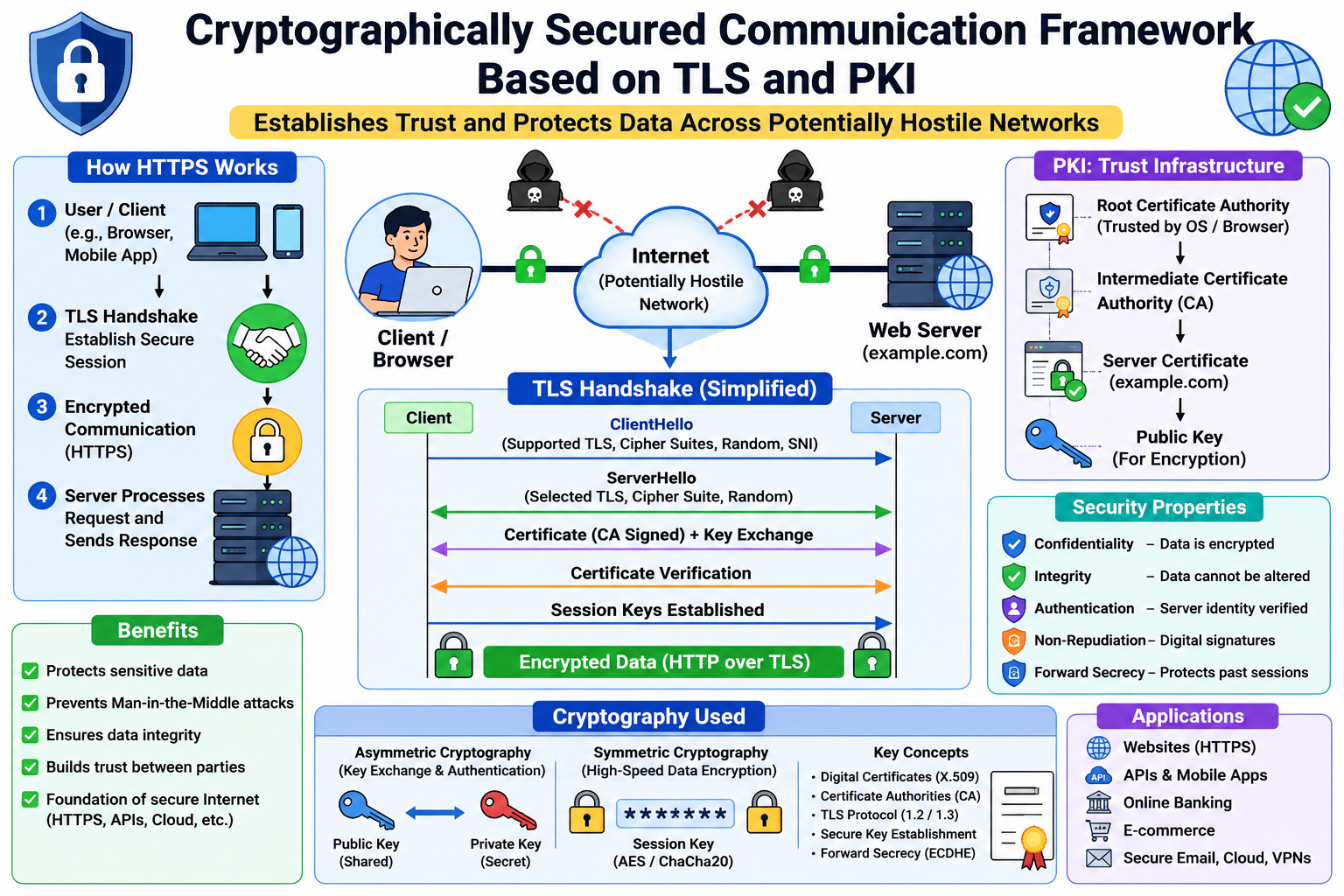
A cryptographically Secured Communication Framework Based On Transport Layer Security (TLS) And Public Key Infrastructure (PKI) Is A Fundamental Component Of Modern Network And Cybersecurity Architecture. It Provides A Systematic Mechanism For Establishing Trust Between Communicating Entities And Protecting Information While It Travels Across Potentially Hostile Or Untrusted Networks. The Internet Is Inherently Distributed, And Data Transmitted Between A User's Device And A Remote Server May Pass Through Numerous Routers, Wireless Networks, Internet Service Providers, Gateways, Proxies, And Other Intermediate Systems. Without Appropriate Security Mechanisms, An Attacker Positioned Somewhere Along This Communication Path Could Potentially Observe, Modify, Inject, Replay, Or Redirect Network Traffic. Cryptographic Protocols Such As TLS Address These Risks By Creating A Secure Communication Channel Between Endpoints, While PKI Provides The Infrastructure Required To Authenticate Identities And Establish Trust. Together, TLS And PKI Form The Technological Foundation Behind HTTPS, Secure APIs, Secure Email Services, Cloud Communication, Enterprise Applications, Online Banking, E-commerce, And Many Other Internet-based Systems.
The Primary Purpose Of This Framework Is To Provide confidentiality, Integrity, Authentication, And Secure Key Establishment. Confidentiality Ensures That Sensitive Information Cannot Be Understood By Unauthorized Parties Who May Intercept Network Traffic. For Example, When A User Submits A Username, Password, Payment Detail, Or Personal Message Through An HTTPS Website, The Information Is Transformed Into Encrypted Data Before Being Transmitted Across The Network. An Attacker Monitoring The Communication May Be Able To Observe Network Packets, But Without The Appropriate Cryptographic Keys, The Attacker Should Not Be Able To Recover The Original Application Data. This Property Is Particularly Important When Users Access Internet Services Through Public Wi-Fi Networks, Shared Networks, Or Other Environments Where Network Traffic Could Potentially Be Monitored.
Integrity Is Another Essential Property Provided By Cryptographically Secured Communication. Encryption Alone Is Not Sufficient Because An Attacker Could Potentially Modify Encrypted Messages Without Necessarily Understanding Their Contents. Modern TLS Therefore Incorporates Cryptographic Authentication Mechanisms That Allow Communicating Parties To Detect Unauthorized Modification Of Transmitted Data. If An Attacker Attempts To Alter A Protected Message, The Cryptographic Verification Process Should Fail, Causing The Receiving System To Reject The Manipulated Data. This Prevents An Attacker From Silently Changing Information During Transmission. For Example, An Attacker Should Not Be Able To Modify An Online Transaction From ?1,000 To ?100,000 Without The Alteration Being Detected. Thus, Integrity Ensures That The Data Received By The Destination Corresponds To The Data That Was Transmitted By The Legitimate Sender.
Authentication Establishes Confidence About The Identity Of The Communicating Endpoint. This Is Particularly Important Because Encryption By Itself Does Not Necessarily Prove Who Is On The Other Side Of A Connection. An Attacker Could Establish An Encrypted Connection With A Victim While Pretending To Be A Legitimate Website. TLS Addresses This Problem Through Digital Certificates And PKI. When A Browser Connects To A Secure Website, The Server Normally Provides An X.509 Digital Certificate Containing Information About The Server's Identity And Its Public Key. The Certificate Is Digitally Signed By A Trusted Certificate Authority (CA), Allowing The Browser To Evaluate Whether The Certificate Can Be Trusted. The Browser Also Verifies Whether The Certificate Is Valid For The Requested Domain, Whether It Has Expired, Whether Its Certificate Chain Is Trustworthy, And Whether It Satisfies Relevant Security Constraints.
PKI Provides The Broader Trust Infrastructure That Makes Certificate-based Authentication Practical At Internet Scale. Public Key Infrastructure Can Be Understood As A Collection Of Technologies, Policies, Cryptographic Keys, Certificates, Certificate Authorities, Validation Mechanisms, And Operational Procedures Used To Establish And Manage Digital Trust. A Typical PKI Hierarchy Contains A Root Certificate Authority, One Or More Intermediate Certificate Authorities, And End-entity Certificates Issued To Servers Or Other Authenticated Entities. The Root CA Is Generally Included In The Trusted Certificate Store Of An Operating System Or Browser. An Intermediate CA Can Issue Certificates On Behalf Of The Root CA, Creating A Certificate Chain. When A Browser Receives A Server Certificate, It Can Validate The Digital Signatures In The Chain Until It Reaches A Trusted Root. This Hierarchical Structure Enables Millions Of Websites And Services To Obtain Certificates Without Requiring Every Client To Maintain An Individual Trust Relationship With Every Server.
Digital Certificates Are Therefore An Important Bridge Between Cryptographic Keys And Real-world Identities. A Public Key By Itself Does Not Necessarily Tell A User Whether It Belongs To The Legitimate Organization Or Server. A Certificate Associates The Public Key With An Identity, Such As A Domain Name, And Includes A Signature From A Trusted Certificate Authority. This Association Allows A Browser To Determine That The Public Key Presented By A Server Is Intended To Represent The Specified Domain. Certificates Commonly Contain Information Such As The Subject, Issuer, Validity Period, Public Key, Serial Number, Certificate Policies, Key Usage Information, And Subject Alternative Names. Modern Browsers Primarily Rely On The Subject Alternative Name Extension When Determining Whether A Certificate Matches The Requested Hostname.
TLS Uses Both Asymmetric And Symmetric Cryptography To Achieve Security Efficiently. Asymmetric Cryptography Uses A Public Key And A Corresponding Private Key. The Public Key Can Be Distributed Openly, Whereas The Private Key Must Be Protected By Its Owner. Public-key Cryptography Is Useful For Authentication And Secure Key Establishment, But Asymmetric Operations Are Generally More Computationally Expensive Than Symmetric Encryption. Symmetric Cryptography, In Contrast, Uses Shared Secret Keys And Is Much More Efficient For Protecting Large Amounts Of Data. Consequently, TLS Uses Asymmetric Cryptographic Mechanisms Primarily During Connection Establishment And Then Uses Efficiently Derived Symmetric Session Keys To Protect The Actual Application Data.
The Process Through Which TLS Establishes A Secure Session Is Called The TLS Handshake. During The Handshake, The Client And Server Negotiate Cryptographic Parameters, Exchange Information Required For Key Establishment, Authenticate The Server, And Derive Shared Session Keys. In Modern TLS 1.3, The Handshake Has Been Streamlined Compared With Older TLS Versions. The Client Begins With A ClientHello Message Containing Information Such As Supported TLS Versions, Cryptographic Capabilities, Extensions, And Key-exchange Information. The Server Responds With A ServerHello And Provides The Information Required For The Selected Cryptographic Configuration. The Server Also Provides Its Certificate And Cryptographic Authentication Information. The Client Validates The Certificate And Verifies The Server's Cryptographic Proof. Both Parties Then Derive Shared Secrets From The Key-exchange Process And Use Those Secrets To Generate Symmetric Traffic Keys.
One Important Cryptographic Concept In Modern TLS Is ephemeral Key Exchange, Commonly Implemented Using Elliptic Curve Diffie-Hellman Ephemeral (ECDHE). The Purpose Of Ephemeral Key Exchange Is To Provide Forward Secrecy. Forward Secrecy Means That The Compromise Of A Server's Long-term Private Key In The Future Should Not, Under The Intended Protocol Assumptions, Allow An Attacker To Decrypt Previously Captured TLS Sessions. This Is An Important Security Property Because Attackers May Record Encrypted Internet Traffic For Long Periods And Attempt To Decrypt It Later After Obtaining Compromised Keys. By Using Independently Generated Ephemeral Session Secrets, Modern TLS Significantly Reduces This Retrospective Decryption Risk.
Once The TLS Handshake Has Successfully Completed, Application-layer Communication Can Proceed Securely. In The Context Of HTTPS, HTTP Requests And Responses Are Transported Through The TLS-protected Channel. A Browser May Logically Send An HTTP Request Such As GET /account, But The Actual HTTP Contents Are Protected By TLS Before Being Transmitted Over The Network. The Web Server Receives The Encrypted TLS Records, Authenticates And Decrypts Them, Reconstructs The HTTP Request, And Passes It To The Appropriate Application. The Response Follows The Reverse Process. Consequently, An Observer Positioned Between The Client And Server Normally Cannot Read The Protected HTTP Payload.
The Framework Is Particularly Important For Defending Against Man-in-the-Middle (MITM) Attacks. In A MITM Attack, An Adversary Attempts To Position Itself Between Two Communicating Parties And Intercept Or Manipulate Their Communication. Without Authentication, The Attacker Could Potentially Impersonate A Legitimate Server. TLS Certificate Validation Makes This Substantially More Difficult Because The Attacker Would Need To Present A Certificate That The Victim's System Accepts As Valid For The Intended Domain, Together With The Corresponding Private Key. Proper Certificate Validation Therefore Provides An Essential Defense Against Server Impersonation. However, Certificate-based Security Is Dependent On The Correct Operation Of The PKI Ecosystem And The Proper Protection Of Private Keys.
The Security Of The Framework Also Depends On key Management. A Cryptographic System Is Only As Secure As Its Keys And The Processes Used To Protect Them. Server Private Keys Must Be Stored Securely Because Possession Of An Applicable Private Key Can Enable Serious Security Consequences. Organizations Should Use Appropriate Access Controls, Secure Key-storage Mechanisms, Monitoring, Rotation Procedures, And Incident-response Processes. If A Private Key Is Compromised, The Organization May Need To Replace The Certificate And Associated Key Material. In Large Environments, Automated Certificate Lifecycle Management Is Increasingly Important Because Certificates Have Limited Validity Periods And Must Be Renewed Before Expiration.
Although HTTPS Provides Strong Protection For Application Data In Transit, It Does Not Provide Complete Anonymity Or Guarantee That The Destination Application Itself Is Trustworthy. Network Observers May Still Obtain Certain Metadata, Such As Source And Destination IP Addresses, Connection Timing, Traffic Volume, And Potentially DNS-related Information Depending On The Network Configuration. Furthermore, HTTPS Cannot Protect Against Vulnerabilities That Exist Inside The Application. SQL Injection, Cross-site Scripting, Broken Access Control, Insecure Authentication, Malicious Software, Compromised Endpoints, And Phishing Attacks May Continue To Operate Even When HTTPS Is Correctly Implemented. A Phishing Website, For Example, Can Possess A Valid TLS Certificate While Still Being Operated By An Attacker. Therefore, Users Should Understand That The Presence Of HTTPS Primarily Indicates That The Communication Channel Is Cryptographically Protected; It Does Not Automatically Mean That The Website Itself Is Legitimate Or Safe.
TLS Is Also An Important Component Of Modern Cloud And Distributed Computing Architectures. Applications Increasingly Communicate Through APIs, Microservices, Cloud Platforms, Mobile Applications, And Containerized Environments. In These Systems, TLS Can Protect Communication Not Only Between A Browser And A Public Web Server But Also Between Internal Services. Organizations May Additionally Use mutual TLS (mTLS), In Which Both Communicating Parties Authenticate Using Certificates. Traditional HTTPS Generally Focuses On Authenticating The Server To The Client, Whereas MTLS Can Provide Authentication Of Both Client And Server. This Is Particularly Valuable In Service-to-service Communication, Enterprise Environments, Zero-trust Architectures, And Sensitive API Infrastructures.
Modern Web Protocols Further Demonstrate The Importance Of TLS. HTTP/2 Is Commonly Deployed Over TLS, Providing Features Such As Multiplexing, Binary Framing, And Header Compression While TLS Protects The Communication Channel. HTTP/3 Uses QUIC, Which Operates Over UDP And Incorporates TLS 1.3 Into Its Connection Establishment. This Demonstrates That Secure Web Communication Is Evolving Beyond The Traditional HTTP-over-TCP Model While Continuing To Rely Heavily On Modern Cryptographic Protection. The Underlying Transport Technology May Change, But Authentication, Confidentiality, Integrity, And Secure Key Establishment Remain Fundamental Requirements.
At A Master's Level, The TLS-PKI Framework Should Therefore Be Analyzed As A multi-layer Security Architecture Rather Than Merely An Encryption Mechanism. At The Application Layer, Secure Coding And Authentication Protect The Application Itself. At The Protocol Layer, HTTP Defines How Web Resources Are Requested And Delivered. TLS Provides Cryptographic Protection For The Communication Channel. PKI Provides Mechanisms For Establishing Identity And Trust. Cryptographic Algorithms Provide Mathematical Foundations For Encryption, Authentication, And Key Establishment. Finally, Operating Systems, Hardware, Key-storage Systems, Certificate-management Platforms, And Security Monitoring Mechanisms Provide The Operational Environment Required To Maintain The Security Of The Entire System.
The Effectiveness Of Cryptographically Secured Communication Depends On Correct Configuration And Continuous Management. Organizations Should Use Modern TLS Versions, Disable Obsolete Protocols And Weak Cryptographic Algorithms, Protect Private Keys, Correctly Configure Certificate Chains, Monitor Certificate Expiration, Implement Secure Cookie Attributes, Use HSTS Where Appropriate, And Regularly Assess Their TLS Configurations. Security Testing Tools Can Be Used To Identify Protocol Weaknesses, Certificate Problems, Insecure Cipher Configurations, And Deployment Errors. However, Technical Configuration Alone Is Insufficient. Security Policies, Employee Awareness, Secure Software Development Practices, Incident Response, Access Control, And Vulnerability Management Must Complement Cryptographic Protections.
In Conclusion, A cryptographically Secured Communication Framework Based On TLS And PKI Establishes Trust And Protects Data While It Travels Across Potentially Hostile Networks By Combining Several Security Mechanisms Into A Coherent Architecture. TLS Creates The Secure Communication Channel, Cryptographic Algorithms Provide Confidentiality And Integrity, Digital Certificates Connect Identities With Public Keys, And PKI Establishes A Scalable Trust Model Through Certificate Authorities And Certificate Chains. Key-exchange Mechanisms Establish Secure Session Secrets, While Modern Approaches Such As Ephemeral Key Exchange Provide Forward Secrecy. HTTPS Represents One Of The Most Important Practical Applications Of This Framework, Protecting Communication Between Web Clients And Servers Across The Internet. Nevertheless, Secure Communication Should Be Considered One Layer Of A Broader Cybersecurity Strategy. Strong TLS And PKI Cannot Compensate For Insecure Applications, Compromised Endpoints, Stolen Credentials, Or Poor Security Practices. At The Master's Level, The Framework Is Best Understood As An Integrated Combination Of cryptography, Authentication, Certificate-based Trust, Secure Key Management, Protocol Security, And Network Defense, Forming A Critical Foundation For Secure Digital Communication In Contemporary Computing Environments.
Tags:
Cryptography, Authentication, Certificate-based Trust, Secure Key Management, Protocol Security, And Network Defense,