DSL (Digital Subscriber Line) In The Physical Layer
Category: NETWORKING | 21st August 2026, Friday
Introduction
Digital Subscriber Line (DSL) Is A Family Of Broadband Communication Technologies Designed To Provide High-speed Digital Data Transmission Over The Existing Copper Twisted-pair Telephone Infrastructure. DSL Operates Primarily At The Physical Layer (Layer 1) Of The OSI Reference Model Because Its Fundamental Purpose Is To Transmit Digital Information As Electrical Signals Over A Physical Communication Medium. Unlike Traditional Dial-up Connections, Which Use The Telephone Network For Relatively Slow Data Communication, DSL Enables Simultaneous Voice And High-speed Data Transmission Over The Same Copper Telephone Line.
DSL Became An Important Broadband Access Technology Because It Allowed Telecommunications Providers To Deliver Internet Connectivity Without Requiring Users To Replace Existing Telephone Wiring. Although Fiber-optic Technologies Have Increasingly Replaced DSL In Many High-speed Networks, DSL Remains Important For Understanding Broadband Access Networks, Digital Modulation, Transmission Media, And Physical Layer Technologies.
1. Meaning Of DSL
DSL Stands For Digital Subscriber Line. It Refers To A Group Of Technologies That Use The Local Telephone Subscriber Loop—the Copper Twisted-pair Cable Connecting A Customer's Premises To The Telephone Company's Central Office Or Access Equipment—to Carry Digital Data.
The Term "subscriber Line" Refers To The Physical Connection Between The Subscriber And The Service Provider. DSL Technologies Exploit Frequency Ranges Above Those Traditionally Used For Voice Communication. As A Result, Telephone Conversations And Internet Data Can Coexist On The Same Physical Copper Pair.
The Major DSL Variants Include:
-
ADSL – Asymmetric Digital Subscriber Line
-
ADSL2 And ADSL2+
-
SDSL – Symmetric Digital Subscriber Line
-
HDSL – High-bit-rate Digital Subscriber Line
-
VDSL – Very-high-bit-rate Digital Subscriber Line
-
VDSL2 – Very-high-bit-rate Digital Subscriber Line 2
Each Technology Provides Different Transmission Speeds, Frequency Characteristics, And Distance Limitations.
2. DSL And The OSI Physical Layer
The OSI Model Divides Network Communication Into Seven Layers. The Physical Layer Is The Lowest Layer And Is Responsible For Transmitting Raw Bits Through A Physical Medium.
DSL Relates Strongly To The Physical Layer Because It Defines Characteristics Such As:
-
Physical Transmission Medium
-
Electrical Signaling
-
Frequency Allocation
-
Signal Modulation
-
Data Transmission Rate
-
Synchronization
-
Signal Power
-
Noise Management
-
Distance Limitations
-
Physical Interfaces And Equipment
At The Physical Layer, The Binary Information Generated By Higher Layers Is Converted Into Signals Suitable For Transmission Over Copper Wires.
For Example, A Digital Sequence Such As:
101101001101
cannot Simply Travel Through A Telephone Cable As Abstract Binary Numbers. The DSL Modem Converts These Bits Into Appropriately Modulated Electrical Signals. At The Receiving End, Another DSL Modem Or DSL Access Multiplexer Performs The Reverse Process And Reconstructs The Digital Data.
3. Physical Medium Used By DSL
DSL Generally Operates Over twisted-pair Copper Telephone Cables. A Twisted Pair Consists Of Two Insulated Copper Conductors Twisted Around Each Other. Twisting Helps Reduce Electromagnetic Interference And Crosstalk.
Traditional Telephone Networks Were Originally Designed Primarily For Voice Communication. Voice Signals Generally Occupy A Relatively Small Frequency Range. DSL Takes Advantage Of Additional Frequency Spectrum Available On The Copper Pair.
The Copper Loop Has Several Physical Limitations. Its Electrical Characteristics Change According To:
-
Cable Length
-
Wire Diameter
-
Cable Quality
-
Electrical Resistance
-
Capacitance
-
Inductance
-
Crosstalk
-
Electromagnetic Interference
-
Bridge Taps
-
Line Attenuation
As Distance Increases, The DSL Signal Becomes Weaker. Consequently, DSL Performance Is Strongly Dependent On The Physical Characteristics Of The Subscriber Loop.
4. Frequency Division In DSL
One Of The Fundamental Principles Behind DSL Is The Separation Of Voice And Data Into Different Frequency Bands.
Traditional Telephone Voice Communication Occupies The Lower-frequency Portion Of The Copper Line. DSL Uses Higher Frequencies For Digital Data Transmission.
A splitter Or Filter Can Separate The Voice And DSL Frequency Ranges. The Customer Can Therefore Use A Telephone And Internet Connection Simultaneously.
Conceptually, The Spectrum Can Be Represented As:
Low Frequencies → Voice Communication
Higher Frequencies → DSL Upstream And Downstream Data
The Exact Frequency Allocation Depends On The DSL Standard. ADSL, For Example, Allocates Different Portions Of The Available Spectrum To Upstream And Downstream Communication.
This Frequency Separation Is One Of The Major Reasons Why DSL Can Provide Internet Access While Preserving Traditional Telephone Service.
5. DSL Modem
A DSL Connection Requires Specialized Equipment Commonly Known As A DSL Modem. The Modem Performs Modulation And Demodulation Functions.
On The Transmitting Side, Digital Data Is Processed And Converted Into Signals Suitable For The Copper Line. On The Receiving Side, The Modem Detects The Incoming Signal And Converts It Back Into Digital Information.
A Simplified Communication Process Is:
Computer → Router/DSL Modem → Copper Telephone Line → DSL Access Equipment → Internet
Modern DSL Devices Often Combine Several Functions, Including:
-
DSL Modem
-
Ethernet Switch
-
Wi-Fi Access Point
-
Router
-
Firewall
-
Network Address Translation
Therefore, The Device Installed At The Customer Premises May Be Called A DSL Router Or Gateway Rather Than Simply A Modem.
6. DSL Access Multiplexer
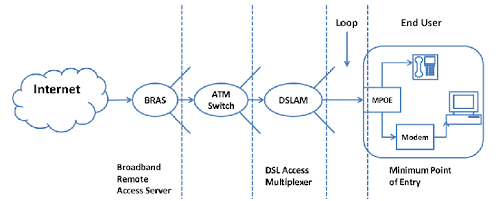
At The Service Provider's Side, Multiple DSL Subscriber Lines Are Connected To A Device Called A DSL Access Multiplexer (DSLAM).
A DSLAM Aggregates Traffic From Many Customers And Forwards The Data Into The Provider's Broadband Network.
A Simplified Architecture Is:
Subscriber Computer
↓
DSL Modem/Router
↓
Copper Subscriber Loop
↓
DSLAM
↓
Aggregation Network
↓
Internet Service Provider Network
↓
Internet
The DSLAM Performs Important Physical And Access-network Functions, Including Receiving DSL Signals From Subscribers, Separating Individual Connections, And Forwarding Their Traffic Toward The Service Provider's Network.
7. Modulation And Signal Transmission
DSL Relies On Sophisticated Digital Modulation Techniques To Transmit Large Amounts Of Information Over Copper Telephone Lines.
One Historically Important Technique Is Discrete Multi-Tone (DMT) Modulation. DMT Divides The Available Frequency Spectrum Into Many Narrow Subchannels, Or Tones.
Instead Of Transmitting All Data Through One Carrier Frequency, DSL Divides The Data Across Many Frequency Subchannels.
If Some Frequencies Experience Significant Interference, Those Subchannels Can Carry Fewer Bits Or May Be Disabled. Other Subchannels With Better Signal Quality Can Carry More Information.
This Makes DSL Adaptive To The Physical Characteristics Of The Copper Line.
The General Principle Is:
Digital Data → DMT Processing → Multiple Frequency Tones → Copper Line
At The Receiving Side:
Copper Signal → Tone Analysis → Demodulation → Digital Data
DMT Is Particularly Useful Because Copper Telephone Lines Do Not Have Identical Frequency Characteristics Across Their Entire Bandwidth.
8. ADSL
Asymmetric Digital Subscriber Line (ADSL) Is One Of The Most Widely Recognized DSL Technologies.
The Term "asymmetric" Means That Downstream And Upstream Data Rates Are Different. Usually, The Downstream Rate Is Greater Than The Upstream Rate Because Typical Internet Users Download More Information Than They Upload.
For Example, Activities Such As:
-
Web Browsing
-
Video Streaming
-
Software Downloads
-
Web Page Loading
-
Online Learning
often Require Substantially More Downstream Capacity.
ADSL Therefore Allocates More Bandwidth To Downstream Communication And Less To Upstream Communication.
The Actual Speed Depends On The DSL Version, Line Quality, Distance, And Service Configuration.
9. ADSL2 And ADSL2+
ADSL2 And ADSL2+ Were Developed To Improve Upon The Capabilities Of Earlier ADSL Implementations.
ADSL2 Introduced Improvements Such As Better Diagnostics, Improved Line Management, And Greater Efficiency. ADSL2+ Extended The Usable Frequency Range And Could Provide Significantly Higher Downstream Rates Under Favorable Line Conditions.
However, Higher Frequency Operation Also Makes Performance More Sensitive To Line Characteristics And Distance.
Therefore, Theoretical Maximum Rates Should Not Be Confused With The Actual Speed Experienced By A Subscriber.
10. VDSL And VDSL2
Very-high-bit-rate Digital Subscriber Line (VDSL) Provides Substantially Higher Data Rates Than Traditional ADSL Technologies Over Relatively Short Copper Loops.
VDSL Is Especially Useful In Fiber-to-the-Cabinet (FTTC) Or Similar Architectures, Where Fiber Carries Traffic Close To The Subscriber And The Remaining Short Distance Is Served Using Copper.
VDSL2 Further Improves Performance And Supports Multiple Profiles Designed For Different Deployment Environments.
The Key Principle Is That Shorter Copper Distances Generally Allow Higher Frequencies And Therefore Higher Data Rates.
A Typical Architecture Can Be Represented As:
Internet → Fiber Network → Cabinet → VDSL2 → Copper Pair → Customer
This Hybrid Architecture Combines The Capacity Of Optical Fiber With The Existing Copper Access Network.
11. DSL Transmission Performance
Several Physical Layer Characteristics Influence DSL Performance.
Attenuation
Attenuation Is The Reduction In Signal Strength As A Signal Travels Through The Transmission Medium.
Longer Copper Cables Generally Produce Greater Attenuation. High-frequency DSL Signals Are Also More Strongly Affected By Attenuation.
Noise
Noise Refers To Unwanted Electrical Energy That Interferes With The Desired Signal. Sources Include Electrical Equipment, Radio-frequency Interference, And Other Communication Signals.
Crosstalk
Crosstalk Occurs When Signals Traveling Through Nearby Copper Pairs Interfere With Each Other. This Can Significantly Affect DSL Performance In Densely Packed Cable Bundles.
Signal-to-Noise Ratio
The Signal-to-Noise Ratio (SNR) Compares The Desired Signal Power With The Noise Power. A Higher SNR Generally Allows More Reliable And Faster Transmission.
DSL Systems Use SNR Information To Determine How Many Bits Can Be Assigned To Different Frequency Tones.
12. Bit Loading
An Important Characteristic Of DMT-based DSL Is adaptive Bit Loading.
Each Subchannel May Have Different Signal Quality. A Frequency With Excellent SNR Can Carry More Bits, While A Noisy Frequency Carries Fewer Bits.
For Example:
Tone 1 → 8 Bits
Tone 2 → 10 Bits
Tone 3 → 4 Bits
Tone 4 → 0 Bits
This Approach Allows DSL To Adapt To Changing Physical Conditions.
The Result Is More Efficient Utilization Of The Available Spectrum Compared With Treating The Entire Channel As Having Identical Characteristics.
13. Upstream And Downstream Transmission
DSL Generally Separates Upstream And Downstream Traffic Using Frequency Allocation Or Other Duplexing Techniques.
Downstream Refers To Data Transmitted From The Service Provider Toward The Subscriber.
Upstream Refers To Data Transmitted From The Subscriber Toward The Service Provider.
In ADSL, Downstream Bandwidth Is Intentionally Larger Than Upstream Bandwidth.
In Symmetric Technologies Such As SDSL And Certain Business-oriented DSL Implementations, Upstream And Downstream Capacities Can Be More Balanced.
This Distinction Is Important For Applications Such As Cloud Backups, Video Conferencing, File Uploads, And Server Hosting.
14. DSL Splitter And Microfilters
A DSL Splitter Separates Telephone Voice Signals From DSL Data Signals.
In A Traditional Installation, The Splitter May Be Located Where The Telephone Line Enters The Premises. Microfilters May Also Be Installed On Individual Telephone Devices.
The Objective Is To Prevent DSL High-frequency Signals From Interfering With Conventional Telephone Equipment And To Prevent Telephone Equipment From Degrading DSL Performance.
The Conceptual Arrangement Is:
Telephone Line
↓
Splitter
???????????
Telephone??? DSL Modem
This Is An Important Physical Layer Arrangement Because It Determines How Different Signal Components Share The Same Physical Copper Medium.
15. DSL Distance Limitations
One Of The Major Limitations Of DSL Is The Relationship Between Transmission Distance And Data Rate.
As The Distance Between The Customer And DSL Access Equipment Increases:
-
Signal Attenuation Increases.
-
SNR Generally Decreases.
-
Available Data Rate Decreases.
-
High-frequency Tones Become Less Usable.
-
Connection Stability May Decrease.
Consequently, Two Customers Using The Same DSL Technology May Experience Different Speeds Because Their Copper Loops Have Different Lengths And Characteristics.
This Is One Reason DSL Performance Is Often Described As distance-dependent.
16. Advantages Of DSL
DSL Offers Several Important Advantages.
Existing Infrastructure
DSL Can Use Existing Telephone Copper Wiring, Reducing The Need To Deploy An Entirely New Physical Access Network.
Simultaneous Voice And Data
Because Different Frequency Ranges Are Used, Voice And Data Can Operate Simultaneously On The Same Physical Connection.
Dedicated Subscriber Loop
A DSL Subscriber Typically Has A Dedicated Physical Copper Loop To The Provider's Access Equipment, Although Network Architecture Beyond The Access Link Is Shared.
Always-On Connectivity
Unlike Traditional Dial-up, DSL Provides Persistent Broadband Connectivity.
Wide Availability
DSL Was Historically Available In Many Areas Where Fiber Infrastructure Was Not Yet Deployed.
17. Limitations Of DSL
Despite Its Advantages, DSL Has Several Limitations.
Distance Dependence
Performance Decreases As Copper Loop Length Increases.
Copper Quality
Old, Damaged, Or Poorly Maintained Cables Can Reduce Performance.
Crosstalk
Signals From Neighboring Copper Pairs Can Interfere With DSL Transmission.
Lower Capacity Than Fiber
DSL Generally Provides Less Bandwidth And Scalability Than Modern Fiber-optic Access Technologies.
Physical Infrastructure Constraints
DSL Performance Depends Heavily On The Existing Telephone Network Architecture.
18. DSL Compared With Fiber
DSL And Fiber Represent Two Different Approaches To Broadband Access.
DSL Uses Electrical Signals Over Copper, Whereas Fiber Uses Optical Signals Through Optical Fiber.
Fiber Generally Provides:
-
Much Higher Bandwidth
-
Lower Attenuation Over Long Distances
-
Greater Scalability
-
Better Support For High-speed Symmetric Services
-
Longer Transmission Distances Without Electrical Regeneration
DSL, However, Can Be Advantageous Where Existing Copper Infrastructure Makes Deployment Easier Or More Economical.
Modern Access Networks May Therefore Use A Combination Of Fiber And Copper, Such As FTTC With VDSL2.
19. Security Considerations
DSL Itself Is Primarily A Physical Layer Technology And Does Not Provide Complete End-to-end Internet Security.
Security Mechanisms Are Implemented At Multiple Layers Above The Physical Layer.
For Example:
-
Ethernet Provides Data-link Communication.
-
IP Provides Network-layer Addressing.
-
TLS Can Protect Application Communications.
-
VPN Technologies Can Provide Encrypted Tunnels.
-
Firewalls Control Network Traffic.
DSL Equipment Can Also Include Authentication, Access Control, Firewall, And Management-security Features.
Thus, DSL Should Not Be Considered A Complete Security Mechanism. It Is Primarily A Method For Transmitting Digital Information Over A Physical Subscriber Line.
20. Applications Of DSL
DSL Has Been Used For Many Applications, Including:
-
Internet Access
-
Web Browsing
-
Email
-
Video Streaming
-
Online Education
-
Voice Over IP
-
Remote Work
-
Cloud Applications
-
Business Connectivity
-
Home Networking
-
Security-system Connectivity
ADSL Was Particularly Successful In Residential Broadband, While Higher-performance DSL Variants Were Used In Business And Fiber-to-the-cabinet Deployments.
21. DSL In Modern Networks
Although Full-fiber Broadband Has Become Increasingly Important, DSL Remains Relevant From Both Practical And Educational Perspectives.
VDSL2 And Related Technologies Demonstrate How Network Engineers Can Extend The Useful Life Of Existing Copper Infrastructure By Combining Advanced Signal Processing With Shorter Copper Loops.
From A Computer Networking Perspective, DSL Is Also An Excellent Example Of How Physical Layer Engineering Directly Affects Network Performance.
Concepts Such As Attenuation, Bandwidth, SNR, Modulation, Frequency Allocation, Crosstalk, And Adaptive Transmission Are Fundamental To Many Modern Communication Technologies Beyond DSL.
Conclusion
Digital Subscriber Line (DSL) Is An Important Physical Layer Broadband Technology That Enables Digital Data Transmission Over Conventional Copper Telephone Lines. By Exploiting Frequency Ranges Beyond Traditional Voice Communication And Using Advanced Modulation Techniques Such As DMT, DSL Can Provide Broadband Connectivity While Allowing Telephone Services To Operate Simultaneously.
The Physical Layer Characteristics Of DSL—including Frequency Allocation, Signal Modulation, Attenuation, SNR, Crosstalk, Bit Loading, And Transmission Distance—directly Determine Its Performance. Technologies Such As ADSL, ADSL2+, VDSL, And VDSL2 Demonstrate The Evolution Of DSL Toward Higher Speeds And More Efficient Use Of Copper Infrastructure.
Although Fiber-optic Technologies Provide Substantially Greater Capacity And Are Increasingly Dominant In Modern Broadband Networks, DSL Remains An Important Technology For Understanding Broadband Access, Digital Signaling, Copper Transmission Systems, And Physical Layer Networking Principles. Its Architecture Also Demonstrates A Significant Engineering Concept: Advanced Signal Processing Can Substantially Increase The Amount Of Information That Can Be Transmitted Through An Existing Physical Communication Medium.
Tags:
Meaning Of DSL, Digital Subscriber Line, DSL And The OSI Physical Layer, Physical Medium Used By DSL