HDLC In Data Link Layer: Definition, Features, Frame Format, Types, Working, And Applications
Category: NETWORKING | 28th August 2026, Friday
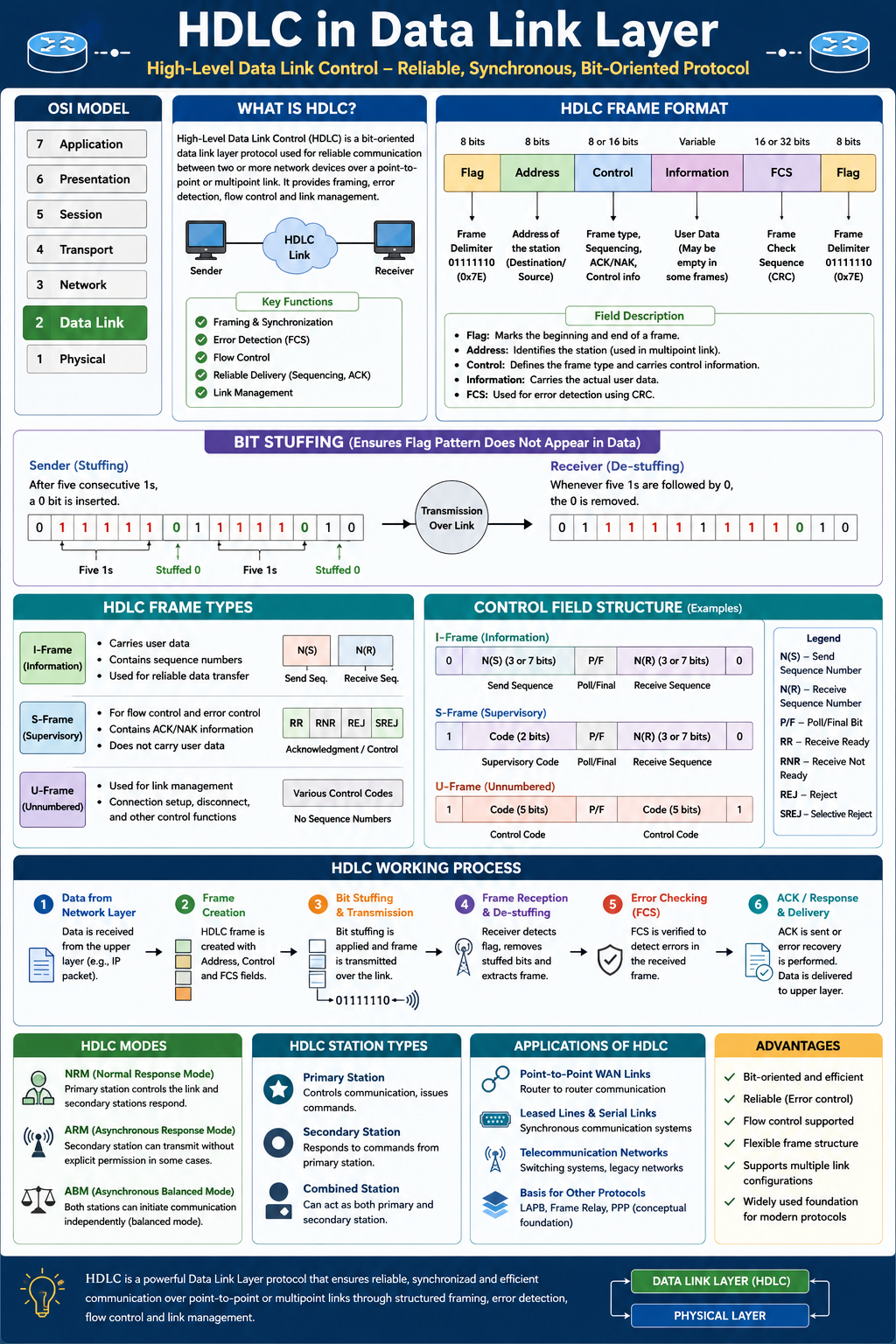
1. Introduction To HDLC In The Data Link Layer
High-Level Data Link Control (HDLC) Is A bit-oriented Data Link Layer Protocol Used For Reliable Communication Between Two Or More Network Devices Over A Data Communication Link. HDLC Operates At Layer 2 Of The OSI Model, Also Known As The Data Link Layer, And Is Designed To Provide Reliable Frame Delivery, Error Detection, Flow Control, And Efficient Synchronization Between Communicating Devices.
It Was Originally Developed By The International Organization For Standardization (ISO) And Is Based On Earlier Data Link Control Concepts Developed By IBM. HDLC Became An Important Foundation For Several Other Data Link Protocols And Influenced Technologies Such As Link Access Procedure Balanced (LAPB), Frame Relay, And Other WAN Communication Protocols.
Unlike Character-oriented Protocols, HDLC Treats Transmitted Information As A Sequence Of Bits, Making It Highly Flexible And Suitable For Synchronous Communication. Its Structured Frame Format Allows Network Devices To Identify The Beginning And End Of Frames While Maintaining Reliable Data Transmission Over Communication Links.
2. What Is HDLC?
HDLC Stands For High-Level Data Link Control. It Is A Synchronous, Bit-oriented Communication Protocol That Provides Mechanisms For Transferring Data Between Directly Connected Network Devices. The Primary Purpose Of HDLC Is To Encapsulate Network-layer Packets Into Frames And Transmit Those Frames Across A Physical Communication Medium. At The Data Link Layer, HDLC Performs Important Functions Such As Framing, Physical Addressing In Supported Implementations, Error Detection, Flow Control, And Link Management.
HDLC Can Operate In Point-to-point And Multipoint Communication Environments, Depending On The Configuration And Implementation. Because HDLC Is Bit-oriented, It Does Not Depend On Particular Character Codes Such As ASCII Or EBCDIC. Instead, It Uses Specific Bit Patterns To Control Frame Boundaries And Communication.
This Characteristic Makes HDLC Efficient For Transmitting Different Types Of Data. Although Modern Computer Networks Commonly Use Ethernet, PPP, And Wireless Technologies, HDLC Remains An Important Concept In Computer Networking Education And Is Still Relevant To Understanding Synchronous WAN Communication And The Design Of Many Related Protocols.
3. Role Of HDLC In The Data Link Layer
The Data Link Layer Is Responsible For Providing Reliable Node-to-node Communication Between Devices Connected Through The Same Physical Communication System. HDLC Fulfills Many Of These Responsibilities By Organizing Raw Bits Received From The Physical Layer Into Structured Frames.
When A Network-layer Packet Is Passed To HDLC, The Protocol Encapsulates The Information Into An HDLC Frame And Adds Control Information Required For Transmission And Error Detection. At The Receiving Device, HDLC Identifies The Frame Boundaries, Examines Control Information, Checks The Frame For Errors, And Passes The Recovered Data To The Appropriate Upper Layer. HDLC Therefore Acts As An Interface Between The Physical Layer And Network Layer.
Its Functions Include framing, Error Detection, Flow Control, Link Management, Frame Sequencing, And Reliable Delivery Mechanisms. By Providing These Services, HDLC Improves The Efficiency And Reliability Of Communication Across Potentially Noisy Or Error-prone Links. Understanding HDLC Is Particularly Useful For Students Studying The OSI Model, WAN Technologies, Computer Networks, Data Communication, And Network Protocol Design.
4. Main Objectives Of HDLC
The Major Objective Of HDLC Is To Provide An Organized And Reliable Mechanism For Transferring Data Frames Between Network Devices. One Of Its Primary Goals Is framing, Which Allows The Receiver To Determine Exactly Where A Data Frame Starts And Ends. HDLC Also Provides Error Detection Through A Frame Check Sequence (FCS), Helping The Receiver Identify Frames That May Have Been Corrupted During Transmission.
Another Important Objective Is Flow Control, Which Prevents A Fast Sender From Overwhelming A Slower Receiver. HDLC Also Supports Different Communication Modes And Configurations, Allowing It To Be Used In Various Network Environments.
Sequence Numbers And Acknowledgments Can Be Used To Maintain Reliable Communication And Ensure That Frames Are Delivered In The Correct Order. HDLC Additionally Provides Link-management Capabilities For Establishing, Maintaining, And Terminating Logical Communication Relationships.
These Features Make HDLC A Comprehensive Data Link Layer Protocol Rather Than Simply A Method For Encapsulating Data. Its Design Demonstrates How Layer 2 Protocols Can Provide Structured Communication Over An Underlying Physical Transmission System.
5. HDLC Frame Structure
An HDLC Frame Consists Of Several Fields That Perform Specific Functions During Communication. The Basic HDLC Frame Format Contains Flag, Address, Control, Information, And Frame Check Sequence (FCS) Fields, Followed By Another Flag Field. The Flag Field Is Normally Represented By The Eight-bit Pattern 01111110, Commonly Written As Hexadecimal 0x7E. It Identifies The Beginning And End Of An HDLC Frame.
The Address Field Identifies The Station Or Destination Involved In Communication. The Control Field Specifies The Type Of Frame And Contains Information Related To Sequencing, Acknowledgments, And Control Operations. The Information Field Carries The Actual User Data And May Not Be Present In Every Type Of HDLC Frame.
The FCS Field Is Used For Error Detection And Is Commonly Based On A Cyclic Redundancy Check Mechanism. The Closing Flag Marks The End Of The Frame. This Structured Format Enables Receiving Devices To Recognize And Process Transmitted Frames Efficiently.
6. Flag Field And Bit Stuffing In HDLC
The Flag Field Is One Of The Most Important Components Of HDLC Because It Provides Frame Synchronization. HDLC Uses The Bit Pattern 01111110 As A Delimiter Between Frames. However, The Same Sequence Could Potentially Occur Inside User Data. If The Receiver Incorrectly Interprets Data Bits As A Flag, Frame Boundaries Could Be Lost. To Prevent This Problem, HDLC Uses A Technique Known As bit Stuffing.
During Transmission, Whenever The Sender Encounters Five Consecutive 1 Bits Within The Data Portion Of A Frame, It Automatically Inserts A 0 Bit. The Receiver Monitors The Incoming Bit Stream And Removes The Inserted 0 Whenever It Detects Five Consecutive 1 Bits Followed By A 0. This Ensures That The Flag Pattern Does Not Accidentally Appear Within The Data Field.
Bit Stuffing Is A Key Characteristic Of Bit-oriented Protocols Such As HDLC. It Provides Transparency Because Users Can Transmit Arbitrary Binary Data Without Needing To Worry About Specific Character Or Byte Values Interfering With Frame Boundaries.
7. Address Field In HDLC
The Address Field Identifies The Station Associated With The Frame. In A Simple Point-to-point Connection, The Addressing Requirements May Be Relatively Straightforward Because Only Two Devices Are Communicating. In Multipoint Configurations, However, The Address Field Becomes More Important Because Multiple Secondary Stations May Share The Same Communication Link.
The Address Allows The Receiving Device To Determine Whether A Particular Frame Is Intended For It. The Exact Interpretation And Size Of The Address Field Can Vary According To The HDLC Implementation. In Traditional HDLC Terminology, Communication May Involve A primary Station, One Or More secondary Stations, And Sometimes Combined Stations.
The Primary Station Can Issue Commands, While Secondary Stations Generally Respond. Addressing Therefore Works Together With HDLC's Station Architecture And Control Mechanisms. In Practical Networking, Implementations Derived From HDLC May Modify The Addressing Model To Meet The Requirements Of Specific Technologies And Communication Environments.
8. Control Field And HDLC Frame Types
The Control Field Is Responsible For Carrying Important Information Related To Frame Classification, Sequencing, Acknowledgments, And Link Management.
HDLC Defines Three Major Frame Categories: Information Frames (I-frames), Supervisory Frames (S-frames), And Unnumbered Frames (U-frames). I-frames Are Primarily Used To Carry User Data And May Also Contain Sequence And Acknowledgment Information. S-frames Are Used For Supervisory Functions Such As Acknowledgment, Flow Control, And Error Recovery.
U-frames Are Used For Link Management And Control Operations That Do Not Require The Normal Sequence-numbering Mechanism Of I-frames. This Division Allows HDLC To Separate Data Transfer From Control And Management Functions.
The Control Field Is Therefore Central To HDLC Operation Because It Helps Communicating Devices Understand How Each Frame Should Be Processed. Depending On The Specific HDLC Mode And Implementation, The Control Field Can Contain Send Sequence Numbers, Receive Sequence Numbers, Polling Information, And Other Protocol-control Bits.
9. Information Field In HDLC
The Information Field Contains The Actual Payload Being Transmitted Through An HDLC Connection. For An I-frame, This Field Generally Carries Data Received From An Upper-layer Protocol, Such As A Network Layer Packet. The Size Of The Information Field Is Not Necessarily Fixed And Depends On The Implementation And Underlying Communication Technology.
Unlike Control-oriented Frames, Some HDLC Frames May Not Contain An Information Field At All. For Example, Certain Supervisory Frames Are Primarily Concerned With Acknowledgments, Flow Control, Or Error Recovery Rather Than Carrying User Data. The Ability To Separate Control Information From User Information Makes HDLC Efficient And Flexible.
The Information Field Can Carry Binary Data, Which Demonstrates One Of The Advantages Of A Bit-oriented Protocol. Since HDLC Does Not Depend On Character Encoding, It Can Support A Wide Variety Of Upper-layer Protocols And Data Formats. This Flexibility Contributed To The Influence Of HDLC Concepts On Many Subsequent Communication Protocols.
10. Frame Check Sequence And Error Detection
HDLC Provides Error Detection Using The Frame Check Sequence (FCS) Field. Transmission Errors Can Occur Because Of Electrical Interference, Noise, Signal Degradation, Synchronization Problems, Or Physical-layer Faults. When A Frame Is Transmitted, The Sender Calculates An Error-detection Value From The Frame Contents And Places The Result In The FCS Field. The Receiver Performs A Similar Calculation After Receiving The Frame.
If The Calculated Value Does Not Match The Received FCS, The Receiver Concludes That The Frame Has Probably Been Corrupted. The Damaged Frame Can Then Be Discarded Or Handled Through The Protocol's Error-recovery Mechanisms. HDLC Commonly Uses Cyclic Redundancy Check Techniques For This Purpose.
FCS Does Not Itself Correct Corrupted Data; Instead, It Helps Detect Errors So That Appropriate Recovery Procedures Can Take Place. This Separation Between Error Detection And Error Recovery Is An Important Concept In Data Link Layer Protocol Design.
11. Error Control In HDLC
HDLC Can Support Reliable Communication Through Acknowledgment, Sequencing, Retransmission, And Error-control Mechanisms. When Frames Are Transmitted Using Numbered Information Frames, The Receiving Station Can Indicate Which Frames Have Been Successfully Received.
If A Frame Is Lost Or Damaged, The Sender Can Retransmit It According To The Selected Error-control Procedure. This Approach Helps Maintain Data Integrity Across Communication Links. Sequence Numbers Are Particularly Important Because They Allow Devices To Determine The Order Of Transmitted Frames And Identify Missing Or Duplicate Frames.
HDLC Implementations Can Use Mechanisms Such As Go-Back-N And Related Sliding-window Concepts For Efficient Error Recovery. Instead Of Waiting For Every Individual Frame To Be Acknowledged Before Sending Another, Multiple Frames May Be Transmitted Within An Allowed Window.
This Improves Link Utilization, Especially On Long-delay Communication Paths. Consequently, HDLC Demonstrates How Reliable Communication Can Be Constructed At The Data Link Layer Using A Combination Of Framing, Sequencing, Acknowledgment, And Retransmission.
12. Flow Control In HDLC
Flow Control Ensures That The Sender Does Not Transmit Frames Faster Than The Receiver Can Process Them. Without Flow Control, A Fast Transmitting Device Could Overwhelm The Buffers Of A Slower Receiving Device, Resulting In Frame Loss. HDLC Addresses This Issue Using Supervisory Mechanisms And Window-based Transmission Strategies. The Receiver Can Communicate Its Ability To Accept Additional Frames Through Appropriate Control Information.
Sliding-window Techniques Allow Several Frames To Be Outstanding Before Acknowledgments Are Required, Providing A Balance Between Performance And Reliability. Flow Control Is Especially Important In Networks Where Devices Have Different Processing Capabilities Or Where Communication Links Introduce Significant Delays.
By Controlling The Amount Of Unacknowledged Data, HDLC Can Improve Overall Transmission Efficiency While Reducing The Possibility Of Buffer Overflow. Flow Control Therefore Represents Another Major Data Link Layer Responsibility Implemented Through HDLC's Control And Supervisory Frames.
13. Information Frames, Supervisory Frames, And Unnumbered Frames
HDLC's Three Primary Frame Types Provide A Logical Separation Between Data Transfer And Protocol Management. I-frames, Or Information Frames, Carry User Information And May Include Sequence Numbers Used For Reliable Transmission. S-frames, Or Supervisory Frames, Support Functions Such As Receiving Acknowledgments, Requesting Retransmission, And Managing Data Flow.
Examples Of Supervisory Operations Include Receive Ready (RR), Receive Not Ready (RNR), And Reject (REJ), Depending On The HDLC Mode And Implementation. U-frames, Or Unnumbered Frames, Perform Various Link-management And Control Functions. These May Be Used To Establish Or Disconnect A Logical Link, Exchange Protocol Information, Or Handle Special Control Operations.
This Three-category Structure Makes HDLC Versatile Because Different Frames Can Be Optimized For Different Tasks. The Receiver Examines The Control Field To Determine Which Type Of Frame Has Arrived And What Action Should Be Taken.
14. HDLC Communication Modes
HDLC Supports Different Communication Configurations, Including Normal Response Mode (NRM), Asynchronous Response Mode (ARM), And Asynchronous Balanced Mode (ABM). In Normal Response Mode, A Primary Station Controls Communication And Secondary Stations Generally Transmit Only When Permitted By The Primary Station. Asynchronous Response Mode Allows A Secondary Station To Transmit Without Receiving An Explicit Permission In Certain Situations, Although The Primary Station Maintains Overall Control.
Asynchronous Balanced Mode Is Particularly Important Because It Supports Balanced Communication Between Two Combined Stations, Allowing Either Station To Initiate Communication. ABM Is Associated With Protocols And Implementations Derived From HDLC And Is Conceptually Important For Point-to-point Communication.
These Modes Demonstrate The Flexibility Of HDLC's Station-management Architecture. The Choice Of Mode Depends On The Network Configuration, Device Roles, And Communication Requirements. Understanding These Modes Is Useful When Studying Traditional WAN Protocols And The Historical Development Of Layer 2 Communication Technologies.
15. HDLC Station Types
HDLC Traditionally Describes Network Devices In Terms Of primary, Secondary, And Combined Stations. A Primary Station Is Responsible For Controlling Communication And Transmitting Commands. A Secondary Station Operates Under The Control Of A Primary Station And Generally Responds To Commands.
A Combined Station Can Perform Both Command And Response Functions. The Station Architecture Enables HDLC To Support Different Types Of Network Relationships. In Point-to-point Communication, Two Combined Stations Can Communicate Using A Balanced Configuration. In Multipoint Communication, One Primary Station May Coordinate Communication With Several Secondary Stations.
These Concepts Are Particularly Important From An Academic Perspective Because They Explain How HDLC Manages Access To A Shared Communication Link. Although Many Modern Networks Use Different Architectures, The Station Model Remains Useful For Understanding The Principles Of Protocol Control, Link Management, Polling, Responses, And Balanced Communication.
16. HDLC Working Process
The HDLC Communication Process Begins When A Sender Prepares Data Received From An Upper-layer Protocol. The Data Is Placed Into An Appropriate HDLC Frame, Together With Addressing And Control Information.
An FCS Value Is Calculated And Added For Error Detection. During Transmission, Bit Stuffing Is Performed Whenever The Data Contains Five Consecutive 1 Bits. The Frame Is Then Transmitted Over The Physical Communication Medium. At The Receiving End, The Device Detects The Flag Field And Identifies The Incoming Frame.
It Removes Stuffed Bits, Examines The Address And Control Fields, Extracts The Information Field When Appropriate, And Verifies The FCS. If The Frame Is Valid, The Receiver Can Acknowledge It According To The Selected HDLC Procedure.
If An Error Is Detected, The Receiving Device Can Initiate An Appropriate Recovery Mechanism. This Complete Process Demonstrates How HDLC Converts A Raw Bit Stream Into A Controlled, Synchronized, And Reliable Communication System.
17. Advantages Of HDLC
HDLC Provides Several Advantages That Have Made It Historically Significant In Computer Networking. First, It Is bit-oriented, Allowing It To Transmit Arbitrary Binary Information Without Depending On Character Encoding. Second, Its Frame Structure Provides Clear Synchronization And Efficient Framing.
Third, HDLC Supports Error Detection Through FCS And Can Provide Reliable Recovery Using Acknowledgments And Retransmission. Fourth, Flow-control Mechanisms Help Prevent Receiver Overload. Fifth, Its Different Frame Types And Communication Modes Provide Flexibility For Various Network Configurations. HDLC Also Influenced Many Other Protocols, Making Its Concepts Valuable Beyond Direct HDLC Implementations.
Another Advantage Is Its Relatively Efficient Use Of Bandwidth Because Control Information Is Integrated Into Structured Frames. However, Modern Networks May Use Alternative Protocols That Provide Better Interoperability, Configuration Flexibility, Security, Or Support For Contemporary Network Environments. Nevertheless, HDLC Remains An Important Protocol For Understanding The Fundamentals Of Reliable Data Link Layer Communication.
18. Limitations Of HDLC
Despite Its Technical Strengths, HDLC Has Several Limitations In Modern Networking Environments. One Limitation Is That Traditional HDLC Does Not Provide Comprehensive Authentication And Encryption Mechanisms Comparable To Modern Secure Networking Protocols. Another Limitation Is Interoperability: Different Vendors And Network Technologies May Implement HDLC-related Features Differently.
HDLC Is Also Primarily Associated With Synchronous Communication Links And Has Been Largely Replaced In Many General-purpose Networking Applications By Technologies Such As Ethernet And PPP. Furthermore, Traditional HDLC Was Designed Around Communication Models That May Not Directly Match Today's Highly Dynamic, Packet-switched, Wireless, And Cloud-based Networks.
Network Administrators May Therefore Choose Protocols With Stronger Standardization, Authentication, Multilink Capabilities, Or Better Support For IP-based Environments. Even With These Limitations, HDLC Remains Valuable For Educational Purposes, Legacy Systems, Specialized WAN Environments, And Understanding The Historical Development Of Modern Data Link Layer Protocols.
19. HDLC Vs. PPP
HDLC And Point-to-Point Protocol (PPP) Are Both Associated With Data Link Layer Communication Over Point-to-point Links, But They Have Important Differences. HDLC Provides A Structured, Bit-oriented Framing Mechanism And Traditionally Focuses On Efficient Synchronous Communication.
PPP Was Designed Specifically For Point-to-point Connections And Offers Features Such As Link Establishment, Authentication, And Support For Multiple Network Layer Protocols. PPP Uses A More Standardized Framework For Negotiating Link Parameters And Network-layer Configuration. HDLC Is Therefore Particularly Useful For Understanding Fundamental Framing, Sequencing, Flow Control, And Error-control Concepts, While PPP Is More Suitable For Environments Requiring Standardized Negotiation And Authentication Features.
Many Networking Technologies Have Historically Adopted HDLC-derived Framing Concepts While Adding Specialized Functionality. Comparing HDLC And PPP Helps Students Understand How Protocols Evolve To Address Changing Networking Requirements. Both Demonstrate The Importance Of The Data Link Layer In Providing Controlled Communication Over Physical Connections.
20. Applications And Conclusion Of HDLC
HDLC Has Historically Been Used In wide Area Networks (WANs), Leased Lines, Point-to-point Communication Links, Telecommunications Systems, And Router-to-router Connections. Although Many Modern Networks Have Moved Toward Ethernet, MPLS, PPP, And Other Technologies, HDLC Remains An Important Topic In Computer Networking Because It Introduced And Formalized Many Fundamental Data Link Layer Concepts.
Its Use Of Frames, Flags, Bit Stuffing, Control Fields, Sequence Numbers, Acknowledgments, FCS, Flow Control, And Error Recovery Provides A Strong Foundation For Understanding Layer 2 Protocols. For Students, Network Engineers, And Researchers, Studying HDLC Makes It Easier To Understand How Reliable Communication Can Be Achieved Over A Physical Transmission Medium.
In Summary, HDLC Is A Bit-oriented Data Link Layer Protocol Designed For Efficient, Synchronized, And Reliable Frame Transmission. Its Historical Influence Extends To Several Protocols And WAN Technologies, Making HDLC An Essential Subject In Computer Networks, Data Communication, Networking Courses, And Technical Examinations.
Tags:
HDLC, High Data Link Control, HDLC Data Link Layer, HDLC Data Link Layer