HTTPS: Definition, Architecture, Working, Security, And Advanced Concepts
Category: NETWORKING | 17th August 2026, Monday
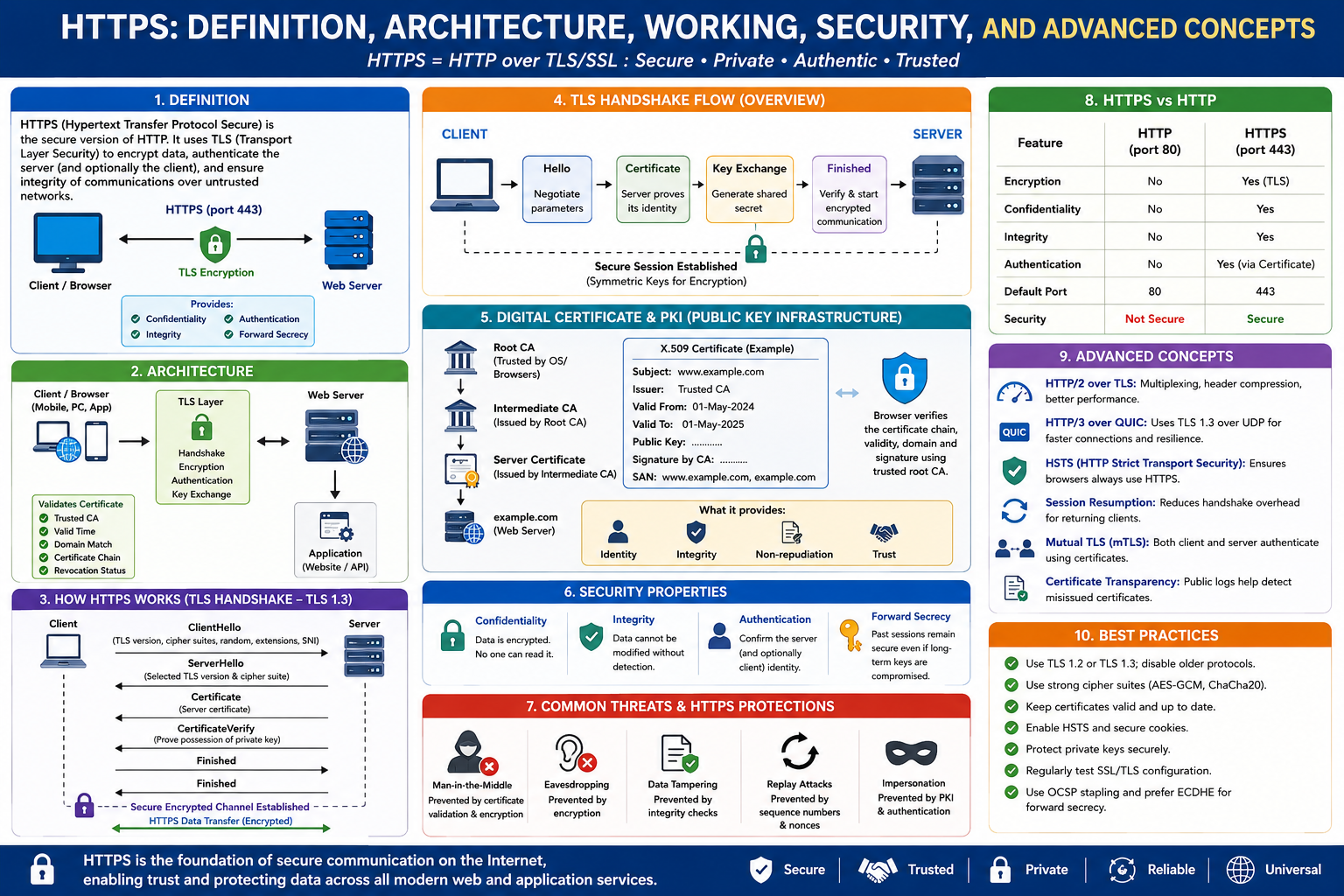
1. Introduction
HTTPS, Or Hypertext Transfer Protocol Secure, Is The Secure Version Of HTTP Used For Communication Between Web Browsers, Mobile Applications, APIs, And Web Servers. It Protects Data Exchanged Over A Network By Combining HTTP With TLS (Transport Layer Security). HTTPS Is Fundamental To Modern Web Security Because It Prevents Attackers From Easily Reading, Modifying, Or Impersonating Communications Between A Client And A Server.
When A User Visits A Website Such As https://example.com, The Browser Establishes A Secure TLS Connection With The Web Server Before HTTP Application Data Is Exchanged. HTTPS Is Widely Used For Online Banking, E-commerce, Cloud Applications, Social Networks, Authentication Systems, APIs, And Virtually All Modern Websites.
At A Master's Level, HTTPS Should Be Understood Not Simply As "HTTP With Encryption," But As A Security Architecture Providing confidentiality, Integrity, Authentication, And Protection Against Several Classes Of Network Attacks.
2. Definition Of HTTPS
HTTPS Is An Application-layer Protocol That Transports HTTP Messages Over A Cryptographically Protected TLS Connection.
Conceptually:
HTTPS = HTTP + TLS
HTTP Itself Does Not Inherently Provide Confidentiality Or Server Authentication. Traditional HTTP Generally Transmits Information In Plaintext. An Attacker Positioned Between The Client And Server Could Potentially Observe, Modify, Or Inject Traffic.
HTTPS Addresses These Problems By Using TLS To Establish A Secure Communication Channel.
For Example:
Client/Browser
      |
      |  TLS-secured HTTP Communication
      |
      V
Web Server
HTTPS Normally Uses TCP Port 443, Although HTTP Over Other Transport Mechanisms And Modern Protocols Such As HTTP/3 Use Different Underlying Transport Technologies.
3. Why HTTPS Is Required
The Internet Is An Untrusted Communication Environment. Data May Travel Through Multiple Networks, Routers, Wireless Access Points, Internet Service Providers, And Intermediary Systems.
Without Encryption, An Attacker Could Potentially Perform A Man-in-the-Middle (MITM) Attack.
For Example, Suppose A User Submits:
Username: Student123
Password: MyPassword
over An Unencrypted HTTP Connection. A Network Attacker Could Potentially Capture The Transmitted Information.
HTTPS Protects The Communication By Encrypting The Application Data:
Plain HTTP Data
      ↓
TLS Encryption
      ↓
Ciphertext
      ↓
Internet
      ↓
TLS Decryption
      ↓
Original HTTP Data
Therefore, HTTPS Provides Important Protection Against Network Interception And Manipulation.
4. Security Properties Of HTTPS
HTTPS Primarily Provides Four Important Security Properties.
4.1 Confidentiality
Confidentiality Means Unauthorized Parties Should Not Be Able To Understand The Transmitted Data.
TLS Encrypts Application Data So That Intercepted Packets Contain Ciphertext Rather Than Readable HTTP Content.
For Example:
HTTP:
GET /account?user=123

HTTPS:
Encrypted TLS Application Data
An Attacker May Still Observe Some Metadata, Such As IP Addresses And Traffic Timing, But Cannot Normally Read The Protected HTTP Payload.
4.2 Integrity
Integrity Ensures That Transmitted Information Is Not Secretly Modified During Communication.
For Example, An Attacker Should Not Be Able To Change:
Transfer: ?1,000into:
Transfer: ?100,000without The Modification Being Detected.
TLS Uses Cryptographic Authentication Mechanisms, Including Authenticated Encryption, To Detect Unauthorized Modifications.
4.3 Authentication
HTTPS Can Authenticate The Server Using A digital Certificate Issued Through The Public Key Infrastructure (PKI).
When Connecting To A Website, The Browser Verifies Whether The Server's Certificate Is Trustworthy, Valid, And Appropriate For The Requested Domain.
This Helps Prevent An Attacker From Pretending To Be The Legitimate Website.
4.4 Forward Secrecy
Modern TLS Configurations Generally Use Ephemeral Key Exchange Mechanisms Such As ECDHE (Elliptic Curve Diffie-Hellman Ephemeral).
This Provides Forward Secrecy: Compromise Of A Server's Long-term Private Key Should Not Allow An Attacker To Decrypt Previously Recorded TLS Sessions When Ephemeral Session Keys Were Properly Used.
5. HTTPS Architecture
The Major Components Involved In HTTPS Include:
- Client/browser
- Web Server
- TLS Protocol
- Digital Certificate
- Certificate Authority (CA)
- Public And Private Keys
- Symmetric Session Keys
- Cryptographic Algorithms
The General Architecture Is:
+------------------+
| Browser / Client |
+------------------+
          |
          | HTTPS
          |
     +----------+
     |   TLS    |
     +----------+
          |
          V
+------------------+
|   Web Server     |
+------------------+
          |
          V
+------------------+
| Application      |
| / Database       |
+------------------+
TLS Operates Below The HTTP Application Protocol And Provides The Secure Channel Over Which HTTP Messages Are Transmitted.
6. TLS And HTTPS
TLS Is The Cryptographic Protocol Responsible For Securing HTTPS.
The Original SSL Protocol Was Developed Before TLS And Is Now Obsolete. Modern HTTPS Deployments Should Use Current TLS Versions, Particularly TLS 1.2 Or TLS 1.3, Depending On Compatibility And Security Requirements.
TLS Provides Mechanisms For:
- Server Authentication
- Key Establishment
- Encryption
- Message Integrity
- Secure Session Management
The Security Of HTTPS Therefore Depends Heavily On Correct TLS Configuration.
7. TLS Handshake
One Of The Most Important Concepts At Master's Level Is The TLS Handshake.
The Handshake Establishes The Cryptographic Parameters Required For Secure Communication.
A Simplified TLS 1.3 Handshake Can Be Represented As:
Client                         Server
  |                              |
  |------ ClientHello ---------->|
  |                              |
  |<----- ServerHello -----------|
  |<----- Certificate ------------|
  |<----- CertificateVerify ------|
  |<----- Finished --------------|
  |                              |
  |------ Finished ------------->|
  |                              |
  |==== Encrypted HTTP Data =====|
ClientHello
The Client Sends Information Such As:
- Supported TLS Versions
- Supported Cryptographic Algorithms
- Random Values
- Key-exchange Information
- Supported Extensions
- Server Name Indication (SNI)
ServerHello
The Server Selects Appropriate Cryptographic Parameters And Responds.
Certificate
The Server Normally Provides A Certificate Containing Its Public Key And Identity Information.
Certificate Verification
The Client Verifies The Certificate Chain And Confirms That The Certificate Is Valid For The Requested Hostname.
Key Establishment
The Client And Server Establish Shared Cryptographic Secrets Using A Secure Key-exchange Mechanism.
Finished Messages
Both Sides Verify That The Handshake Has Not Been Manipulated.
After Successful Completion, Encrypted Application Data Can Be Exchanged.
8. Digital Certificates
A Digital Certificate Binds An Identity, Typically A Domain Name, To A Public Key.
An X.509 Certificate Can Contain Information Such As:
- Subject
- Subject Alternative Names (SANs)
- Issuer
- Public Key
- Validity Period
- Serial Number
- Signature Algorithm
- Certificate Authority Signature
For Example:
Domain: Example.com
Issuer: Trusted CA
Public Key: ...
Valid From: ...
Valid To: ...
Signature: ...
The Browser Uses The Certificate To Help Establish Confidence That The Server Is Associated With The Requested Domain.
9. Certificate Authorities And PKI
HTTPS Relies On Public Key Infrastructure (PKI).
The PKI Ecosystem Includes:
Root CA
   |
Intermediate CA
   |
Server Certificate
   |
Example.com
A Browser Or Operating System Contains A Trust Store Containing Trusted Root Certificates.
When A Server Presents A Certificate, The Browser Attempts To Construct A Valid Chain From The Server Certificate To A Trusted Root.
The Browser Checks Factors Such As:
- Certificate Validity
- Domain Name
- Certificate Chain
- Digital Signatures
- Key Usage
- Certificate Constraints
- Revocation-related Information Where Applicable
If Validation Fails, The Browser May Display A Security Warning.
10. Symmetric And Asymmetric Cryptography
HTTPS Uses Both Asymmetric And Symmetric Cryptography, But For Different Purposes.
Asymmetric Cryptography
Asymmetric Cryptography Uses A Key Pair:
Public Key
Private Key
The Private Key Must Remain Secret.
Public-key Cryptography Is Particularly Important For Authentication And Key Establishment.
Symmetric Cryptography
Symmetric Cryptography Uses The Same Secret Key For Encryption And Decryption.
Examples Of Modern Authenticated Encryption Algorithms Include:
- AES-GCM
- ChaCha20-Poly1305
Symmetric Encryption Is Computationally Efficient And Therefore Suitable For Protecting Large Amounts Of Application Data.
In Simplified Form:
TLS Handshake
      ↓
Establish Shared Secret
      ↓
Derive Session Keys
      ↓
Encrypt HTTP Traffic
11. HTTPS Request And Response
Once TLS Has Been Established, HTTP Operates Inside The Encrypted TLS Channel.
For Example, The Logical HTTP Request May Be:
GET /index.html HTTP/1.1
Host: Example.com
However, Network Observers Do Not Normally See The HTTP Request In Plaintext When It Is Transported Through HTTPS.
The Server Decrypts And Processes The Request, Then Sends An Encrypted HTTP Response.
Browser
   |
   | Encrypted HTTP Request
   V
TLS Layer
   |
   V
Web Server
   |
   | Encrypted HTTP Response
   V
Browser
12. HTTPS And HTTP/2
HTTPS Is Commonly Used With HTTP/2.
HTTP/2 Introduces Improvements Such As:
- Binary Framing
- Multiplexing
- Header Compression
- Stream Prioritization Mechanisms
- Multiple Requests Over A Single Connection
TLS Protects The Communication Channel While HTTP/2 Manages Application-level Request And Response Transport.
13. HTTPS And HTTP/3
HTTP/3 Differs Significantly Because It Uses QUIC, Which Operates Over UDP Rather Than TCP.
Conceptually:
HTTP/1.1 → TCP + TLS
HTTP/2   → TCP + TLS
HTTP/3   → QUIC + TLS 1.3
QUIC Integrates TLS 1.3 Into Its Connection Establishment And Provides Features Such As Stream Multiplexing And Improved Connection Handling.
Thus, HTTPS Should Be Understood As A Security Concept That Can Operate With Different Generations Of HTTP And Transport Technologies.
14. HTTPS Does Not Encrypt Everything
A Common Misconception Is That HTTPS Makes All Information About A Connection Completely Invisible.
HTTPS Protects HTTP Application Data, But Some Metadata Can Remain Observable.
Depending On The Protocol And Configuration, An Observer May Potentially Determine:
- Source IP Address
- Destination IP Address
- Connection Timing
- Traffic Volume
- Some DNS Information
- Other Network-level Metadata
Technologies Such As Encrypted DNS And Newer TLS Features Can Reduce Some Metadata Exposure, But HTTPS Itself Should Not Be Considered Complete Anonymity.
15. Common HTTPS Attacks
HTTPS Significantly Improves Security, But It Does Not Eliminate All Attacks.
Man-in-the-Middle Attack
An Attacker Attempts To Intercept And Manipulate Communication.
TLS Certificate Validation And Cryptographic Authentication Are Designed To Prevent An Attacker From Successfully Impersonating The Legitimate Server.
SSL/TLS Downgrade Attacks
An Attacker May Attempt To Force Communication Toward Weaker Protocol Versions Or Cryptographic Configurations.
Modern Security Configurations Disable Obsolete Protocols And Algorithms.
Certificate Misconfiguration
Incorrect Certificates, Expired Certificates, Invalid Certificate Chains, Or Hostname Mismatches Can Cause Browser Warnings Or Security Failures.
Weak TLS Configuration
Using Obsolete Protocols, Weak Cipher Suites, Poor Key Management, Or Insecure Server Configurations Can Weaken HTTPS.
Application-Layer Attacks
HTTPS Cannot Prevent Vulnerabilities In The Application Itself.
Examples Include:
- SQL Injection
- Cross-Site Scripting (XSS)
- Cross-Site Request Forgery (CSRF)
- Broken Authentication
- Authorization Vulnerabilities
- Server-side Request Forgery
HTTPS Protects Communication; It Does Not Automatically Make The Application Secure.
16. HSTS
HTTP Strict Transport Security (HSTS) Is A Security Mechanism That Instructs Browsers To Communicate With A Website Only Through HTTPS.
A Server Can Send A Policy Such As:
Strict-Transport-Security:
Max-age=31536000; IncludeSubDomains
HSTS Helps Reduce Attacks Involving Accidental HTTP Connections And Certain Downgrade Or SSL-stripping Scenarios.
A Carefully Configured HSTS Policy Can Be An Important Component Of Web Security.
17. HTTPS And Cookies
HTTPS Is Especially Important For Protecting Authentication Cookies.
Secure Cookies Can Be Configured Using:
Set-Cookie: Sessionid=abc123; Secure; HttpOnly; SameSite=LaxSecure
The Cookie Should Only Be Transmitted Over HTTPS.
HttpOnly
JavaScript Cannot Directly Access The Cookie Through Normal Browser APIs, Reducing Some Cookie-theft Risks From XSS.
SameSite
Controls When Cookies Are Sent In Cross-site Contexts And Can Help Mitigate Certain CSRF Scenarios.
HTTPS And Secure Cookie Configuration Should Therefore Be Considered Together.
18. HTTPS Performance Considerations
Encryption Introduces Computational Work, But Modern Hardware And Optimized TLS Implementations Make The Performance Cost Relatively Small For Most Applications.
TLS 1.3 Improves Connection Establishment By Reducing Handshake Latency Compared With Older TLS Versions.
Performance Can Also Be Improved Through:
- Persistent Connections
- HTTP/2
- HTTP/3
- Session Resumption
- Efficient Cryptographic Implementations
- Proper Server Configuration
- Content Caching
Modern Websites Generally Should Not Avoid HTTPS Because Of Performance Concerns.
19. HTTPS In APIs And Distributed Systems
HTTPS Is Not Limited To Web Pages. It Is Also Fundamental To:
- REST APIs
- GraphQL APIs
- Microservices
- Mobile Applications
- Cloud Services
- Authentication Systems
- Payment Gateways
- IoT Platforms
For Example:
Mobile App
     |
     | HTTPS API Request
     V
API Gateway
     |
     | HTTPS / Secure Internal Communication
     V
Microservice
     |
     V
Database
In Large Distributed Systems, Organizations May Use Additional Mechanisms Such As mutual TLS (mTLS).
With MTLS, Both The Client And Server Authenticate Using Certificates.
Client Certificate ↔ Server CertificateThis Is Useful In Service-to-service Authentication And Zero-trust Architectures.
20. HTTPS And Zero Trust Security
In Modern Enterprise Environments, HTTPS/TLS Is Often Part Of A Broader Zero Trust Architecture.
Zero Trust Assumes That Network Location Alone Should Not Establish Trust.
Instead, Systems Continuously Verify:
- Identity
- Device Status
- Application Identity
- Authorization
- Connection Security
- Contextual Security Policies
TLS Provides Secure Transport, While Identity And Authorization Systems Provide Additional Security Controls.
21. Limitations Of HTTPS
HTTPS Is Extremely Important But Has Limitations.
It Does Not Automatically Protect Against:
- Vulnerable Web Applications
- Compromised Servers
- Malware On Endpoints
- Phishing Websites With Valid Certificates
- Stolen Credentials
- Weak Authentication
- Poor Authorization
- Insider Threats
- DNS-related Attacks In Certain Environments
- Traffic-analysis Attacks
A Phishing Website Can Have A Perfectly Valid HTTPS Certificate. Therefore:
HTTPS Does Not Mean That A Website Is Trustworthy; It Primarily Means That The Connection Is Cryptographically Protected And The Server Identity Has Passed The Relevant Certificate Validation Process.
22. HTTPS Security Best Practices
Organizations Should Follow Several Practices:
- Use Modern TLS Versions.
- Disable Obsolete SSL/TLS Versions.
- Use Strong Cryptographic Algorithms.
- Use Valid Certificates.
- Protect Private Keys Carefully.
- Configure Certificate Chains Correctly.
- Enable HSTS Where Appropriate.
- Redirect HTTP To HTTPS Carefully.
- Use Secure Cookies.
- Implement Strong Authentication.
- Monitor Certificate Expiration.
- Regularly Test TLS Configuration.
- Keep Web Servers And TLS Libraries Updated.
- Use Appropriate Security Headers.
- Implement Application-level Security Controls.
23. HTTPS Vs HTTP
| Feature | HTTP | HTTPS |
|---|---|---|
| Encryption | No | Yes |
| Confidentiality | No | Yes |
| Integrity Protection | No | Yes |
| Server Authentication | No Built-in TLS Authentication | Yes, Through TLS Certificates |
| Typical Port | 80 | 443 |
| Protection Against Network Interception | Very Limited | Strong |
| Modern Web Usage | Limited | Standard |
The Fundamental Difference Is That HTTPS Adds A Cryptographically Protected TLS Layer Around HTTP Communication.
24. Master's-Level Security Perspective
At The Master's Level, HTTPS Should Be Viewed As A Combination Of protocol Engineering, Applied Cryptography, Authentication, Network Security, And Systems Security.
Its Security Depends On Several Interacting Layers:
Application Security
       ↓
HTTP Security
       ↓
TLS Security
       ↓
Cryptographic Security
       ↓
Key Management
       ↓
PKI / Certificate Trust
       ↓
Operating System / Hardware Security
A Weakness At Any Layer Can Undermine The Overall Security Objective.
For Example, Strong TLS Cannot Compensate For A Stolen Server Private Key Or An Application Vulnerability That Exposes User Credentials.
Therefore, HTTPS Should Be Treated As One Component Of A Comprehensive Defense-in-depth Strategy.
25. Conclusion
HTTPS Is The Foundation Of Secure Web Communication. It Combines HTTP With TLS To Provide confidentiality, Integrity, Authentication, And, With Modern Key-exchange Mechanisms, Forward Secrecy. Digital Certificates And PKI Help Browsers Authenticate Servers, While Symmetric Session Encryption Efficiently Protects Application Data.
Modern Versions Of TLS, Particularly TLS 1.3, Provide Substantial Improvements In Security And Performance. HTTPS Also Works With Modern Web Protocols Such As HTTP/2 And HTTP/3, Making It An Essential Component Of Contemporary Internet Infrastructure.
However, HTTPS Is Not A Complete Cybersecurity Solution. It Protects Communication Between Endpoints But Does Not Eliminate Application Vulnerabilities, Compromised Devices, Phishing, Stolen Credentials, Or Malicious Servers. Effective Security Therefore Requires HTTPS To Be Combined With Secure Software Development, Authentication, Authorization, Endpoint Protection, Monitoring, Access Control, And Proper Key Management.
From A Master's-level Cybersecurity Perspective, HTTPS Is Best Understood As A cryptographically Secured Communication Framework Built On TLS And PKI That Establishes Trust And Protects Data While It Travels Across Potentially Hostile Networks.
Tags:
HTTPS Definition, HTTPS Architecture, HTTPS Working, HTTPS Security, And HTTPS Advanced Concepts