ICMP: Definition, Working, Uses, Applications, Types, And Importance
Category: NETWORKING | 29th August 2026, Saturday
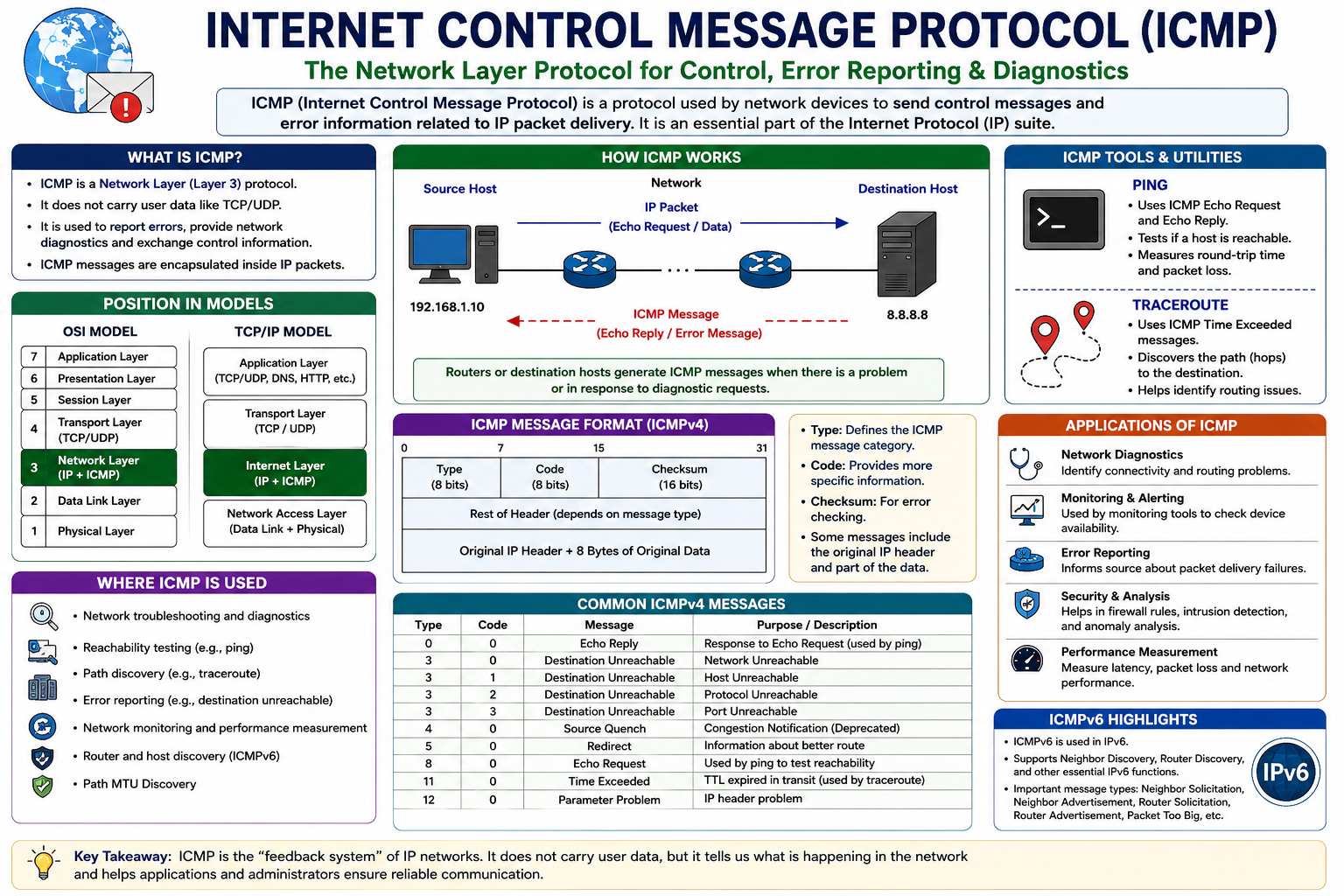
Introduction To ICMP
ICMP (Internet Control Message Protocol) Is An Important Protocol Used In IP-based Computer Networks For Sending Control, Diagnostic, Error-reporting, And Status Messages. ICMP Works Closely With The Internet Protocol (IP) And Is Commonly Associated With The Network Layer (Layer 3) Of The OSI Model. Unlike TCP And UDP, ICMP Is Not Designed To Carry Application Data Between Users.
Instead, It Helps Network Devices And Hosts Communicate Information About Network Conditions, Delivery Problems, Reachability, And Routing-related Events. Tools Such As ping And traceroute Depend Heavily On ICMP Functionality Or ICMP-related Behavior To Diagnose Network Connectivity.
What Is ICMP?
ICMP Stands For Internet Control Message Protocol. It Is A Protocol Defined For Exchanging Control And Error Information In IP Networks. When An IP Packet Cannot Be Delivered Successfully, A Router Or Destination System May Generate An ICMP Message To Inform The Source About The Problem.
For Example, If A Destination Host Cannot Be Reached, An ICMP Destination Unreachable Message May Be Generated. ICMP Therefore Provides Feedback About The Operation Of IP Communication. It Is Important To Understand That ICMP Does Not Provide Reliable Data Transmission Itself; Its Primary Purpose Is Network Control And Diagnostics.
ICMP And The Network Layer
ICMP Is Closely Associated With The Network Layer Because It Operates Alongside IP And Communicates Information About IP Packet Delivery. In The TCP/IP Model, ICMP Is Generally Considered Part Of The Internet Layer. IP Provides The Basic Mechanism For Addressing And Forwarding Packets, While ICMP Provides Messages Concerning The Status Or Problems Associated With That Delivery.
For This Reason, ICMP Is Frequently Discussed As A Network Layer Protocol In Computer-networking Courses. Understanding ICMP Is Essential For Understanding How IP Networks Identify And Report Communication Problems.
Main Objective Of ICMP
The Main Objective Of ICMP Is To Provide error Reporting, Network Diagnostics, And Control Information Related To IP Communication. IP Itself Follows A Best-effort Delivery Model And Does Not Guarantee That Every Packet Will Reach Its Destination. When A Problem Occurs, ICMP Can Provide Feedback To The Sender.
For Example, A Router May Send An ICMP Message When A Destination Network Is Unreachable Or When A Packet's TTL Expires. This Feedback Allows Network Administrators, Operating Systems, And Diagnostic Tools To Understand What Is Happening Within The Network.
Why ICMP Is Necessary
IP Is Intentionally Designed As A Relatively Simple Packet-delivery Protocol. It Does Not Establish A Connection Before Transmitting Every Packet And Does Not Normally Provide Detailed Explanations When Delivery Fails. ICMP Fills This Communication Gap. Suppose A Router Receives A Packet For A Network That It Cannot Reach.
Instead Of Silently Discarding The Packet, The Router May Generate An ICMP Error Message Indicating That The Destination Is Unreachable. This Information Can Help The Sender Or Administrator Identify The Problem And Take Corrective Action.
How ICMP Works
ICMP Generally Works By Generating A Message In Response To An IP-related Event Or By Sending A Diagnostic Request. Consider A Host Attempting To Communicate With Another Host. The Original IP Packet Is Processed By Routers Along Its Path.
If A Forwarding Problem Occurs, An Appropriate ICMP Message May Be Generated And Sent Back Toward The Source. The Source System Can Then Examine The ICMP Information And Determine That The Original Packet Encountered A Particular Problem. Diagnostic Applications Can Also Intentionally Generate ICMP Messages To Test Connectivity.
ICMP Message Structure
An ICMP Message Is Carried Inside An IP Packet. An ICMP Message Generally Contains Fields Such As Type, Code, And Checksum, Followed By Additional Information Specific To The Particular ICMP Message. The Type Field Identifies The Broad Category Of The Message, While The Code Field Provides More Specific Information About The Condition.
Different ICMP Versions Have Different Message Formats And Capabilities. For Example, ICMPv4 Is Used With IPv4, While ICMPv6 Is Designed Specifically For IPv6 Networks And Performs Several Functions That Are Fundamental To IPv6 Operation.
ICMP Echo Request And Echo Reply
One Of The Most Familiar Uses Of ICMP Is The Echo Request And Echo Reply Mechanism. A Computer Can Send An ICMP Echo Request To Another Device And Wait For An ICMP Echo Reply. If The Reply Is Received, The Sender Has Evidence That The Destination Is Reachable And Responding To ICMP Echo Messages.
The Popular ping Utility Uses This Mechanism. For Example, Executing ping 8.8.8.8 On A Suitable System May Cause ICMP Echo Requests To Be Sent To That IP Address. A Responding Host Can Return Echo Replies.
The Ping Utility
The ping Command Is One Of The Most Important Practical Applications Of ICMP. Network Administrators And Users Can Use Ping To Test Whether An IP Destination Is Reachable And Responsive. It Can Also Provide Information About round-trip Time (RTT), Which Represents Approximately How Long It Takes For A Request To Travel To The Destination And The Response To Return.
Packet Loss May Also Be Observed During Repeated Tests. However, Failure To Respond To Ping Does Not Necessarily Prove That A Host Is Offline Because Firewalls And Security Policies May Intentionally Block ICMP Echo Messages.
Destination Unreachable Messages
Another Important Category Of ICMP Messages Is Destination Unreachable. A Router Or Destination System May Generate An ICMP Destination Unreachable Message When A Packet Cannot Be Delivered Under Certain Conditions.
Possible Reasons Include An Unreachable Network, Unreachable Host, Inaccessible Protocol Or Port, Or Other Delivery-related Conditions Depending On The ICMP Version And Message Definition. Such Messages Provide Useful Feedback To The Sender. Network Administrators Can Use Them To Investigate Routing, Connectivity, Filtering, And Service-access Problems.
Time Exceeded Messages
ICMP Time Exceeded Messages Are Particularly Important For Diagnosing Routing Paths. IPv4 Packets Contain A TTL Field That Is Decreased By Routers As Packets Are Forwarded. If The TTL Reaches Zero Before The Packet Reaches Its Destination, The Router Discards The Packet And Can Send An ICMP Time Exceeded Message To The Source.
IPv6 Uses A Hop Limit Field And ICMPv6 Has Corresponding Functionality. This Mechanism Prevents Packets From Circulating Indefinitely And Also Supports Network Diagnostic Techniques.
Traceroute And ICMP
The traceroute Utility Is Another Major Application Associated With ICMP Behavior. It Attempts To Discover The Sequence Of Routers Between A Source And Destination. A Traditional Traceroute Implementation Can Send Packets With Progressively Increasing TTL Values.
When A Router Reduces The TTL To Zero, It May Generate An ICMP Time Exceeded Message. By Examining The Source Of These Responses, Traceroute Can Identify Intermediate Hops. Different Operating Systems And Implementations May Use Different Probe Protocols, Including UDP, ICMP Echo, Or TCP, So Traceroute Is Not Exclusively An ICMP Application.
ICMP Error Reporting
Error Reporting Is One Of ICMP's Fundamental Purposes. When An IP Packet Cannot Be Delivered Because Of Certain Network Conditions, An ICMP Error Message Can Communicate The Problem To The Originating System. Examples Include Destination-unreachable Conditions, Time-exceeded Conditions, And Certain Parameter-related Errors.
This Is Especially Valuable Because IP Itself Generally Does Not Provide A Built-in Mechanism For Explaining Why A Packet Was Discarded. ICMP Therefore Improves The Observability Of IP Networks By Communicating Information About Delivery Failures.
ICMP And Routing Problems
ICMP Can Help Identify Certain Routing Problems. If A Router Does Not Have A Suitable Route To A Destination, It May Generate An ICMP Message Indicating An Unreachable Condition. Similarly, TTL Or Hop Limit Expiration Can Reveal Potential Routing Loops Or Unexpectedly Long Paths.
Network Administrators Can Analyze ICMP Responses Alongside Routing Tables, Packet Captures, And Other Diagnostic Information. ICMP Does Not Itself Solve Every Routing Problem, But Its Messages Can Provide Valuable Evidence When Troubleshooting Routing And Forwarding Behavior.
ICMP Redirect
Some ICMP Implementations Support Redirect Messages. An ICMP Redirect Can Inform A Host That A Better Next-hop Router Is Available For A Particular Destination. The Intention Is To Improve Routing Behavior Within An Appropriate Network Environment.
However, Because Redirect Messages Can Have Security Implications, Modern Network Configurations May Restrict Or Disable Their Use. Administrators Should Therefore Understand Both The Operational Purpose And Security Considerations Of ICMP Redirect Messages Before Relying On Them.
ICMP And Network Troubleshooting
ICMP Is Widely Used In network Troubleshooting. When A User Reports That A Website, Server, Or Network Service Cannot Be Accessed, An Administrator Can Use Tools Such As Ping And Traceroute To Investigate Connectivity. Ping Can Help Determine Whether An IP Address Responds, While Traceroute Can Reveal Intermediate Routing Behavior.
ICMP Error Messages Can Also Provide Clues About Delivery Problems. Network Troubleshooting Normally Requires More Than ICMP Alone, However; DNS Testing, TCP Connection Tests, Routing-table Inspection, Firewall Analysis, And Packet Capture May Also Be Necessary.
ICMP And Network Monitoring
Network Monitoring Systems Can Use ICMP To Check Whether Devices Are Responding. A Monitoring Platform May Periodically Send ICMP Echo Requests To Routers, Servers, Switches With IP Interfaces, Or Other Networked Devices. If Responses Stop Arriving, The Monitoring System Can Generate An Alert.
ICMP Monitoring Is Useful For Determining Basic Network Reachability And Availability. However, An ICMP Response Only Confirms That The Device Or Network Path Is Responding To That Particular Type Of Traffic; It Does Not Necessarily Mean That Every Application Or Service On The Device Is Functioning Correctly.
ICMP And Availability Testing
Organizations Can Use ICMP To Perform Basic availability Testing. For Example, An Administrator Might Monitor A Server's IP Address At Regular Intervals And Record Response Times And Packet Loss. A Sudden Increase In Latency May Indicate Congestion Or Another Network Condition, While Complete Loss Of Responses May Indicate A Connectivity Issue.
Nevertheless, ICMP Monitoring Should Be Combined With Service-level Monitoring. A Web Server Might Respond Perfectly To Ping While Its HTTP Service Is Unavailable. Therefore, ICMP Is Best Viewed As One Layer Of A Broader Monitoring Strategy.
ICMPv4 And ICMPv6
There Are Important Differences Between ICMPv4 And ICMPv6. ICMPv4 Supports Error Reporting And Diagnostic Functions For IPv4. ICMPv6 Provides Similar Capabilities For IPv6 But Also Plays A Much More Fundamental Role In IPv6 Network Operation.
ICMPv6 Supports Mechanisms Such As Neighbor Discovery And Router Discovery. These Functions Are Essential To How IPv6 Hosts Discover Routers And Neighboring Nodes And Configure Network Communication. Consequently, Blocking ICMPv6 Indiscriminately Can Seriously Disrupt IPv6 Networking.
ICMPv6 Neighbor Discovery
One Of The Most Significant Applications Of ICMPv6 Is Neighbor Discovery Protocol (NDP) Functionality. NDP Uses ICMPv6 Messages To Allow IPv6 Nodes To Discover Neighboring Devices, Determine Link-layer Addresses, Discover Routers, And Perform Address-related Operations.
Neighbor Solicitation And Neighbor Advertisement Messages Are Important Examples. Router Solicitation And Router Advertisement Messages Are Also Used In IPv6 Network Configuration. Thus, ICMPv6 Is Not Merely A Diagnostic Protocol; It Is An Essential Component Of Normal IPv6 Operation.
ICMP And Security
ICMP Has Important security Implications. Because ICMP Can Reveal Information About Network Reachability And Topology, Attackers May Use Certain ICMP Messages During Reconnaissance. Excessive ICMP Traffic Can Also Contribute To Denial-of-service Conditions In Poorly Protected Environments.
For These Reasons, Firewalls Commonly Apply Policies To ICMP Traffic. However, Completely Blocking ICMP Is Generally Not A Good Universal Security Strategy Because Legitimate Troubleshooting, Error Reporting, Path MTU Discovery, And IPv6 Functions Can Depend On ICMP Or ICMPv6.
ICMP In Firewalls
Firewalls Can Control ICMP Traffic According To Message Type, Source, Destination, Interface, And Other Security Policies. An Administrator May Allow Diagnostic Traffic Within A Trusted Management Network While Restricting Certain ICMP Traffic From Untrusted Networks.
Good Firewall Design Aims To Balance Security With Network Functionality. In Particular, Administrators Should Be Careful When Filtering ICMPv6 Because IPv6 Relies On ICMPv6 For Important Control Functions. Security Policies Should Therefore Be Based On A Clear Understanding Of The Required Network Behavior Rather Than Simply Blocking All ICMP Traffic.
ICMP And Denial-of-Service Attacks
ICMP Has Historically Been Associated With Several Denial-of-service And Abuse Techniques. An Attacker May Generate A Large Amount Of ICMP Traffic To Consume Bandwidth Or Processing Resources. ICMP-based Attacks Can Include Flooding And Reflection/amplification Scenarios Involving Vulnerable Or Misconfigured Systems.
Modern Networks Mitigate These Risks Through Rate Limiting, Filtering, Anti-spoofing Controls, Traffic Monitoring, And Appropriately Configured Network Infrastructure. The Existence Of ICMP Attacks Does Not Make The Protocol Unnecessary; Rather, It Highlights The Need For Appropriate Security Controls.
ICMP And Path MTU Discovery
ICMP Also Plays An Important Role In Path MTU Discovery (PMTUD). Networks Along An End-to-end Path May Support Different Maximum Packet Sizes. If A Packet Is Too Large For A Particular Link, The Network Needs A Mechanism To Communicate This Condition To The Sender So That An Appropriate Packet Size Can Be Used.
In IPv4 And IPv6, ICMP-related Messages Can Communicate Information Relevant To Packet-size Limitations. Correct Handling Of These Messages Is Important Because Excessive Filtering Can Cause Connectivity Problems Known As PMTUD Black Holes.
ICMP Is Not A Transport Protocol
It Is Important Not To Confuse ICMP With TCP Or UDP. TCP And UDP Are Transport Layer Protocols That Support Communication Between Applications Using Port Numbers. ICMP Does Not Provide Application-to-application Transport In The Same Manner.
It Does Not Establish A TCP-style Connection, Provide TCP's Reliable Byte Stream, Or Perform Conventional Application Data Transfer. Instead, ICMP Communicates Network-control And Diagnostic Information. Understanding This Distinction Is Particularly Important For Students Learning The OSI And TCP/IP Models.
Where Is ICMP Used?
ICMP Is Used In Many Networking Environments, Including enterprise Networks, Internet Service Provider Networks, Data Centers, Cloud Environments, Home Networks, Educational Laboratories, And Cybersecurity Operations.
Network Engineers Use ICMP For Connectivity Testing, Troubleshooting, Monitoring, And Diagnostics. Operating Systems Use ICMP-related Functionality As Part Of IP Networking. Routers And Other Network Devices Generate ICMP Messages Under Appropriate Conditions. Security Teams May Also Analyze ICMP Traffic To Identify Unusual Behavior, Reconnaissance Activity, Or Network Anomalies.
Major Applications Of ICMP
The Major Applications Of ICMP Include ping-based Connectivity Testing, Traceroute-based Path Discovery, Error Reporting, Network Troubleshooting, Availability Monitoring, Routing Diagnostics, Packet-delivery Analysis, And Path MTU Discovery.
In IPv6, ICMPv6 Has Additional Applications Involving Neighbor Discovery, Router Discovery, And Address Configuration Mechanisms. These Applications Make ICMP An Essential Supporting Protocol For IP Networking. Although Most Users Rarely Interact With ICMP Directly, Many Network Diagnostic Operations Depend On It.
Advantages And Limitations Of ICMP
ICMP Provides Several Advantages. It Gives Networks A Standardized Way To Report Certain IP Delivery Problems, Supports Powerful Diagnostic Tools, Helps Administrators Monitor Connectivity, And Provides Essential Functionality For IPv6. However, It Also Has Limitations.
ICMP Does Not Guarantee Packet Delivery, Does Not Replace TCP Or UDP, And Can Be Filtered By Firewalls. Furthermore, An ICMP Response Does Not Necessarily Indicate That An Application Is Available. For Example, A Server Can Respond To Ping While Its Web Application Is Completely Down. Therefore, ICMP Results Must Be Interpreted In Context.
ICMP In Modern Computer Networks
In Modern Computer Networks, ICMP Continues To Be Highly Relevant Despite The Growth Of Cloud Computing, Virtualization, Software-defined Networking, IoT, And Advanced Security Systems. Modern Infrastructure Still Depends On IP Communication, And IP Networks Require Mechanisms For Diagnostics And Control.
ICMP And ICMPv6 Therefore Remain Important For Network Engineers, System Administrators, Cybersecurity Professionals, And Researchers. In Advanced Environments, ICMP Traffic May Be Analyzed Using Packet-capture Tools, Network Monitoring Systems, Intrusion Detection Systems, And Firewall Logs To Understand Network Behavior.
Conclusion
ICMP (Internet Control Message Protocol) Is A Fundamental Supporting Protocol For IP Networks. Its Primary Purpose Is To Provide control, Error-reporting, Diagnostic, And Network-status Information Associated With IP Communication. It Is Widely Used By Tools Such As ping And traceroute, While Also Supporting Network Monitoring, Troubleshooting, Routing Diagnostics, And Path MTU Discovery. ICMPv6 Is Particularly Important Because It Supports Essential IPv6 Functions Such As Neighbor Discovery And Router Discovery.
Although ICMP Can Be Abused For Reconnaissance Or Denial-of-service Attacks, Appropriately Controlled ICMP Traffic Is Essential For Healthy Network Operation. Therefore, Understanding ICMP Is Crucial For Mastering The Network Layer, IP Networking, Network Troubleshooting, And Modern Cybersecurity.
Tags:
What Is ICMP?, Describe ICMP?, Where To Use ICMP And Application Of ICMP, ICMP, Internet Control Message Protocol