Main Objectives And Goals Of The Physical Layer In Computer Networks
Category: NETWORKING | 27th August 2026, Thursday
Introduction
The Physical Layer Is The First And Lowest Layer Of The Open Systems Interconnection (OSI) Model And Provides The Fundamental Foundation For Communication Between Network Devices. Its Primary Responsibility Is To Transmit Raw Bits—zeros And Ones—over A Physical Communication Medium Such As Copper Cable, Fiber-optic Cable, Or Wireless Radio Waves. While Higher Layers Deal With Frames, Packets, Addressing, Routing, And Applications, The Physical Layer Focuses On The Actual Transmission Of Electrical, Optical, Or Electromagnetic Signals.
Understanding The main Objectives And Goals Of The Physical Layer Is Essential For Students, Networking Professionals, System Administrators, And Anyone Studying Computer Networks. It Defines How Digital Information Is Converted Into Physical Signals And How Those Signals Travel From One Device To Another.
The First Major Objective Of The Physical Layer Is bit Transmission. Computers Internally Process Information In Binary Form, Represented By 0s And 1s. However, A Communication Medium Cannot Directly Understand Abstract Binary Values. Therefore, The Physical Layer Converts Bits Into Appropriate Physical Signals.
For Example, Electrical Voltage Variations Can Represent Binary Data Over Copper Ethernet Cables, While Pulses Of Light Can Represent Data Through Fiber-optic Cables. In Wireless Communication, Radio-frequency Signals Carry The Information. The Physical Layer Establishes The Rules Required To Encode And Transmit These Bits Reliably From The Sender To The Receiver.
Another Important Goal Is To Define The physical Characteristics Of Communication Media. Different Networks Use Different Transmission Media, And Each Medium Has Unique Physical Properties. Copper Twisted-pair Cables, Coaxial Cables, Optical Fibers, And Wireless Channels Have Different Capabilities, Limitations, And Transmission Characteristics. The Physical Layer Specifies Factors Such As Cable Type, Connector Design, Signal Levels, Transmission Frequencies, Wavelength, Distance Limitations, And Physical Interfaces.
Standards Such As Ethernet Physical Specifications Define How Devices Should Communicate Through Particular Media. These Characteristics Ensure That Compatible Networking Equipment Can Establish Physical Communication.
The Physical Layer Also Aims To Establish data Transmission Rates. Transmission Speed Determines How Many Bits Can Be Transmitted Over A Communication Channel During A Specific Period, Usually Measured In Bits Per Second. Common Ethernet Speeds Include 10 Mbps, 100 Mbps, 1 Gbps, 10 Gbps, And Higher Rates.
The Physical Layer Determines The Signaling Techniques And Physical Specifications Necessary To Achieve A Particular Data Rate. A Higher Transmission Speed Requires Appropriate Bandwidth, Signal Quality, Encoding Methods, And Hardware. Therefore, Selecting The Correct Physical Layer Technology Is Critical For Achieving The Desired Network Performance.
A Further Objective Is signal Encoding And Modulation. Binary Information Must Be Represented As Physical Signals Before It Can Travel Through A Network. Signal Encoding Defines How 0s And 1s Are Represented Using Electrical, Optical, Or Electromagnetic Characteristics.
In Wired Systems, Encoding Can Involve Voltage Transitions Or Signal Patterns, While Wireless Systems Commonly Use Modulation Techniques To Modify Properties Of Carrier Signals. Modern High-speed Networking Technologies Use Sophisticated Signaling Mechanisms To Increase Data Rates And Improve Efficiency. The Physical Layer Therefore Provides The Mechanisms Through Which Digital Information Becomes A Form Suitable For Transmission Across A Physical Channel.
The Physical Layer Is Also Responsible For Defining signal Timing And Synchronization. The Sender And Receiver Must Agree About When Individual Bits Begin And End. Without Synchronization, A Receiver May Incorrectly Interpret The Incoming Signal. Timing Mechanisms Allow Network Devices To Identify The Boundaries Between Transmitted Bits And Maintain A Consistent Communication Process.
Some Systems Use Clock Signals, While Others Use Transitions Within The Transmitted Signal To Maintain Synchronization. Accurate Timing Becomes Particularly Important At High Transmission Speeds, Where Even Small Timing Errors Can Cause Data Corruption.
Another Central Goal Is To Determine The physical Topology And Network Interface Characteristics. Physical Topology Describes How Networking Devices And Transmission Media Are Physically Arranged. Common Physical Arrangements Include Bus, Star, Ring, And Point-to-point Configurations.
Modern Ethernet Networks Commonly Use A Star-like Physical Arrangement In Which Individual Devices Connect To Switches. The Physical Layer Defines How Devices Physically Connect To The Network, Including Interfaces, Connectors, Pin Configurations, And Transmission Paths. These Specifications Allow Equipment From Different Manufacturers To Communicate When They Conform To The Same Standard.
The Physical Layer Also Focuses On transmission Distance And Communication Range. Every Communication Medium Has A Practical Distance Limitation. Electrical Signals Traveling Through Copper Cables Experience Attenuation And Distortion Over Distance, While Wireless Signals Weaken Because Of Propagation Losses And Environmental Interference. Fiber-optic Technology Can Support Much Longer Distances Under Appropriate Conditions.
Physical Layer Standards Specify Maximum Cable Lengths, Supported Transmission Characteristics, And Other Limitations. Network Designers Must Understand These Restrictions When Planning LANs, WANs, Data Centers, And Telecommunications Systems. Proper Medium Selection Helps Ensure Reliable Communication Over The Required Distance.
One Of The Most Important Objectives Is Maintaining signal Integrity. During Transmission, Physical Signals May Experience Attenuation, Noise, Electromagnetic Interference, Crosstalk, Distortion, Reflection, And Other Forms Of Degradation. If Signal Quality Becomes Too Poor, The Receiver May Interpret Bits Incorrectly.
Physical Layer Technologies Therefore Use Appropriate Signaling Methods, Transmission Media, Shielding, Error-resistant Techniques, Amplification, Equalization, And Other Mechanisms To Improve Communication Quality. Although Complete Error Control Is Primarily Associated With Higher Layers, Maintaining A High-quality Physical Signal Is Essential For Reducing Transmission Errors Throughout The Network.
The Physical Layer Also Defines connectors, Interfaces, And Hardware Specifications. Networking Devices Require Standardized Physical Interfaces So That Cables And Equipment Can Be Connected Correctly. Examples Include RJ-45 Interfaces Commonly Associated With Twisted-pair Ethernet, Optical Connectors Used In Fiber Networks, And Various Physical Interfaces Used In Telecommunications Systems.
Specifications Can Define Connector Dimensions, Pin Assignments, Electrical Characteristics, Optical Properties, And Mechanical Requirements. Standardization At This Level Makes It Possible To Build Interoperable Networking Equipment And Simplifies Network Installation, Maintenance, And Troubleshooting.
Another Important Goal Of The Physical Layer Is To Support efficient Use Of Available Bandwidth. Bandwidth Represents The Capacity Of A Communication Channel To Carry Information. Physical Layer Technologies Are Designed To Use The Available Spectrum Or Physical Medium Efficiently.
Different Encoding, Modulation, Multiplexing, And Signaling Techniques Can Improve The Amount Of Useful Information Transmitted Through A Channel. In High-speed Networks, Advanced Signaling Methods Allow Multiple Bits Or Symbols To Be Transmitted Efficiently. Efficient Bandwidth Utilization Is Particularly Important In Modern Data Centers, Broadband Networks, Wireless Systems, And High-capacity Backbone Infrastructures.
The Physical Layer Additionally Contributes To multiplexing And Transmission Efficiency In Appropriate Technologies. Multiplexing Allows Multiple Communication Streams To Share A Physical Communication Medium. Techniques Such As Time-division, Frequency-division, Wavelength-division, And Related Approaches Can Enable Several Signals To Use The Same Physical Infrastructure.
For Example, Optical Networks Can Use Different Wavelengths Of Light To Carry Multiple Data Channels Through A Single Fiber. Although The Exact Implementation Depends On The Networking Technology, The Physical Layer Provides Many Of The Fundamental Mechanisms That Enable Information To Share A Transmission Medium Efficiently.
A Major Objective In Modern Networking Is Also interoperability And Standardization. Networks Often Contain Equipment Manufactured By Different Companies. Without Common Physical Layer Standards, A Network Cable Or Interface From One Manufacturer Might Not Work Correctly With Equipment From Another Manufacturer. Standards Organizations And Industry Groups Establish Specifications For Transmission Rates, Signaling, Connectors, Media, Frequencies, And Interfaces.
Ethernet Standards, For Example, Define Numerous Physical Transmission Technologies. Standardization Ensures That Compliant Devices Can Communicate Reliably And Gives Network Engineers Predictable Technical Requirements When Designing Infrastructures.
The Physical Layer Is Closely Associated With physical Network Hardware. Devices And Components Operating Primarily At This Layer Include Cables, Connectors, Antennas, Repeaters, Transceivers, Optical Modules, Hubs, And Physical Interfaces. A Repeater, For Example, Can Regenerate Signals To Extend A Communication Path Within The Limitations Of The Relevant Technology.
Transceivers Convert Signals Between Appropriate Physical Forms, Such As Electrical And Optical Signals. Understanding These Components Helps Network Administrators Diagnose Physical Connectivity Problems. Issues Such As Damaged Cables, Incorrect Connectors, Poor Termination, Incompatible Transceivers, And Inadequate Signal Strength Can Prevent Communication Even When Higher-layer Configurations Are Correct.
Another Important Goal Is reliable Physical Connectivity. Before Protocols Such As IP, TCP, UDP, HTTP, Or DNS Can Operate Successfully, Devices Need A Functioning Physical Communication Path. A Computer May Have A Correctly Configured IP Address And Routing Table, But It Cannot Communicate If The Network Cable Is Disconnected Or The Wireless Radio Link Is Unavailable.
Physical Connectivity Is Therefore The Foundation On Which All Other Network Operations Depend. Troubleshooting Frequently Begins At The Physical Layer By Checking Power, Cables, Connectors, Link Indicators, Signal Levels, Interfaces, And Transmission Media Before Investigating Higher-layer Problems.
The Physical Layer Also Supports Different communication Modes And Transmission Arrangements. Communication May Occur Through Point-to-point Links Or Shared Physical Media Depending On The Technology. Transmission Can Also Be Classified As Simplex, Half-duplex, Or Full-duplex. In Simplex Communication, Information Travels In One Direction.
Half-duplex Communication Permits Communication In Both Directions But Not Simultaneously, While Full-duplex Communication Allows Simultaneous Transmission And Reception. Modern Switched Ethernet Commonly Operates Using Full-duplex Links, Providing Efficient Bidirectional Communication. Physical Interfaces And Signaling Technologies Must Support The Communication Mode Required By The Network.
Another Key Objective Is scalability And Technological Evolution. Networking Requirements Continuously Increase Because Of Cloud Computing, Artificial Intelligence, Internet Of Things (IoT), Video Streaming, Data Analytics, Virtualization, And Large-scale Data Centers.
Physical Layer Technologies Have Evolved From Relatively Low-speed Communication Systems To Extremely High-speed Optical And Electrical Interfaces. Ethernet Technologies Have Expanded From Megabit Speeds To Gigabit, 10-gigabit, 40-gigabit, 100-gigabit, 400-gigabit, And Higher-capacity Systems. This Evolution Demonstrates How The Physical Layer Must Continuously Improve Transmission Efficiency, Signal Quality, Bandwidth Utilization, And Communication Capacity.
The Physical Layer Is Also Essential For wireless Communication. In Wireless Networks, Information Is Transmitted Using Electromagnetic Waves Rather Than Physical Cables. Wireless Physical Layer Technologies Define Aspects Such As Radio Frequencies, Channels, Modulation, Signal Strength, Antenna Characteristics, Coding, And Transmission Rates.
Technologies Such As Wi-Fi, Bluetooth, Cellular Communication, And Various IoT Communication Systems Depend Heavily On Physical Layer Principles. Wireless Environments Introduce Additional Challenges, Including Interference, Multipath Propagation, Fading, Obstacles, And Shared Spectrum. Consequently, Physical Layer Design Is Critical For Achieving Reliable Wireless Connectivity.
From A Networking Perspective, Another Important Goal Is energy And Resource Efficiency. Modern Networking Equipment Is Expected To Deliver High Performance While Consuming Reasonable Amounts Of Power. Physical Layer Technologies Can Incorporate Mechanisms That Reduce Unnecessary Energy Consumption During Periods Of Low Network Activity.
Efficient Optical Components, Improved Transceivers, Advanced Signaling, And Power-management Mechanisms Contribute To More Sustainable Network Infrastructure. Energy Efficiency Has Become Particularly Important In Large Data Centers And Telecommunications Facilities, Where Thousands Of Network Interfaces And Optical Modules May Operate Continuously.
Finally, The Overall Objective Of The Physical Layer Is To Provide A reliable, Standardized, Efficient, And Compatible Foundation For Digital Communication. It Transforms Binary Information Into Physical Signals, Transports Those Signals Through An Appropriate Medium, And Provides The Specifications Necessary For The Receiving Device To Interpret Them Correctly. The Physical Layer Does Not Determine The Meaning Of The Data Or Perform Routing And Application-level Processing.
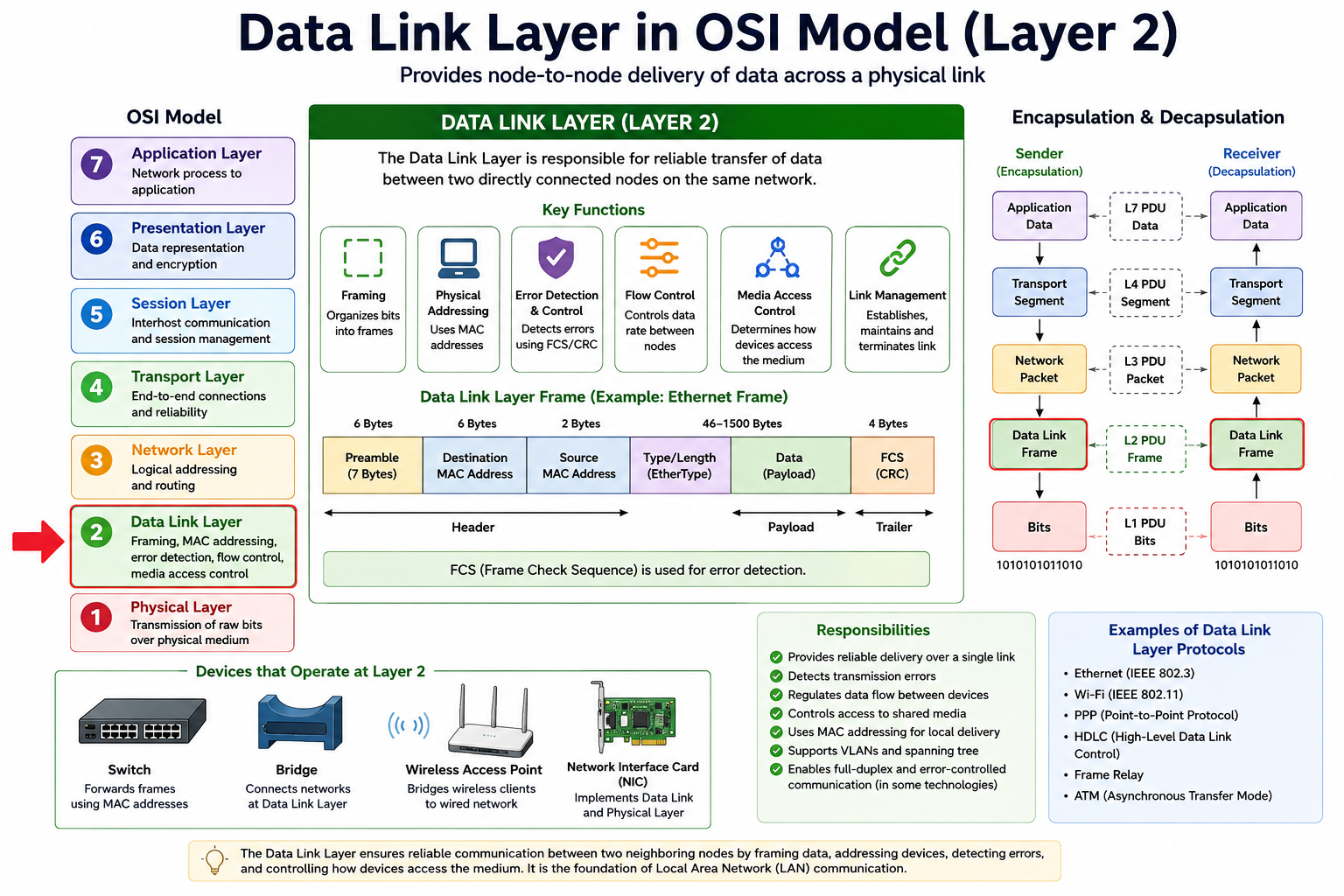
Instead, It Provides The Fundamental Communication Channel On Which The Data Link Layer, Network Layer, Transport Layer, And Application Layer Depend. In Simple Terms, The Physical Layer Answers The Question: “How Are Bits Physically Represented And Transmitted From One Device To Another?” Its Major Goals Include Bit Transmission, Signaling, Encoding, Synchronization, Data-rate Support, Media Definition, Physical Connectivity, Interoperability, Bandwidth Utilization, Signal Integrity, And Reliable Communication.
A Strong Understanding Of These Objectives Is Therefore Essential For Mastering Computer Networking, OSI Architecture, Ethernet, Wireless Networks, Fiber-optic Communication, And Modern High-speed Network Infrastructure.
Tags:
Physical Layers, Network Layer, OSI Network Layer, OSI Physical Layers