Network Layer: Definition, Objectives, Functions, Protocols, And Importance
Category: NETWORKING | 29th August 2026, Saturday
Introduction To The Network Layer
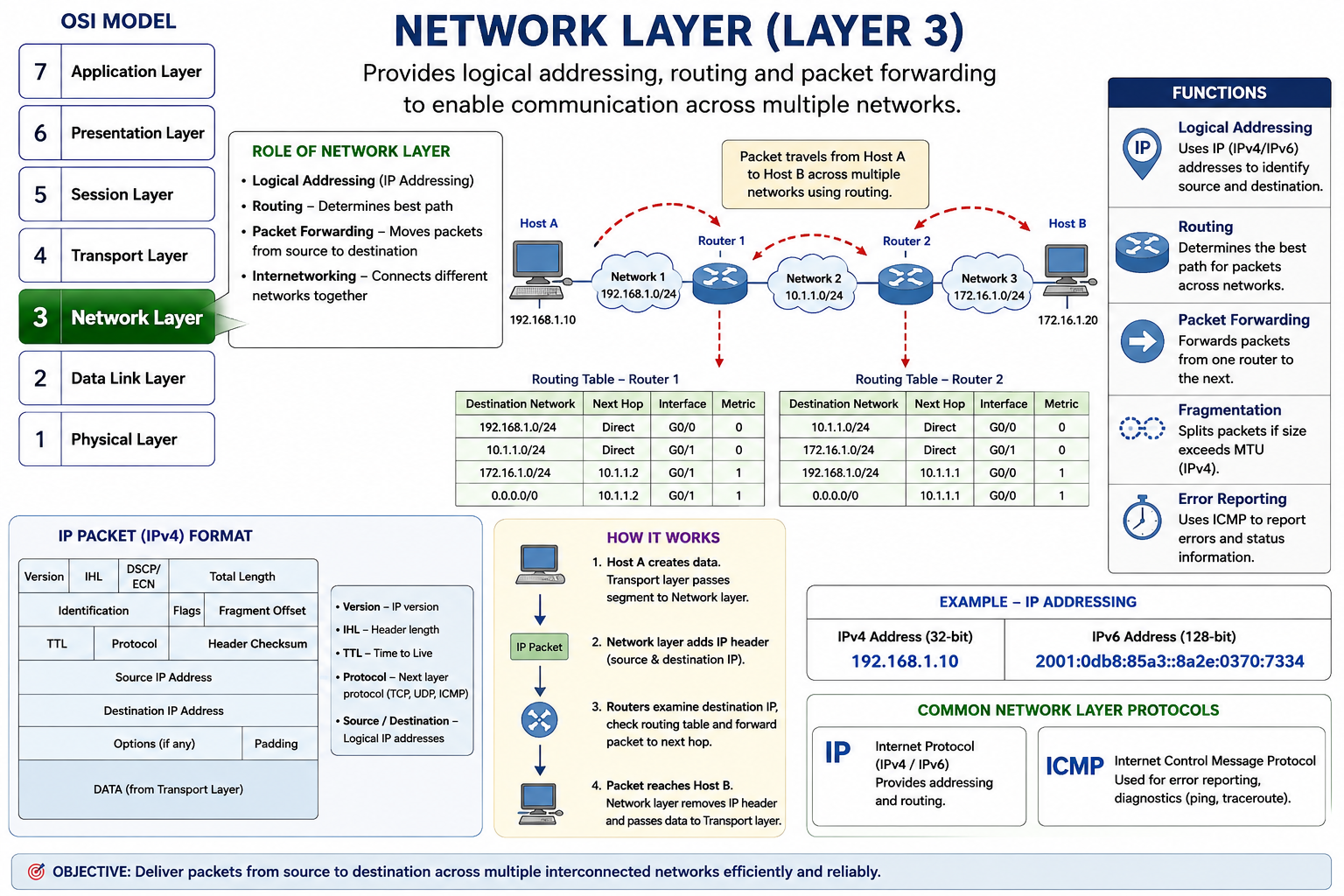
The Network Layer Is The Third Layer Of The OSI (Open Systems Interconnection) Model And Plays A Fundamental Role In Computer Networking. It Is Positioned Above The Data Link Layer And Below The Transport Layer. The Primary Responsibility Of The Network Layer Is To Provide logical Addressing, Routing, Packet Forwarding, And Internetwork Communication Between Devices Located On Different Networks.
While The Data Link Layer Is Mainly Concerned With Communication Between Devices On The Same Local Network, The Network Layer Enables Packets To Travel Across Multiple Interconnected Networks. In Practical Networking, The Internet Protocol (IP), Including IPv4 And IPv6, Is The Most Important Network Layer Protocol.
What Is The Network Layer?
The Network Layer Is A Communication Layer Responsible For Determining How Data Packets Should Move From A Source Device To A Destination Device Across One Or More Networks. When An Application Sends Data, The Transport Layer Divides Or Organizes The Data Into Segments.
The Network Layer Encapsulates These Segments Into packets And Adds Information Such As Source And Destination IP Addresses. Network Devices Such As Routers Examine This Information And Determine An Appropriate Path For Forwarding The Packet. Therefore, The Network Layer Can Be Understood As The Layer That Provides The Logical Structure Necessary For Communication Between Different Networks.
Position In The OSI Model
The OSI Model Consists Of Seven Layers: Physical, Data Link, Network, Transport, Session, Presentation, And Application. The Network Layer Is The third Layer. The Data Link Layer Provides Node-to-node Delivery Within A Local Network, Whereas The Network Layer Provides network-to-network Delivery.
Above The Network Layer, The Transport Layer Provides End-to-end Transport Services To Applications. This Layered Organization Allows Networking Responsibilities To Be Divided Into Manageable Functions. Consequently, A Change In One Layer Can Often Be Implemented Without Completely Redesigning The Other Layers.
Main Objective Of The Network Layer
The Main Objective Of The Network Layer Is To Provide logical Communication Between Devices That May Exist On Different Networks. Its Most Important Goal Is To Ensure That Packets Can Be Delivered From A Source Network To A Destination Network Using Appropriate Addressing And Routing Mechanisms.
To Achieve This Objective, The Network Layer Performs Logical Addressing, Routing, Packet Forwarding, Fragmentation And Reassembly Where Applicable, Congestion-related Functions In Some Architectures, And Error Reporting Through Supporting Protocols. The Overall Objective Is Not Simply To Move Data, But To Create An Efficient And Scalable Mechanism For Communication Across Interconnected Networks.
Logical Addressing
One Of The Most Important Functions Of The Network Layer Is logical Addressing. Every Device Participating In An IP Network Generally Requires An IP Address That Identifies Its Network-layer Location. IPv4 Uses 32-bit Addresses, While IPv6 Uses 128-bit Addresses.
Unlike A Physical MAC Address, An IP Address Is Associated With Logical Network Organization And Routing. For Example, An IPv4 Address Such As 192.168.1.10 Can Identify A Host Within A Particular IP Network. Logical Addressing Allows Routers To Determine Where Packets Originate And Where They Need To Go.
Routing
Routing Is Another Major Function Of The Network Layer. Routing Refers To The Process Of Selecting A Path Through Interconnected Networks From A Source To A Destination. Routers Maintain Routing Information And Use It To Determine The Next Hop For Packets.
Routing Decisions Can Be Based On Factors Such As Destination Network, Network Topology, Administrative Policies, Cost, Bandwidth, Delay, And Reliability. Routing Can Be Static, Where Routes Are Manually Configured, Or Dynamic, Where Routing Protocols Automatically Exchange Information And Calculate Routes.
Packet Forwarding
Routing And Forwarding Are Related But Different Concepts. Routing Determines The Path, Whereas forwarding Is The Actual Process Of Sending A Packet Toward The Next Device On That Path. When A Router Receives An IP Packet, It Examines The Destination IP Address And Consults Its Forwarding Or Routing Table.
It Then Determines The Appropriate Outgoing Interface And Next Hop. The Packet Is Forwarded Toward Its Destination. This Process Occurs Repeatedly As The Packet Travels Through Multiple Routers Across An Internetwork.
Network Layer Packets
At The Network Layer, The Basic Protocol Data Unit Is Generally Called A packet Or Datagram. When Data Arrives From The Transport Layer, The Network Layer Adds A Header Containing Network-layer Information.
In IPv4, This Header Can Include Fields Such As Source Address, Destination Address, Time To Live (TTL), Protocol Identification, Fragmentation Information, And Header Checksum. IPv6 Uses A Redesigned Base Header And Extension Headers. The Resulting Packet Is Passed To The Data Link Layer For Transmission Over The Current Physical Network.
IP As The Major Network Layer Protocol
The Internet Protocol (IP) Is The Central Protocol Associated With The Network Layer Of The TCP/IP Architecture. IPv4 And IPv6 Provide Addressing And Packet Delivery Across Interconnected Networks. IP Is Fundamentally Designed As A connectionless, Best-effort Packet Delivery Protocol.
This Means IP Itself Does Not Guarantee That Every Packet Will Arrive, Arrive In Order, Or Arrive Without Duplication. Reliability, When Required, Is Generally Provided By Higher-layer Protocols Such As TCP Or By Applications Themselves. This Separation Contributes Significantly To The Flexibility And Scalability Of Internet Architecture.
IPv4 And IPv6
IPv4 And IPv6 Are The Two Major Versions Of The Internet Protocol. IPv4 Uses 32-bit Addresses And Supports Approximately 4.3 Billion Possible Address Values, Although Practical Allocation Is More Complex Because Addresses Are Divided Into Networks And Hosts.
IPv6 Uses 128-bit Addresses, Providing An Enormously Larger Address Space. IPv6 Also Introduces Improvements In Areas Such As Address Configuration, Multicast Support, And Packet-header Design. Both Protocols Perform Network Layer Functions, Although Their Packet Formats And Operational Mechanisms Differ.
Subnetting And Network Organization
The Network Layer Supports The Organization Of Large Networks Into Smaller Logical Networks Through subnetting. Subnetting Divides An IP Address Space Into Multiple Subnetworks. This Improves Address Management, Routing Efficiency, Security Segmentation, And Network Administration.
For Example, An Organization Might Separate Its Employee Computers, Servers, Laboratories, And Guest Devices Into Different IP Subnets. Routers Can Then Control Communication Between These Networks. Subnetting Is Therefore An Important Concept For Designing Scalable And Manageable IP Networks.
Routing Tables
Routers Use routing Tables To Determine Where Packets Should Be Sent. A Routing Table Generally Contains Information Such As Destination Networks, Prefixes, Next-hop Information, Outgoing Interfaces, And Route Metrics. When A Router Receives A Packet, It Performs A Lookup Based Primarily On The Destination IP Address.
In Modern IP Networks, Routers Generally Use longest-prefix Matching To Select The Most Specific Applicable Route. Efficient Routing-table Processing Is Essential Because High-speed Routers May Need To Make Forwarding Decisions For Enormous Numbers Of Packets Per Second.
Static Routing
Static Routing Involves Manually Configuring Routes On Network Devices. Network Administrators Explicitly Specify Which Destination Network Should Use Which Next Hop Or Interface. Static Routes Can Be Useful In Small Networks, Simple Topologies, Default Routes, And Situations Where Predictable Traffic Paths Are Desired.
They Do Not Automatically Adapt To Topology Changes, However. If A Link Fails, An Administrator May Need To Modify The Configuration Unless Additional Mechanisms Are Present. Therefore, Static Routing Is Generally More Suitable For Simple Or Controlled Network Environments.
Dynamic Routing
Dynamic Routing Allows Routers To Automatically Exchange Routing Information And Respond To Changes In Network Topology. Dynamic Routing Protocols Calculate Or Select Paths According To Their Specific Algorithms And Metrics.
Examples Include OSPF (Open Shortest Path First), RIP (Routing Information Protocol), IS-IS, And BGP (Border Gateway Protocol). Dynamic Routing Is Particularly Important In Large Networks Because Manually Configuring Every Route Would Be Difficult And Error-prone. When Network Conditions Change, Routing Protocols Can Update Routing Information And Potentially Select Alternative Paths.
Routing Algorithms
Routing Protocols Rely On Different Approaches And Algorithms To Determine Suitable Paths. Distance-vector Protocols Generally Exchange Information About Reachable Networks And Associated Metrics. Link-state Protocols Build A More Detailed Representation Of Network Topology And Calculate Shortest Paths.
Path-vector Routing, Particularly BGP, Uses Path Information And Routing Policies Between Autonomous Systems. The Choice Of Routing Algorithm Affects Convergence, Scalability, Resource Consumption, And Route-selection Behavior. Therefore, Routing Algorithms Form A Critical Theoretical And Practical Component Of Network Layer Design.
16. Path Selection And Metrics
A Router May Have Multiple Possible Paths To A Destination. The Network Layer Therefore Requires Mechanisms For Selecting An Appropriate Route. Routing Protocols May Use Metrics Such As Hop Count, Link Cost, Bandwidth, Delay, Reliability, Or Administrative Policy.
For Example, RIP Primarily Uses Hop Count, While OSPF Uses A Cost Metric. BGP Uses A Collection Of Path Attributes And Policy Rules Rather Than Simply Selecting The Numerically Shortest Path. Path Selection Allows Networks To Balance Performance, Reliability, Cost, And Administrative Requirements.
Fragmentation And Packet Size
Different Networks Can Have Different Maximum Transmission Unit (MTU) Sizes. Historically, IPv4 Routers Could Fragment Packets When Necessary, Although Modern Network Design Often Attempts To Avoid Fragmentation. IPv6 Routers Do Not Fragment Packets In Transit; Fragmentation, When Needed, Is Handled By The Source Using IPv6 Extension Headers.
Fragmentation Can Increase Processing Overhead And Introduce Additional Complexity. Network Engineers Therefore Commonly Use Techniques Such As Path MTU Discovery To Determine Suitable Packet Sizes And Reduce Fragmentation-related Problems.
Time To Live And Hop Limit
IP Packets Include Mechanisms That Prevent Them From Circulating Indefinitely Due To Routing Errors. IPv4 Uses A Time To Live (TTL) Field, While IPv6 Uses A Hop Limit Field. Each Router That Forwards A Packet Reduces The Relevant Value. When The Value Reaches Zero, The Packet Is Discarded.
This Prevents A Routing Loop From Consuming Network Resources Forever. Supporting Diagnostic Mechanisms Can Then Report The Problem To The Sender. This Concept Is Also Fundamental To Tools Such As Traceroute, Which Can Use Controlled TTL Or Hop Limit Values To Discover Intermediate Routing Hops.
ICMP And Network Error Reporting
The Internet Control Message Protocol (ICMP) Is Closely Associated With IP Networking And Is Commonly Used For Error Reporting And Diagnostic Communication. For Example, ICMP Can Communicate Conditions Such As Destination Unreachable Or Time Exceeded.
Utilities Such As ping Use ICMP Echo Messages To Test Reachability And Response. traceroute Can Also Rely On ICMP And Related Packet-handling Behavior To Identify Routing Paths. ICMP Does Not Replace IP; Rather, It Provides Important Control And Diagnostic Functionality Around IP Communication.
Best-Effort Delivery
IP Provides best-effort Delivery, Meaning That The Network Layer Attempts To Deliver Packets But Does Not Itself Guarantee Successful Delivery. Packets May Be Lost Because Of Congestion, Link Failures, Routing Problems, Buffer Overflow, Or Other Conditions.
Packets May Also Arrive Out Of Order Or, In Some Situations, Be Duplicated. This Design Makes IP Relatively Simple And Scalable. When Reliable Delivery Is Necessary, Higher Layers Can Provide Mechanisms Such As Acknowledgments, Retransmissions, Sequencing, And Flow Control.
Connectionless Communication
IP Communication Is Generally connectionless. Before Sending An Individual IP Packet, The Network Layer Does Not Establish A Dedicated End-to-end Connection Comparable To A Traditional Circuit. Each Packet Contains Sufficient Destination Information For Routers To Make Forwarding Decisions.
Different Packets Belonging To The Same Higher-layer Communication Can Potentially Follow Different Paths, Depending On Routing And Network Conditions. This Connectionless Architecture Contributes To The Internet's Ability To Adapt To Failures And Changing Traffic Conditions.
Network Layer And Routers
Routers Are The Most Important Networking Devices Associated With The Network Layer. A Router Connects Different IP Networks And Makes Forwarding Decisions Based On Network Layer Information. When A Packet Enters A Router, The Router Examines The Packet Header, Determines The Destination, Consults Its Forwarding Information, And Sends The Packet Through An Appropriate Interface.
Routers Can Connect Local Networks, Data Centers, Enterprise Networks, Internet Service Providers, And Large-scale Global Networks. Modern Routers May Also Perform Additional Functions Such As Filtering, Policy Enforcement, Tunneling, And Traffic Management.
Difference Between Data Link And Network Layers
The Data Link Layer And Network Layer Are Closely Related But Serve Different Purposes. The Data Link Layer Primarily Provides node-to-node Communication Over A Particular Link Or Local Network, Using Technologies Such As Ethernet And Wi-Fi.
The Network Layer Provides Logical Communication Across Multiple Interconnected Networks. MAC Addresses Are Primarily Associated With Data Link Layer Delivery, While IP Addresses Are Used For Network Layer Communication. During Packet Forwarding, The IP Destination Remains Relevant End-to-end, While The Data Link Frame And MAC Addressing Can Change At Each Network Hop.
Network Layer And Transport Layer
The Network Layer Should Also Be Distinguished From The Transport Layer. The Network Layer Provides Packet Delivery Between Hosts Or Networks, Whereas The Transport Layer Provides Communication Services Between Applications Or Processes.
TCP, For Example, Provides Reliable, Ordered Byte-stream Communication, While UDP Provides A Simpler Connectionless Datagram Service. The Network Layer Does Not Normally Concern Itself With Application Ports Or Application-level Reliability. This Separation Enables Applications To Use Different Transport Protocols While Sharing The Same Underlying IP Infrastructure.
Quality Of Service And Network Layer
Although Basic IP Provides Best-effort Delivery, Modern Networks May Implement Mechanisms For Quality Of Service (QoS) And Traffic Differentiation. Network Layer Fields And Associated Technologies Can Help Identify Or Classify Traffic.
Network Administrators Can Then Apply Policies That Prioritize Certain Types Of Traffic, Such As Voice Or Interactive Applications, Under Appropriate Conditions. QoS Becomes Particularly Important When Network Resources Are Limited Or When Delay-sensitive Applications Share Infrastructure With Large Amounts Of Ordinary Data Traffic.
Security At The Network Layer
Security Is An Important Consideration In Network Layer Communication. IPsec (Internet Protocol Security) Can Provide Security Services Such As Authentication, Integrity Protection, And Confidentiality For IP Communications. Network Devices Can Also Implement Packet Filtering And Routing Policies To Control Traffic.
Firewalls And Access-control Mechanisms May Inspect IP Addresses, Protocols, Ports, And Other Attributes. Network-layer Security Is Particularly Important Because Attacks Can Target Addressing, Routing, Packet Forwarding, And Availability. However, Network Layer Security Works Alongside, Rather Than Replacing, Application And Transport Security.
Network Layer In Modern Networks
The Network Layer Remains Essential In Modern Environments Such As Cloud Computing, Mobile Networks, Data Centers, The Internet Of Things (IoT), And Large Enterprise Infrastructures. Technologies Such As Virtualization And Software-defined Networking Have Introduced New Ways To Implement Networking Functions, But Logical Addressing And Packet Forwarding Remain Fundamental Concepts.
Virtual Networks Can Create Logical Topologies Over Physical Infrastructure, While Routing And Forwarding Mechanisms Determine How Traffic Reaches Its Destination. Consequently, Understanding The Network Layer Is Essential For Students, Network Engineers, Cybersecurity Professionals, And Researchers.
Importance Of The Network Layer
The Importance Of The Network Layer Comes From Its Ability To Make internetworking Possible. Without A Network Layer Addressing And Routing Mechanism, Independent Networks Would Have Difficulty Communicating As A Unified Global System.
The Network Layer Hides Many Details Of The Underlying Physical Networks And Provides A Common Logical Addressing Framework. Ethernet, Wi-Fi, Fiber-optic Networks, Cellular Networks, And Other Technologies Can Participate In Larger IP-based Communication Systems. This Abstraction Is One Of The Major Reasons The Internet Can Connect An Enormous Variety Of Devices And Networks.
Key Objectives Of The Network Layer
The Major Objectives Of The Network Layer Can Be Summarized As logical Addressing, Routing, Packet Forwarding, Internetwork Connectivity, Path Selection, Packet Delivery, Scalability, And Network Organization. It Provides A Mechanism Through Which A Source Can Identify A Destination And Routers Can Determine How Traffic Should Move Between Networks.
It Also Supports Mechanisms For Handling Packet Lifetime, Diagnostics, Addressing, And Interoperability. From An Academic Perspective, The Network Layer Represents The Fundamental Layer Responsible For Moving Packets Between Different Networks Using Logical Addresses And Routing Decisions.
Conclusion
The Network Layer Is The Third Layer Of The OSI Model And One Of The Most Important Foundations Of Computer Networking. Its Central Objective Is To Enable Communication Across Interconnected Networks By Using Logical Addressing, Routing, And Packet Forwarding. IP Is The Dominant Network Layer Protocol, With IPv4 And IPv6 Providing The Addressing And Packet-delivery Foundation Of The Internet.
Routers Use Routing Information To Select Paths And Forward Packets Toward Their Destinations, While Supporting Protocols Such As ICMP Provide Diagnostic And Control Capabilities. Understanding The Network Layer Is Therefore Essential For Mastering Computer Networks, Routing, Cybersecurity, Cloud Infrastructure, IoT, And Advanced Networking Technologies.
Tags:
Network Layer, OSI Network Layer, What Is Network Layer, OSI Model, Logical Addressing