OSPF In Computer Networks: Is OSPF A Data Link Layer Protocol?
Category: NETWORKING | 31st August 2026, Monday
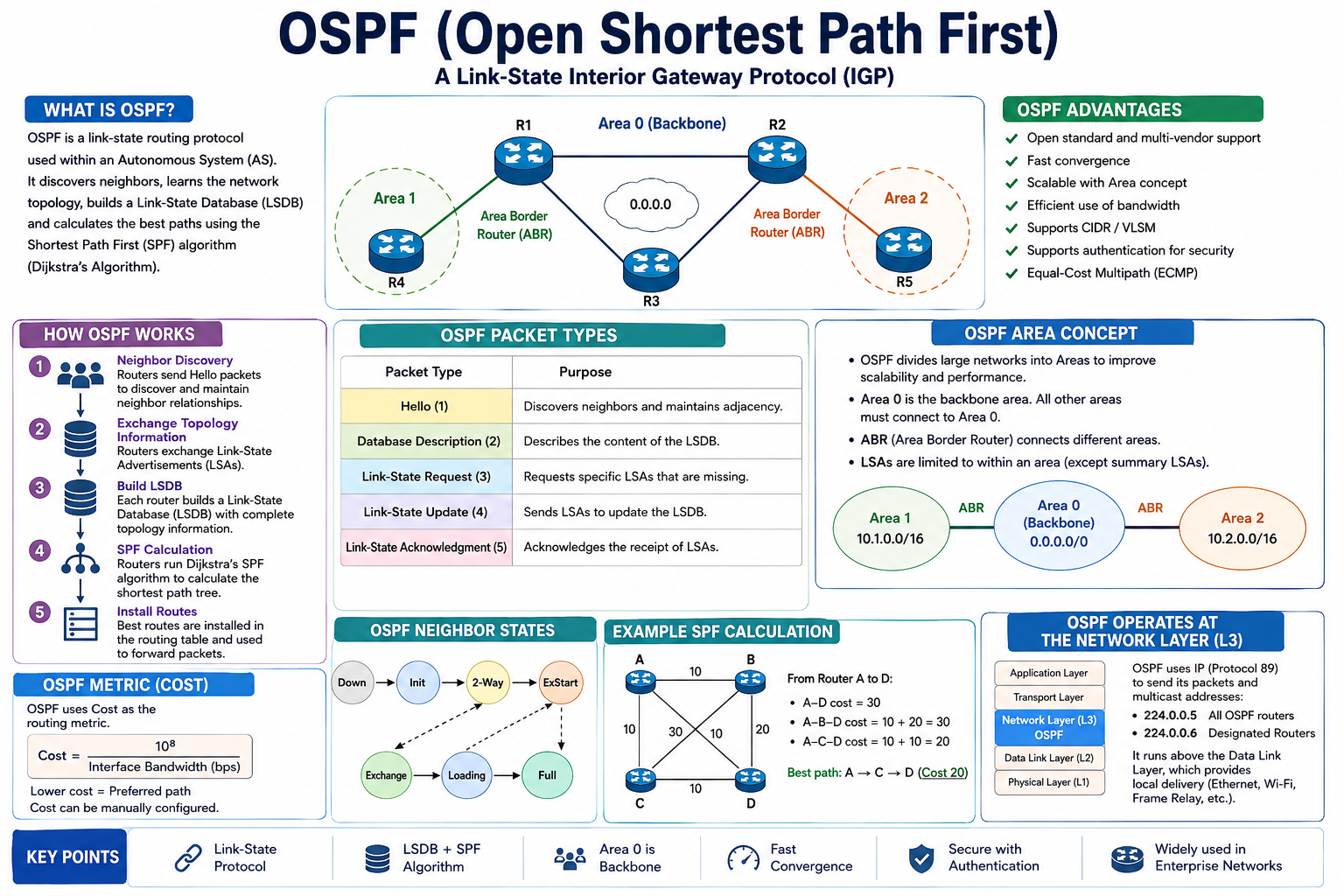
Introduction To OSPF
OSPF, Or Open Shortest Path First, Is One Of The Most Important Routing Protocols Used In Modern Computer Networks. However, An Important Clarification Is Necessary At The Beginning: OSPF Does Not Operate At The Data Link Layer. OSPF Is Primarily A Network Layer (Layer 3) Routing Protocol In The OSI Model.
It Is An Interior Gateway Protocol (IGP) Designed To Exchange Routing Information Between Routers Within A Single Autonomous System. OSPF Uses IP Packets To Communicate Routing Information And Determines The Best Paths Through A Network Using The Shortest Path First Algorithm.
OSPF And The OSI Model
The OSI Model Divides Network Communication Into Seven Layers: Physical, Data Link, Network, Transport, Session, Presentation, And Application. The Data Link Layer Is Responsible For Frame Delivery, MAC Addressing, Error Detection, And Communication Over A Local Network Segment.
Examples Of Data Link Layer Technologies Include Ethernet, Wi-Fi, HDLC, And PPP. OSPF, In Contrast, Belongs Conceptually To The Network Layer Because It Makes Decisions About IP Routes Between Different Networks. Therefore, Describing OSPF As A Data Link Layer Protocol Would Be Technically Incorrect.
Why OSPF Is Sometimes Associated With The Data Link Layer
Although OSPF Is A Layer 3 Protocol, It Interacts Closely With Data Link Layer Technologies. An OSPF Router Needs An Underlying Network Interface Such As Ethernet, Fiber Ethernet, Serial Communication, Or Another Layer 2 Technology To Transmit OSPF Packets.
Consequently, Students Sometimes Encounter OSPF While Studying Ethernet, LANs, Or The Data Link Layer. The Data Link Layer Provides The Local Delivery Mechanism, While OSPF Operates Above It To Determine Where Packets Should Be Forwarded. Understanding This Distinction Is Essential For Correctly Understanding Network Architecture.
Definition Of OSPF
OSPF Stands For Open Shortest Path First. It Is A Link-state Routing Protocol Standardized By The Internet Engineering Task Force (IETF). OSPF Enables Routers To Discover Neighboring Routers, Exchange Information About Network Topology, Construct A Topology Database, And Calculate Optimal Routes.
Unlike Distance-vector Protocols That Primarily Learn Routes From Neighboring Routing Information, OSPF Builds A More Complete Representation Of The Network Topology. It Then Runs The Shortest Path First Algorithm, Commonly Associated With Dijkstra's Algorithm, To Calculate Routing Paths.
OSPF As An Interior Gateway Protocol
OSPF Is Classified As An Interior Gateway Protocol (IGP) Because It Is Designed To Route Traffic Within An Autonomous System. An Autonomous System Is A Collection Of Networks And Routers Administered Under A Common Routing Policy.
OSPF Is Therefore Commonly Deployed Inside Enterprise Networks, University Networks, Data Centers, Service-provider Infrastructures, And Large Organizational Networks. For Routing Between Autonomous Systems, Protocols Such As BGP Are Generally Used. OSPF Focuses On Efficiently Calculating Routes Inside The Organization Or Administrative Domain.
Link-State Routing Concept
OSPF Uses A link-state Routing Approach. In This Approach, Routers Advertise Information About Their Directly Connected Links And Network Interfaces. These Advertisements Allow Other OSPF Routers To Understand The Topology Of The Routing Domain.
Each Router Builds A Link-State Database (LSDB), Which Contains Information Describing The Known OSPF Topology. Because Routers Within The Same OSPF Area Generally Maintain Synchronized Topology Information, They Can Independently Calculate Routes Rather Than Relying Solely On A Neighbor To Tell Them Which Route To Use.
OSPF Neighbor Discovery
Before OSPF Routers Can Exchange Detailed Routing Information, They Must Discover One Another And Establish Neighbor Relationships. OSPF Uses Hello Packets For This Purpose. A Router Periodically Sends Hello Packets Through An OSPF-enabled Interface.
Other OSPF Routers Receiving These Packets Examine Parameters Such As The OSPF Area, Timers, Authentication Configuration, And Network-related Settings. If The Relevant Parameters Match, The Routers Can Establish An OSPF Adjacency Or Neighbor Relationship. This Neighbor Discovery Process Is Fundamental To OSPF Operation.
OSPF Hello Packets
Hello Packets Perform Several Important Functions. They Allow Routers To Discover Neighbors, Maintain Neighbor Relationships, And Verify That Neighboring Routers Are Still Reachable. OSPF Routers Typically Send Hello Packets Periodically, And Neighbors Expect To Receive Them Within A Configured Dead Interval.
If Hello Packets Stop Arriving For The Required Period, A Router Can Consider The Neighbor Unavailable And Update Its Routing Information. This Mechanism Enables OSPF To Respond To Topology Changes And Failures Relatively Quickly.
OSPF Router ID
Every OSPF Router Requires A Router ID (RID) That Uniquely Identifies The Router Within The OSPF Routing Domain. The Router ID Is Represented As A 32-bit Value, Commonly Displayed In IPv4 Dotted-decimal Notation, Although It Functions As An Identifier Rather Than Necessarily Being A Physical Interface Address.
Depending On The Implementation, The Router ID Can Be Explicitly Configured Or Automatically Selected From Available Addresses. A Stable And Predictable Router ID Is Desirable Because It Makes Network Troubleshooting And Topology Management Easier.
OSPF Areas
One Of OSPF's Major Design Features Is Its Support For areas. Large Networks Can Be Divided Into Multiple OSPF Areas To Reduce Routing Complexity And Improve Scalability. The Central Area Is Known As Area 0, Or The Backbone Area. Other Areas Normally Connect To The Backbone Through Appropriate OSPF Design.
Dividing A Large Network Into Areas Reduces The Amount Of Topology Information That Must Be Maintained And Limits The Scope Of Certain Routing Calculations. This Hierarchical Architecture Makes OSPF Suitable For Large Enterprise Networks.
OSPF Area 0
Area 0 Is The Backbone Area Of An OSPF Network. It Plays A Central Role In Communication Between Non-backbone Areas. An OSPF Design Normally Expects Inter-area Traffic To Pass Through The Backbone. Routers Connecting Different OSPF Areas Are Called Area Border Routers (ABRs).
Proper Backbone Design Is Important Because An Incorrectly Designed OSPF Topology Can Result In Routing Problems. In Large Networks, Administrators Carefully Plan Area 0 And The Relationships Between The Backbone And Other Areas.
Link-State Database
The Link-State Database (LSDB) Is One Of The Most Important Components Of OSPF. It Contains Link-state Information Describing The OSPF Topology Within An Area. Routers Exchange Link-State Advertisements (LSAs), And These Advertisements Are Used To Construct And Maintain The LSDB.
When The Network Topology Changes, Relevant LSAs Are Updated Or Regenerated. OSPF Routers Use Their LSDB As The Input To The Shortest Path First Calculation. Therefore, The LSDB Provides The Information Needed To Determine The Best Available Paths.
Link-State Advertisements
OSPF Uses Different Types Of Link-State Advertisements (LSAs) To Describe Network Topology And Routing Information. Different LSA Types Serve Different Purposes. For Example, Router LSAs Describe Router Links, While Network LSAs Describe Certain Multi-access Network Segments.
Summary And External LSAs Can Be Used To Communicate Information Between Areas Or About External Routes. The Exact Set Of LSA Types And Their Behavior Depends On The OSPF Version And Network Design. LSAs Are Fundamental To The Operation Of The OSPF Link-state Architecture.
Dijkstra's Shortest Path First Algorithm
After Obtaining The Necessary Topology Information, An OSPF Router Runs The Shortest Path First (SPF) Algorithm To Calculate Routes. The Algorithm Is Based On Dijkstra's Shortest-path Algorithm. The Router Treats The Network Topology As A Graph Containing Routers, Links, And Associated Costs.
It Calculates The Shortest Path From Itself To Other Destinations According To The Configured OSPF Costs. The Resulting SPF Tree Is Then Used To Determine Entries For The Routing Table. This Allows OSPF To Select Efficient Paths Through The Network.
OSPF Cost Metric
OSPF Uses cost As Its Primary Routing Metric. The Cost Is Associated With An Interface Or Link And Is Used To Determine The Preferred Path. Generally, Links With Lower OSPF Cost Are Preferred Over Links With Higher Cost.
Interface Bandwidth Is Commonly Used As An Input When Automatically Determining Cost, Although Administrators Can Manually Configure Costs. For Example, If Two Possible Paths Exist Between Networks, OSPF May Select The Path With The Lowest Total Cost. This Provides More Sophisticated Path Selection Than Simply Counting Hops.
OSPF Routing Table
Once SPF Calculations Have Been Completed, OSPF Contributes Routes To The Router's Routing Table. The Routing Table Contains Information That The Router Uses To Forward IP Packets Toward Their Destinations. It Can Contain Routes Learned From OSPF As Well As Routes Learned From Other Routing Protocols, Static Routes, Or Directly Connected Networks.
If OSPF Determines That A Particular Destination Is Reachable Through A Specific Next-hop Router And Interface, That Information Can Be Installed Into The Routing Table According To Routing Selection Rules.
OSPF Packet Types
OSPF Communication Uses Several Specialized Packet Types. The Five Traditional OSPF Packet Types Are Hello, Database Description (DBD), Link-State Request (LSR), Link-State Update (LSU), And Link-State Acknowledgment (LSAck). Hello Packets Discover And Maintain Neighbors.
Database Description Packets Summarize Database Information. Link-State Requests Ask For Specific Missing Information. Link-State Updates Carry LSAs, While Link-State Acknowledgments Confirm Receipt Of LSAs. Together, These Packet Types Allow OSPF Routers To Synchronize Their Topology Information.
Database Synchronization
When OSPF Routers Establish An Adjacency, They Need To Synchronize Their Link-State Databases. Database Description Packets Help Routers Compare The Information They Possess. If One Router Determines That It Is Missing Specific LSAs, It Can Send Link-State Requests.
The Neighboring Router Responds With Link-State Updates Containing The Requested Information. Acknowledgments Help Provide Reliable LSA Flooding. This Synchronization Process Ensures That Participating Routers Have Sufficiently Consistent Topology Information For SPF Calculations.
OSPF On Ethernet Networks
OSPF Commonly Operates Over Ethernet Networks. Ethernet Itself Belongs Primarily To The Data Link And Physical Layers, While OSPF Operates At Layer 3. On An Ethernet Segment Containing Multiple OSPF Routers, OSPF Uses Multicast Communication To Reduce Unnecessary Traffic.
Two Important IPv4 Multicast Addresses Associated With OSPF Are 224.0.0.5, Used For All OSPF Routers, And 224.0.0.6, Used For Designated OSPF Routers. The Ethernet Network Transports The OSPF Packets, While OSPF Itself Performs Routing And Topology Functions.
Designated Router And Backup Designated Router
On Certain Multi-access Networks Such As Ethernet, OSPF Uses A Designated Router (DR) And Backup Designated Router (BDR). Without This Mechanism, Every OSPF Router Could Potentially Need To Form An Adjacency With Every Other Router On The Same Network Segment, Creating Many Relationships.
The DR Reduces This Complexity By Acting As A Central Point For Certain OSPF Exchanges. The BDR Provides Redundancy And Can Take Over If The DR Fails. This Mechanism Improves OSPF Scalability On Shared Networks.
OSPF And Data Link Layer Interaction
The Relationship Between OSPF And The Data Link Layer Can Be Understood Through Encapsulation. An OSPF Message Is Generated At The Network Layer And Is Carried Using IP. The IP Packet Is Then Encapsulated Inside A Data Link Layer Frame Appropriate For The Underlying Technology.
For Example, On Ethernet, The IP Packet Is Carried Inside An Ethernet Frame. The Ethernet Frame Uses MAC Addresses For Local Delivery, While OSPF Uses Routing Information To Help Routers Determine Paths Between IP Networks. Thus, Both Layers Cooperate But Perform Different Jobs.
22. OSPFv2 And OSPFv3
Two Important Versions Of OSPF Are OSPFv2 And OSPFv3. OSPFv2 Is Widely Associated With IPv4 Routing. OSPFv3 Was Developed To Support IPv6 Routing And Has Architectural Differences From OSPFv2. Modern Networks May Use OSPFv3 For IPv6 While Continuing To Use OSPFv2 For IPv4.
Understanding The Distinction Is Important For Network Administrators Because IPv4 And IPv6 Routing Requirements Differ, Even Though Both Versions Use The Same General Link-state And SPF Concepts.
OSPF Authentication And Security
Security Is An Important Consideration When Deploying OSPF. An Attacker Who Can Inject Unauthorized Routing Information Into An OSPF Domain Could Potentially Influence Traffic Paths Or Disrupt Routing. OSPF Implementations Therefore Provide Authentication Mechanisms To Help Routers Verify Routing Peers.
Network Administrators Should Also Use Appropriate Layer 2 Protections, Access Controls, Network Segmentation, And Infrastructure Security. Authentication Alone Is Not Sufficient To Secure An Entire Routing Infrastructure; OSPF Security Should Be Considered As Part Of A Broader Network-security Architecture.
OSPF Convergence
Convergence Refers To The Process By Which Routers Reach A Consistent Understanding Of Network Topology After A Change. If A Link Fails, OSPF Can Detect The Failure, Generate Appropriate Topology Updates, Flood Relevant LSAs, And Recalculate Routes.
The Speed Of This Process Depends On Configuration, Network Size, Hardware, Timers, And Topology. Fast Convergence Is One Reason OSPF Is Widely Used In Enterprise Networks. However, Excessively Aggressive Timers Or Poorly Designed Networks Can Increase CPU Usage And Control-plane Traffic.
Advantages Of OSPF
OSPF Provides Numerous Advantages. It Is An Open Standard, Making It Available Across Equipment From Many Networking Vendors. It Supports Hierarchical Network Design Through Areas, Provides Relatively Fast Convergence, Supports Classless Routing And CIDR, And Uses A Sophisticated Link-state Algorithm.
OSPF Also Supports Equal-cost Multipath Routing In Appropriate Circumstances And Provides Detailed Topology Information. These Characteristics Make OSPF Particularly Useful For Medium-sized And Large IP Networks Where Scalable And Dynamic Routing Is Required.
Limitations Of OSPF
Despite Its Advantages, OSPF Also Has Limitations. It Is More Complex To Configure And Troubleshoot Than Simple Static Routing Or Some Basic Routing Protocols. Maintaining LSDBs And Performing SPF Calculations Requires Router Memory And CPU Resources. Poor Area Design Can Introduce Complexity And Routing Problems.
Administrators Must Understand Concepts Such As LSAs, Neighbor States, Areas, Costs, DR/BDR Elections, And Route Summarization. Consequently, OSPF Is Powerful But Requires Appropriate Network Engineering And Operational Knowledge.
OSPF Compared With RIP
OSPF Is Significantly More Sophisticated Than Routing Information Protocol (RIP). RIP Is A Distance-vector Protocol That Traditionally Uses Hop Count As Its Primary Metric And Has Limitations On Network Diameter. OSPF Instead Uses A Link-state Model And A Cost-based SPF Algorithm.
OSPF Can Converge More Efficiently In Many Larger Networks And Provides Hierarchical Areas. RIP May Be Easier To Understand For Introductory Networking Exercises, But OSPF Is Generally Much More Suitable For Modern Enterprise Environments Requiring Scalable Dynamic Routing.
OSPF Compared With EIGRP
OSPF And Enhanced Interior Gateway Routing Protocol (EIGRP) Are Both Widely Discussed IGPs, Although They Use Different Routing Approaches. OSPF Uses A Link-state Architecture And SPF Calculations, While EIGRP Uses An Advanced Distance-vector Approach Based On The Diffusing Update Algorithm.
OSPF Is An Open IETF Standard And Therefore Has Broad Multi-vendor Support. EIGRP Has Historically Been Strongly Associated With Cisco Environments, Although Implementations And Support Have Evolved. Network Engineers Select Protocols According To Architecture, Interoperability, Operational Requirements, And Existing Infrastructure.
Importance Of OSPF In Modern Networks
OSPF Remains An Important Routing Protocol For Enterprise Networks, Campus Networks, Service-provider Environments, And Other IP Infrastructures. Its Ability To Maintain Topology Information, Support Hierarchical Areas, Respond To Failures, And Calculate Efficient Routes Makes It Suitable For Networks Where Static Routing Is Impractical.
OSPF Also Provides An Excellent Example Of How Routing Protocols Operate At The Network Layer While Depending On Lower-layer Technologies For Actual Packet Transmission. Understanding OSPF Therefore Helps Students Connect Theoretical OSI Concepts With Practical Network Engineering.
Conclusion: OSPF Is Not A Data Link Layer Protocol
In Conclusion, OSPF Is Not A Data Link Layer Protocol; It Is A Network Layer Routing Protocol. Its Primary Purpose Is To Exchange Routing Information And Calculate The Best Paths Between IP Networks Within An Autonomous System. OSPF Uses Hello Packets, LSAs, Link-State Databases, Areas, And The Shortest Path First Algorithm To Maintain An Accurate View Of Network Topology.
The Data Link Layer, Meanwhile, Provides Local Frame Delivery Through Technologies Such As Ethernet And Wi-Fi. Understanding The Boundary Between These Layers Is Essential: Data Link Layer Protocols Deliver Frames Across Local Links, While OSPF Operates At Layer 3 To Determine How IP Packets Should Travel Across Interconnected Networks.
Tags:
OSPF, Open Shortest Path First, Data Link Layers, Network Layer, OSPF And The OSI Model, OSPF Protocol