SQL Sessions In The Session Layer Of The OSI Model: A Details Explanation
Category: NETWORKING | 9th October 2026, Friday
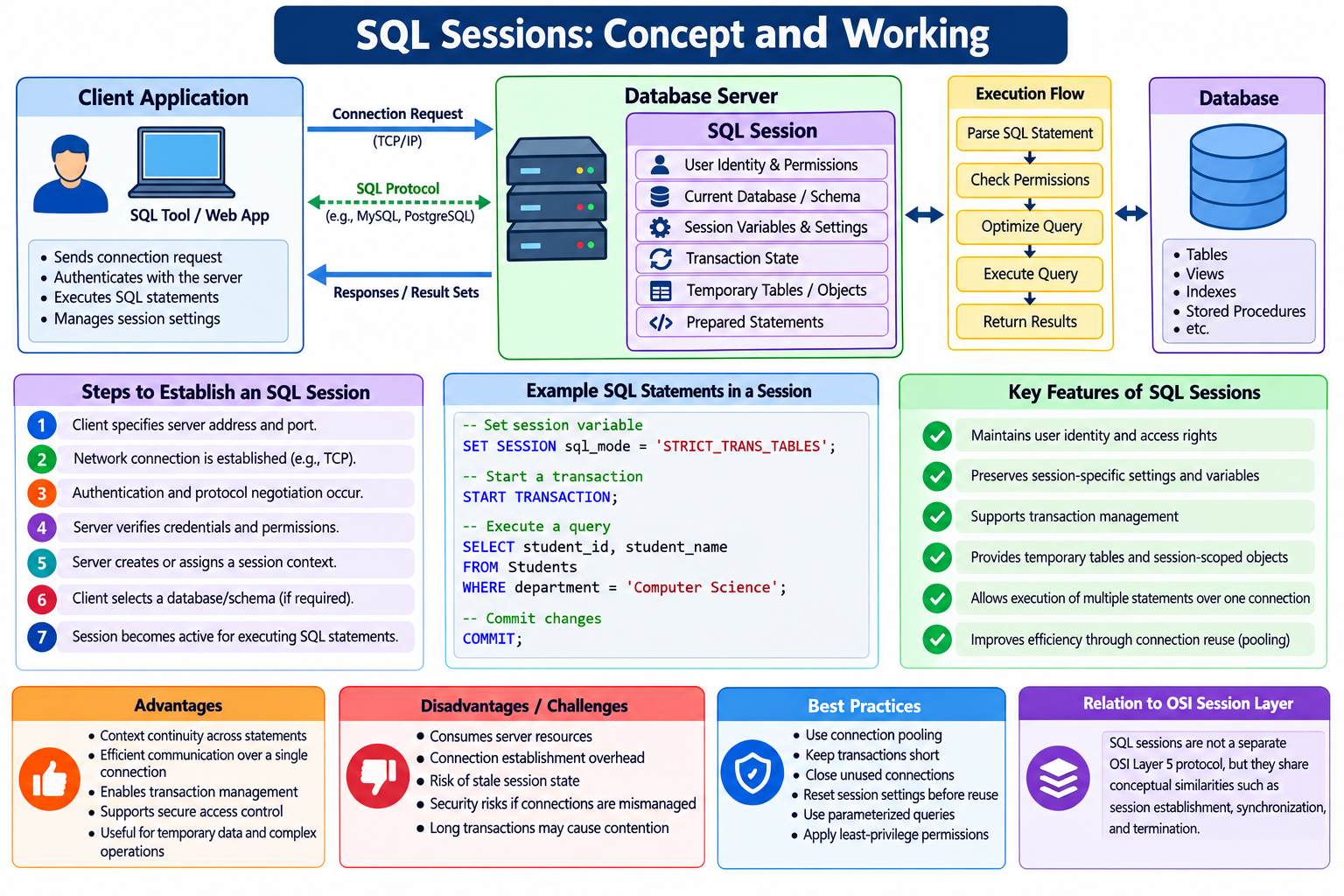
Introduction To SQL Sessions
SQL Sessions Are An Important Concept In Database Management Systems Because They Provide A Logical Environment In Which A Client Application Communicates With A Database Server, Executes SQL Statements, Manages Transactions, And Maintains Connection-specific Information. In Computer Networking, The Session Layer Is Layer 5 Of The Open Systems Interconnection (OSI) Model. It Is Responsible For Establishing, Managing, Synchronizing, And Terminating Communication Sessions Between Applications.
However, SQL Sessions Are Not A Separate Protocol Of The OSI Session Layer. Instead, They Are Database-level Communication Contexts That Perform Some Functions Conceptually Associated With Session Management. SQL Sessions Are Commonly Implemented By Database Management Systems (DBMSs), Such As MySQL, PostgreSQL, Oracle Database, And Microsoft SQL Server.
Understanding SQL Sessions Requires Studying Both The Theoretical Responsibilities Of The OSI Session Layer And The Practical Mechanisms Used By Database Systems To Maintain Communication Between Clients And Servers.
What Is A Session In Computer Networking?
A Session Is A Logical Association Between Two Communicating Entities That Enables Them To Exchange Information Over A Period Of Time. It Establishes A Context Within Which Communication Takes Place And Defines How The Communication Begins, Continues, And Ends.
For Example, When A User Logs In To A Database Application, The Application May Establish A Connection With A Database Server. The Server Authenticates The User, Assigns A Session Context, And Allows The User To Execute Database Operations According To Their Privileges.
A Session May Maintain Information Such As Authentication Identity, Transaction State, Configuration Settings, Temporary Objects, And Other Context Required For Processing Requests.
At The Networking Level, Session-related Functions May Include Dialogue Management, Synchronization, And Recovery Coordination. At The Database Level, Comparable Responsibilities Are Implemented Through DBMS-specific Mechanisms.
SQL Sessions And The OSI Session Layer
The OSI Model Divides Network Communication Into Seven Layers. Each Layer Performs Specific Functions And Provides Services To The Layer Above It.
OSI Model And Database Communication
7 Application Layer
Database Clients, SQL Tools, Application Interfaces
6 Presentation Layer
Data Representation, Character Encoding, Serialization
5 Session Layer
Logical Dialogue, Session Coordination, Synchronization Concepts
4 Transport Layer
TCP Connections, Reliable Byte-stream Delivery
3 Network Layer
IP Addressing And Packet Routing
2 Data Link Layer
Frames And Local Network Delivery
1 Physical Layer
Transmission Of Bits Over Physical Media
The OSI Model Is A Conceptual Framework. Real Database Implementations May Combine Session, Application, Authentication, And Transaction-management Functions.
SQL Is Primarily An Application-level Language Used To Define, Query, And Manipulate Relational Data. A Database Session Exists At A Higher Logical Level Than The Underlying TCP Connection In Many Common Client-server Architectures.
For Example, A Database Client Can Establish A TCP Connection And Then Authenticate To The Server To Create A Database Session. The Session Can Subsequently Execute Many SQL Statements Without Requiring A New TCP Connection For Every Statement.
Therefore, SQL Sessions Should Be Understood As Database Application Sessions That Share Conceptual Similarities With OSI Session Layer Functions, Rather Than As A Standardized Layer 5 Protocol.
Definition Of An SQL Session
An SQL Session Is A Logical Execution Context Maintained By A Database Management System For A Client Or Database Connection. It Provides The Environment In Which SQL Statements Are Executed And Database Operations Are Performed.
A Session May Contain:
-
User Identity And Authentication Information.
-
Current Database Or Schema.
-
Session-specific Configuration Variables.
-
Transaction Status And Isolation Settings.
-
Temporary Tables And Other Session-scoped Objects.
-
Prepared Statements And Server-side Execution State.
-
Session-specific Permissions And Resource Information.
The Exact Contents Depend On The Database Platform. Some Systems Associate A Session Closely With A Physical Connection, While Others Provide Additional Abstractions.
Consider The Following Example:
SQL
SELECT * FROM Students;When This Query Is Executed Through An Authenticated Database Session, The Server Interprets The Statement Within That Session's Context. The Selected Database, Permissions, Transaction State, And Configuration Settings May Affect How The Query Is Processed.
The Session Does Not Necessarily Store The Complete Result Of Every Query. Instead, It Maintains The State Required For The Database To Process Operations Correctly.
Establishment Of An SQL Session
Session Establishment Is The Initial Stage In Database Communication. A Client Application Requests A Connection To A Database Server, And The Server Establishes The Required Communication Context.
A Typical Process Includes The Following Steps.
-
The Client Specifies The Database Server's Hostname Or IP Address And Port.
-
The Client And Server Establish The Required Network Connection, Commonly Using TCP.
-
The Database Protocol Performs Authentication And Connection Negotiation.
-
The Server Verifies The Supplied Credentials And Access Permissions.
-
The Server Creates Or Assigns The Appropriate Session Context.
-
The Client Selects A Database Or Schema If Necessary.
-
The Session Becomes Available For Executing SQL Statements.
Client Application
SQL Tool, Website, Or Application
Network Connection
TCP And Database Wire Protocol
Authentication And Session Creation
Database Session Active
Execute Queries, Manage Transactions, And Access Authorized Objects
The Precise Order Varies Among DBMS Implementations. For Example, Authentication May Occur During Protocol Negotiation Rather Than After The Entire Network Connection Is Established.
SQL Sessions And Connection Management
Connection Management Is Closely Associated With SQL Sessions, But A Database Connection And A Session Are Not Always Identical Concepts.
A Connection Provides A Communication Channel Between The Client And The Server. A Session Provides A Logical Context In Which The Server Processes Requests.
In A Conventional Database Client, One Connection Commonly Corresponds To One Active Database Session. However, Connection Pooling, Multiplexing, And Database-specific Architectures Can Complicate This Relationship.
For Example, A Web Application May Use A Connection Pool Containing Ten Database Connections. Instead Of Establishing A New Network Connection For Every Visitor, The Application Temporarily Assigns An Available Connection To Each Database Task.
Connection Pooling Reduces Connection-establishment Overhead And Helps The Application Handle Many Concurrent Users. Nevertheless, Applications Must Carefully Manage Session State Because A Reused Connection May Retain Settings Or Other State From An Earlier Task.
A Secure Connection Pool Should Reset Or Validate Session State Before Reusing A Connection, According To The Database Driver's Capabilities.
Executing SQL Statements Within A Session
Once An SQL Session Is Active, The Client Can Submit SQL Statements To The Database Server.
A Typical Execution Cycle Includes:
-
The Client Sends An SQL Statement Through The Database Protocol.
-
The Server Parses The Statement And Checks Its Syntax.
-
The Server Validates Permissions And Resolves Database Objects.
-
The Query Optimizer Selects An Execution Strategy When Applicable.
-
The Execution Engine Performs The Required Operations.
-
The Server Returns The Result Set, Affected-row Count, Or Error Information.
Consider This SQL Statement:
SQL
SELECT Student_id, Student_name
FROM Students
WHERE Department = 'Computer Science';
The DBMS Processes This Query Within The Active Session. The Server Checks Whether The Session's Database Identity Has Permission To Access The Students Table And Then Executes The Query.
Multiple Statements Can Be Executed Within The Same Session. Depending On The DBMS, Each Statement May Inherit The Current Database, Session Configuration, And Transaction Context.
The Session Provides Continuity Across Requests, But It Does Not Guarantee That Every Query Will Execute Successfully. Errors May Occur Because Of Invalid Syntax, Missing Privileges, Unavailable Objects, Or Transaction Conflicts.
Session Variables And Configuration
SQL Sessions Often Support Settings That Influence The Behavior Of Subsequent Statements. These Settings May Be Temporary And Specific To The Current Session.
For Example, MySQL Supports Session-scoped System Variables.
SQL
SET SESSION Sql_mode = 'STRICT_TRANS_TABLES';This Statement Configures The SQL Mode For The Current MySQL Session, Subject To The Server's Supported Configuration And Privileges.
The Setting May Affect How The Server Handles Certain Invalid Or Problematic Data Operations. It Generally Does Not Change The Corresponding Setting For Every Other Session.
Other Examples Of Session-related State Include:
-
Current Database Selection.
-
Time Zone Configuration.
-
Transaction Isolation Level.
-
Character-set Settings.
-
Query Execution Preferences Supported By The DBMS.
Session Variables Are Useful Because Different Applications May Require Different Execution Environments. However, Applications Using Connection Pools Should Avoid Assuming That Session-specific Settings Are Automatically Reset When A Connection Is Reused.
Transactions And SQL Sessions
A Transaction Is A Logical Unit Of Database Work. It May Contain One Or More SQL Statements That Must Be Committed Or Rolled Back According To The Application's Requirements.
Transactions Are Commonly Managed Within Database Sessions.
For Example:
SQL
START TRANSACTION;

UPDATE Accounts
SET Balance = Balance - 1000
WHERE Account_id = 101;

UPDATE Accounts
SET Balance = Balance + 1000
WHERE Account_id = 202;

COMMIT;
This Simplified Example Transfers 1,000 Currency Units Between Two Accounts. A Production Implementation Should Also Verify That The Source Account Exists, Has Sufficient Funds, And That The Required Number Of Rows Was Updated.
The Transaction Groups The Updates So That They Can Be Committed Together Or Rolled Back If An Error Occurs Before The Commit.
Database Transactions Are Often Described Using The ACID Properties:
-
Atomicity: A Transaction's Operations Are Treated As A Unit.
-
Consistency: The Transaction Preserves Applicable Database Constraints.
-
Isolation: Concurrent Transactions Are Controlled According To The Isolation Level.
-
Durability: Committed Changes Are Intended To Persist Despite Failures Covered By The DBMS's Durability Guarantees.
Transactions And Sessions Are Related But Distinct. A Session Can Execute Several Transactions Sequentially, And A Session May Exist Even When No Transaction Is Currently Active.
The Exact Behavior Of Implicit Transactions, Autocommit, And Transaction Boundaries Differs Between Database Systems.
Session Synchronization And Dialogue Management
Dialogue Management Is One Of The Central Concepts Associated With The OSI Session Layer. It Concerns The Organization Of Communication Between Participating Entities.
Database Systems Implement Comparable Coordination At The Application And Database-protocol Levels.
For Example, A Client Sends A Query And Waits For The Corresponding Result. The Client Must Associate The Returned Data Or Error With The Appropriate Request. In A Simple Request-response Protocol, A Client May Wait For One Query To Complete Before Sending The Next.
Some Database Protocols And Drivers Support Asynchronous Queries, Pipelining, Or Multiple Outstanding Operations. Such Capabilities Require Appropriate Request Tracking And Protocol Coordination.
Database Synchronization Also Involves Transaction Locks, Concurrency Control, And Coordination Among Simultaneous Sessions. These Functions Are Implemented Primarily By Database Engines And Related Subsystems Rather Than By A Standalone OSI Layer 5 Protocol.
A Session Can Therefore Provide A Logical Communication Context While The Database Engine Independently Manages Shared Data And Concurrent Access.
Temporary Tables And Session-Scoped Objects
Some DBMSs Support Objects Whose Lifetime Is Associated With A Session Or Transaction.
A Temporary Table, For Example, Can Hold Intermediate Results That An Application Needs While Performing A Complex Operation.
In MySQL, A Temporary Table Can Be Created As Follows:
SQL
CREATE TEMPORARY TABLE TempResults (
    Student_id INT,
    Score DECIMAL(5,2)
);
The Application Can Then Insert And Query Temporary Data:
SQL
INSERT INTO TempResults (student_id, Score)
VALUES (101, 89.50);

SELECT * FROM TempResults;
In MySQL, A Temporary Table Is Generally Visible Only To The Current Session And Is Automatically Dropped When That Session Ends. It Can Also Be Explicitly Dropped Before The Session Terminates.
This Feature Is Useful For Intermediate Calculations, Data Transformations, And Multistep Analytical Queries.
Temporary-object Visibility And Lifetime Vary Across DBMSs. In Addition, Temporary Tables Should Not Be Confused With Ordinary Permanent Tables, Which Are Generally Available To Other Authorized Sessions.
Authentication, Authorization, And Session Security
SQL Session Security Begins With Authentication, Which Establishes The Identity Of The Connecting User Or Application. Authorization Determines Which Database Operations That Identity Is Permitted To Perform.
A Database May Require Authentication Using Passwords, Integrated Authentication, Certificates, Or Other Mechanisms Supported By The Platform.
Once Authenticated, The Session Operates Under The Privileges Granted To Its Database Identity, Subject To Any Additional Security Rules.
For Example, A Read-only Reporting Account Might Be Allowed To Execute SELECT Statements But Prohibited From Modifying Records.
SQL
GRANT SELECT ON University.Students
TO 'report_user'@'localhost';
This Example Uses MySQL-style Account Syntax. The Exact Syntax And Privilege Model Vary By DBMS.
Important Security Practices Include:
-
Use Strong Authentication And Least-privilege Permissions.
-
Encrypt Database Traffic With Correctly Configured TLS When Appropriate.
-
Use Parameterized Queries To Reduce SQL Injection Risk.
-
Protect Credentials And Avoid Embedding Unrestricted Database Passwords In Client-side Code.
-
Apply Session Timeouts And Appropriate Connection Limits.
-
Monitor Unusual Activity And Failed Authentication Attempts.
-
Avoid Exposing Sensitive Information Through Application Logs.
A Database Session Should Not Be Treated As Secure Merely Because The Client Successfully Authenticated. Security Depends On The Full Combination Of Authentication, Authorization, Transport Protection, Query Handling, And Session Lifecycle Management.
Session Termination
Session Termination Is The Final Stage Of A Session's Lifecycle. It Occurs When The Client Explicitly Disconnects, The Server Closes The Session, Or A Timeout Or Failure Ends The Connection.
In MySQL, A Client Can Terminate Its Connection Using:
SQL
QUIT;In Other SQL Tools, The Equivalent Action May Be Called disconnect, close, Or exit.
Session Termination Typically Releases Session-specific Resources, Including Temporary Objects And Server-side Execution State. If A Transaction Remains Uncommitted, The DBMS Generally Rolls It Back When The Session Is Terminated, Although The Exact Handling Of Failure Conditions Depends On The Platform.
Termination Can Also Result From Network Failure, Administrator Action, Server Restart, Or Resource-management Policies.
Applications Should Handle Disconnections Safely And Should Not Assume That A Connection Remains Active Indefinitely. If Reconnection Is Necessary, They Must Restore Required Session Settings And Carefully Determine Whether Previously Submitted Transactions Committed Successfully.
This Is Especially Important For Financial And Other Critical Operations, Because A Lost Connection Does Not Always Reveal Whether The Server Completed A Request Before The Failure Occurred.
SQL Sessions In MySQL: A Practical Example
The Following Example Demonstrates Session State In MySQL. It Illustrates How A Session-specific Variable Retains Its Value Within The Current Connection.
SQL
-- Session 1
SET @student_count = 100;

SELECT @student_count;
The Output Is:
@student_count
--------------
100
Now Open A Separate Database Connection And Execute:
SQL
-- Session 2
SELECT @student_count;
In The Second Session, The Result Is NULL Because The User-defined Session Variable Was Not Assigned In That Connection.
Return To Session 1 And Execute:
SQL
SET @student_count = @student_count + 50;

SELECT @student_count;
The Output Becomes:
@student_count
--------------
150
This Demonstrates Three Important Principles:
-
Session State Can Persist Across Multiple SQL Statements.
-
Different Sessions Have Separate User-defined Session-variable Contexts.
-
A Session Can Maintain Context Without Creating A New Network Connection For Every Statement.
The Example Uses MySQL User-defined Variables. Other DBMSs Implement Session State Differently, So This Particular Syntax Should Not Be Assumed To Work Identically In PostgreSQL, Oracle Database, Or SQL Server.
SQL Sessions And Concurrent Database Users
Modern Database Servers Support Multiple Sessions Operating Concurrently. Each Session Can Execute Its Own Queries, But Multiple Sessions May Access The Same Tables And Records.
For Example, Two Users May Attempt To Update The Same Account Balance At Nearly The Same Time. Without Suitable Concurrency Control, One Operation Could Overwrite Another Or Produce An Incorrect Result.
DBMSs Address These Risks Using Mechanisms Such As:
-
Transaction Isolation.
-
Row-level Or Table-level Locking.
-
Multiversion Concurrency Control (MVCC).
-
Deadlock Detection And Resolution.
-
Constraint Enforcement.
Consider The Following Simplified Scenario:
-
Session A Reads An Account Balance Of 5,000.
-
Session B Also Reads The Balance Of 5,000.
-
Both Sessions Attempt To Make Independent Updates.
-
The DBMS Must Coordinate The Operations According To Its Concurrency-control Rules.
The Result Depends On The Transaction Design, Isolation Level, Locking Behavior, And Whether Updates Are Expressed Safely. An SQL Session Alone Does Not Prevent Concurrency Anomalies.
A Robust Application Should Use Appropriate Transaction Boundaries, Database Constraints, And Atomic Update Statements Rather Than Relying On Assumptions About The Order In Which Users Execute Queries.
Session Management In Web Applications
Web Applications Frequently Use SQL Sessions Indirectly Through Database Drivers And Connection Pools.
Suppose A University Management Website Is Developed Using PHP, MySQL, HTML, Bootstrap, And JavaScript. A User Requests A Student Record Through A Web Page.
A Typical Workflow Is:
-
The Browser Sends An HTTP Request To The PHP Application.
-
The PHP Application Validates The Request And User Permissions.
-
The Application Obtains A Database Connection.
-
The Database Session Executes A Parameterized SQL Query.
-
MySQL Returns The Requested Data.
-
PHP Generates The Response And Sends It To The Browser.
-
The Application Returns The Connection To Its Pool Or Closes It.
There May Be Two Different Types Of Session In This Workflow.
Web Session: Maintains Application-level Information Such As A Logged-in User's Identity, Preferences, And Authentication State.
SQL Session: Maintains The Database Connection's Execution Context, Permissions, Variables, And Transaction State.
These Sessions Are Related Through The Application, But They Are Not Identical. Logging Out Of A Website Does Not Necessarily Terminate A Shared Database Connection, And Closing A Database Connection Does Not Automatically Destroy Every Web-session Record.
Separating These Concepts Is Essential When Designing Secure And Scalable Web Applications.
Advantages Of SQL Sessions
SQL Sessions Provide Several Practical Benefits.
1. Context Continuity: Session Settings And Supported State Can Persist Across Multiple Statements.
2. Efficient Communication: A Client Can Issue Many SQL Statements Through An Established Connection Instead Of Repeatedly Negotiating New Connections.
3. Transaction Management: Sessions Provide A Context In Which Applications Can Execute And Control Transactions.
4. Security Enforcement: The DBMS Applies Authentication And Authorization Rules To Database Operations.
5. Temporary Data Management: Session-scoped Temporary Tables And Variables Support Intermediate Computations.
6. Application Integration: Database Sessions Allow Websites, Desktop Tools, Analytics Systems, And Enterprise Applications To Interact With Database Servers.
7. Resource Coordination: DBMSs Can Associate Execution Resources, Query State, And Transaction Information With Individual Sessions.
These Benefits Depend On Correct Configuration And Appropriate Use Of The DBMS.
Disadvantages And Limitations Of SQL Sessions
SQL Sessions Also Introduce Challenges.
1. Resource Consumption: Large Numbers Of Active Sessions Can Consume Memory, Sockets, And Other Server Resources.
2. Connection Overhead: Establishing Connections Can Be Expensive When Authentication And Protocol Negotiation Occur Frequently.
3. Stale Session State: Reused Connections May Retain Configuration Or Temporary Objects That Affect Subsequent Operations.
4. Security Risks: Stolen Credentials Or Improperly Managed Connections May Permit Unauthorized Database Access.
5. Transaction Contention: Long-running Transactions Can Hold Locks, Delay Other Sessions, Or Increase Resource Usage.
6. Connection Failures: Network Interruptions Can Leave Applications Uncertain About The Outcome Of An Operation.
7. Scalability Challenges: Applications With Many Users Need Appropriate Connection Pooling, Limits, Timeouts, And Workload Management.
These Limitations Can Be Reduced Through Careful Application Architecture, Secure Configuration, Transaction Design, Monitoring, And Connection-pool Management.
SQL Sessions Versus OSI Session Layer Sessions
The Two Concepts Are Related At A Conceptual Level, But They Should Not Be Treated As Interchangeable.
| Feature | OSI Session Layer | SQL Database Session |
|---|---|---|
| Primary Purpose | Organize Logical Communication Dialogues | Maintain A Database Execution Context |
| Conceptual Scope | Communication Between Applications | Interaction With A DBMS |
| Session Establishment | Abstract Session Establishment And Management | Database Connection, Authentication, And Context Setup |
| Synchronization | Dialogue Coordination And Synchronization Points | Request Coordination, Transaction State, And Database Concurrency Mechanisms |
| State Management | Communication-related State | Variables, Settings, Permissions, And Transaction Context |
| Termination | End Of A Logical Communication Session | Database Disconnect Or Server-side Session Closure |
| Standardization | Defined As Part Of The OSI Reference Model | Varies By DBMS And Database Protocol |
| Example | A Conceptual Session-oriented Application Protocol | A MySQL Client Connected To A Database |
The Key Distinction Is That The OSI Session Layer Describes Networking Functions In An Abstract Reference Model, Whereas An SQL Session Is A Concrete Feature Of A Database System.
Database Sessions May Rely On TCP, TLS, And A Database-specific Application Protocol. Their Existence Does Not Imply That The Implementation Contains A Distinct Protocol Corresponding Exactly To OSI Layer 5.
Applications Of SQL Sessions
SQL Sessions Are Widely Used In Practical Computing Environments.
-
University Management Systems: Maintain Database Contexts While Managing Students, Courses, Examinations, And Results.
-
Banking Systems: Execute Account Operations Within Controlled Transaction Contexts.
-
E-commerce Platforms: Process Orders, Inventory Changes, And Payment Records.
-
Healthcare Systems: Access Patient Records According To Authentication And Authorization Policies.
-
Data Analytics: Execute Sequences Of Queries And Intermediate Computations.
-
Enterprise Resource Planning: Support Concurrent Users Accessing Business Data.
-
Cloud Database Services: Manage Client Connections, Workloads, Session State, And Resource Allocation.
-
Cybersecurity Monitoring: Associate Database Activity With Identities And Sessions For Auditing And Incident Investigation.
In These Systems, SQL Sessions Help Applications Maintain A Consistent Database Execution Environment While Performing Authorized Operations.
Best Practices For SQL Session Management
For Postgraduate Study And Practical Database Development, The Following Practices Are Important.
-
Use Connection Pooling When Appropriate For Applications With Frequent Database Requests.
-
Keep Transactions Short And Avoid Holding Locks Longer Than Necessary.
-
Close Unused Connections And Configure Suitable Idle-session Timeouts.
-
Reset Session-specific Variables And Settings Before Reusing Pooled Connections.
-
Use Prepared Statements Or Parameterized Queries.
-
Apply Least-privilege Database Permissions.
-
Use TLS Where Required To Protect Data In Transit.
-
Monitor Connection Counts, Long-running Queries, Idle Transactions, And Authentication Failures.
-
Handle Connection Failures And Transaction Retries Carefully.
-
Avoid Storing Application Authentication State Solely In A Database Connection's Transient Session Context.
These Practices Improve Reliability, Security, And Performance In Database-driven Applications.
Conclusion
SQL Sessions Are Fundamental To Database Communication Because They Provide A Logical Context For Executing SQL Statements, Maintaining Configuration State, Managing Transactions, And Applying Database Access Controls. They Enable Clients To Communicate With Database Servers Through Established Connections And Allow Multiple Users To Interact With Shared Data Under The DBMS's Concurrency-control Mechanisms.
From The Perspective Of The OSI Model, SQL Sessions Illustrate Concepts Associated With Session Establishment, State Management, Communication Continuity, And Termination. Nevertheless, An SQL Session Is A Database-level Abstraction Rather Than A Standardized Protocol Of The OSI Session Layer.
For Postgraduate Students In Computer Science, The Most Important Distinction Is Between Network Session Management, Database Connection Management, And Transaction Management. These Mechanisms Interact, But They Solve Different Problems. Understanding Their Relationship Provides A Strong Foundation For Advanced Study In Database Systems, Computer Networking, Distributed Applications, And Cybersecurity.
Tags:
SQL Sessions, Definition Of SQL Sessions, SQL Sessions And The OSI Session Layer, SQL Session Management