What Is Datagram Congestion Control Protocol (DCCP) In The Transport Layer
Category: NETWORKING | 20th September 2026, Sunday
Introduction To DCCP
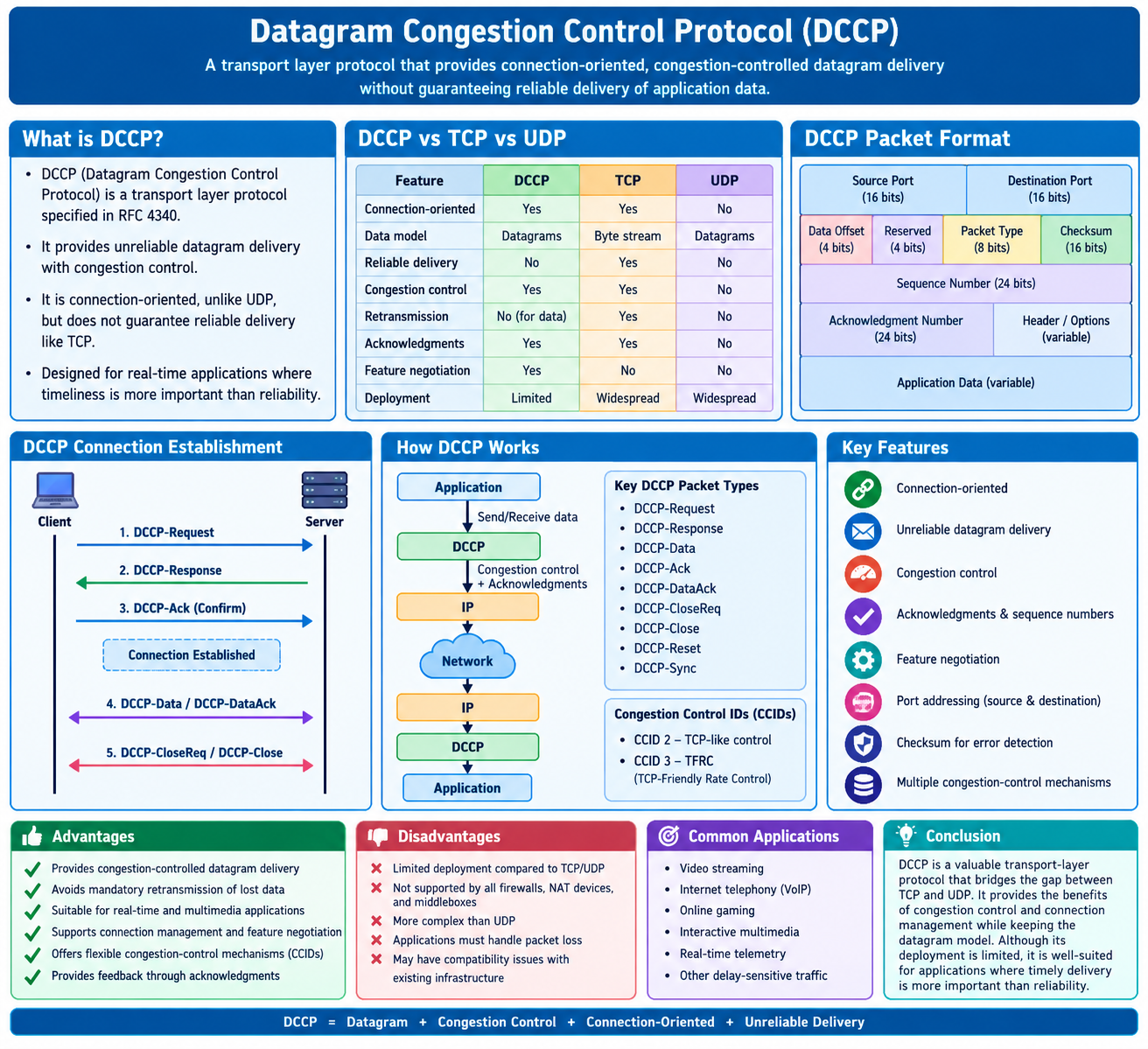
Datagram Congestion Control Protocol (DCCP) Is A Transport-layer Protocol Designed To Provide Applications With unreliable Datagram Delivery Combined With Congestion Control. It Occupies An Interesting Position Between TCP And UDP. UDP Provides Lightweight Datagram Communication But Does Not Include Built-in Congestion Control, While TCP Provides Reliable, Ordered Byte-stream Delivery Together With Sophisticated Congestion Control. DCCP Attempts To Provide Congestion-controlled Communication Without Imposing TCP's Reliability And Retransmission Mechanisms.
Definition Of DCCP
DCCP Is A connection-oriented Transport Protocol Standardized By The Internet Engineering Task Force (IETF). It Is Specified Primarily In RFC 4340. Although DCCP Establishes A Logical Connection Between Endpoints, The Application Data Itself Is Delivered As Datagrams Rather Than As A Reliable Byte Stream. This Makes DCCP Suitable For Applications Where timeliness Is More Important Than Guaranteed Delivery.
DCCP And The Transport Layer
DCCP Operates At The Transport Layer (Layer 4) Of The OSI Model And Alongside TCP, UDP, And SCTP In The Internet Protocol Architecture. Its Major Responsibility Is To Provide End-to-end Communication Services Between Applications. The Protocol Uses Port Numbers To Identify Applications And IP Addresses To Identify Hosts. DCCP Therefore Provides Transport-layer Functionality While Preserving The Datagram-oriented Nature Required By Many Real-time Applications.
Why Was DCCP Developed?
Many Applications Send Large Amounts Of Data Where Retransmitting Lost Packets Is Either Unnecessary Or Harmful. Examples Include streaming Media, Internet Telephony, Online Gaming, And Real-time Multimedia. TCP's Reliability Mechanisms Can Introduce Delays Because Lost Packets Must Be Retransmitted. UDP Avoids Those Delays But Traditionally Leaves Congestion Control To The Application. DCCP Was Designed To Address This Gap By Providing congestion Control Without Reliable Retransmission.
DCCP Compared With TCP
TCP Provides A Reliable, Ordered Byte Stream. When Packets Are Lost, TCP Retransmits Them. DCCP, In Contrast, Provides unreliable Datagram Delivery. A Lost DCCP Packet Is Normally Not Retransmitted As Application Data. However, DCCP Still Performs Congestion Control. Consequently, DCCP Can Be Viewed Conceptually As Providing Some Of TCP's Traffic-management Characteristics While Retaining UDP-like Datagram Semantics.
DCCP Compared With UDP
UDP Is Connectionless And Has Very Little Protocol Overhead. It Does Not Inherently Provide Congestion Control, Connection Negotiation, Or Acknowledgments. DCCP Introduces These Capabilities While Maintaining Datagram-based Data Transfer. Therefore, DCCP Is More Complex Than UDP But Can Provide Better Network Behavior For Applications That Require High-speed Datagram Transmission While Remaining Responsive To Network Congestion.
Basic Characteristics Of DCCP
Important Characteristics Of DCCP Include connection Orientation, Unreliable Datagram Delivery, Congestion Control, Acknowledgments, Sequence Numbers, Port Addressing, And Feature Negotiation. DCCP Also Supports Different Congestion-control Mechanisms Through Its Congestion Control IDs (CCIDs). This Allows Applications And Implementations To Select An Appropriate Congestion-control Behavior For Their Traffic Requirements.
Connection-Oriented Nature
Although DCCP Does Not Guarantee Application-data Delivery, It Is Connection-oriented. Before Normal Data Transfer Begins, The Endpoints Establish A DCCP Connection. This Provides A Mechanism For Negotiating Protocol Parameters And Congestion-control Behavior. Connection Establishment Also Gives DCCP Greater Control Over Communication Than A Simple UDP Exchange.
DCCP Communication Model
A Typical DCCP Communication Involves A client And Server. The Client Initiates A Connection, And The Server Responds. After The Connection Is Established, Application Data Can Be Exchanged In DCCP-Data And DCCP-DataAck Packets. When Communication Is Complete, The Connection Can Be Terminated Through Appropriate DCCP Control Packets.
DCCP Packet Structure
DCCP Packets Contain Several Fields Required For Connection Management, Sequencing, Acknowledgment, And Congestion Control. Important Fields Include source Port, Destination Port, Data Offset, Checksum, Packet Type, Sequence Number, Acknowledgment Information, And Feature-related Information. Depending On The Packet Type, The Exact Fields And Their Interpretation Can Differ.
DCCP Packet Types
DCCP Defines Several Packet Types. Important Types Include DCCP-Request, DCCP-Response, DCCP-Data, DCCP-Ack, DCCP-DataAck, DCCP-CloseReq, DCCP-Close, DCCP-Reset, And DCCP-Sync. Each Packet Type Serves A Particular Function In Connection Establishment, Data Transmission, Acknowledgment, Synchronization, Or Termination.
DCCP Connection Establishment
DCCP Uses A Multi-step Connection-establishment Procedure. A Client Can Send A DCCP-Request To A Server. The Server Responds With A DCCP-Response, And The Client Subsequently Confirms The Connection. This Process Allows The Endpoints To Establish Protocol State And Negotiate Features Before Regular Data Communication Begins.
DCCP Data Transmission
Once The Connection Is Established, Application Data Can Be Transmitted Using DCCP Data Packets. Unlike TCP, DCCP Does Not Create A Continuous Reliable Byte Stream. Individual Packets Represent Datagrams, Allowing An Application To Process Data According To Its Own Timing And Usefulness Requirements. This Property Is Particularly Important For Real-time Applications.
Unreliable Delivery
The Word unreliable In DCCP Does Not Mean That The Protocol Is Poorly Designed. It Means That DCCP Does Not Guarantee That Every Application-data Packet Will Reach The Destination. Packets May Be Lost Because Of Congestion, Transmission Errors, Routing Changes, Or Other Network Conditions. Applications Therefore Need To Tolerate Packet Loss Or Implement Application-specific Recovery When Necessary.
Why Packet Loss Can Be Acceptable
In Real-time Communication, An Old Packet May Become Useless After Its Intended Playback Or Processing Deadline. For Example, If A Video Frame Arrives Several Seconds Late, Retransmitting It May Not Improve The User Experience. DCCP Allows Applications To Avoid Unnecessary Retransmissions And Instead Continue Processing Newer Information.
Sequence Numbers
DCCP Uses Sequence Numbers To Identify Packets And Maintain Communication State. Sequence Information Helps Endpoints Detect Packet Ordering, Losses, And Synchronization Problems. However, The Presence Of Sequence Numbers Does Not Transform DCCP Into A Reliable Protocol. Applications Can Use Information About Packet Sequence And Loss According To Their Own Requirements.
Acknowledgments
DCCP Supports Acknowledgments, But These Acknowledgments Are Not Primarily Intended To Provide TCP-style Reliable Delivery. They Play An Important Role In congestion Control And Feedback. An Endpoint Can Use Acknowledgment Information To Determine Network Conditions And Adjust Its Transmission Behavior.
Congestion Control In DCCP
Congestion Control Is One Of DCCP's Most Important Features. When Many Devices Transmit Simultaneously Through A Network, Routers And Links Can Become Overloaded. Packet Loss, Delay, And Queue Growth Can Result. DCCP Attempts To Prevent Applications From Continuously Transmitting At An Inappropriate Rate By Applying Congestion-control Mechanisms.
Congestion Control IDs
DCCP Uses Congestion Control IDs (CCIDs) To Identify Congestion-control Algorithms. Two Historically Important Mechanisms Are CCID 2, Associated With TCP-like Congestion Control, And CCID 3, Associated With TCP-Friendly Rate Control (TFRC). These Mechanisms Provide Different Approaches For Controlling Transmission Rates.
CCID 2
CCID 2 Uses A Congestion-control Approach Broadly Related To TCP's Behavior. The Sender Adjusts Its Transmission According To Congestion Feedback. This Can Make DCCP Traffic Behave More Like TCP Traffic When Sharing Network Resources. CCID 2 May Be Appropriate When Applications Need Relatively Aggressive Adaptation To Changing Congestion Conditions.
CCID 3 And TFRC
CCID 3 Uses TCP-Friendly Rate Control (TFRC). TFRC Is Designed To Provide Smoother Changes In Transmission Rate Than Traditional TCP-style Congestion Control. This Characteristic Can Be Useful For Multimedia Applications Because Abrupt Rate Changes Can Negatively Affect Audio Or Video Quality.
TCP-Friendly Behavior
A Major Design Goal Of DCCP Is To Encourage Applications To Behave Responsibly On Shared Networks. A High-bandwidth Multimedia Application That Simply Sends Continuously Without Congestion Control Can Negatively Affect Other Traffic. DCCP's Congestion-control Mechanisms Help Applications Adapt Their Sending Rate Based On Network Conditions.
DCCP Feature Negotiation
DCCP Includes A Feature-negotiation Mechanism. Endpoints Can Negotiate Various Protocol Parameters And Features During Communication. Feature Negotiation Helps DCCP Adapt Its Behavior To The Capabilities And Requirements Of Both Endpoints.
DCCP Service Codes
DCCP Also Supports The Concept Of A Service Code. A Service Code Can Help Identify The Application Service Associated With A DCCP Connection. This Is Useful In Connection Establishment Because The Receiving Host Can Determine What Service The Requester Is Trying To Access.
DCCP Checksum
DCCP Includes A Checksum Mechanism To Detect Corruption In Transmitted Packets. The Checksum Provides Integrity Protection Against Accidental Transmission Errors. As With Other Internet Transport Protocols, Checksum Processing Is Important Because Corrupted Packets Should Generally Not Be Delivered As Valid Transport-layer Data.
DCCP Security Considerations
DCCP Itself Should Not Be Regarded As A Complete Security Solution. Applications Requiring Confidentiality, Authentication, Or Strong Integrity Protection Generally Need Additional Security Mechanisms. For Example, Cryptographic Protection Can Be Provided At Another Layer Depending On Application Requirements. Network Administrators Must Also Consider Firewall And Middlebox Compatibility.
DCCP And Real-Time Applications
DCCP Was Designed With Applications Such As multimedia Streaming And Real-time Communication In Mind. These Applications Frequently Need High Throughput And Controlled Network Behavior But Do Not Necessarily Require Every Packet To Arrive. DCCP Can Therefore Provide A Useful Transport Abstraction For Certain Classes Of Real-time Traffic.
DCCP For Video Streaming
Video Applications Can Generate Substantial Network Traffic. If A Video Packet Is Lost, Retransmitting It May Sometimes Be Less Useful Than Continuing With Subsequent Packets. DCCP's Unreliable Delivery Model Can Therefore Fit Applications That Have Their Own Strategies For Handling Missing Data, Although Modern Video Systems Often Use Other Protocols And Application-layer Mechanisms.
DCCP For Voice Communication
Voice Communication Has Strict Delay Requirements. Excessive Retransmission Can Increase Latency And Create Unacceptable Delays. DCCP Can Support Datagram-oriented Voice Traffic While Providing Congestion Control. However, Actual Deployment Depends On Application Requirements, Network Support, And Compatibility With Existing Real-time Communication Technologies.
DCCP For Online Gaming
Online Games Frequently Exchange Small, Time-sensitive Messages. The Newest Position Or State Information Can Be More Useful Than An Older Packet That Arrives Late. DCCP's Datagram-oriented Model Can Therefore Be Conceptually Suitable For Some Gaming Traffic. Nevertheless, Game Developers Often Use UDP Plus Application-specific Reliability And Congestion Mechanisms Instead.
DCCP Advantages
DCCP Has Several Advantages. It Provides congestion-controlled Datagram Communication, Avoids Mandatory Retransmission Of Lost Application Data, Supports Connection Management, Provides Feedback Through Acknowledgments, And Allows Different Congestion-control Mechanisms. These Properties Make It More Capable Than UDP For Applications That Need Explicit Congestion Control.
DCCP Disadvantages
DCCP Also Has Disadvantages. Its Deployment Has Historically Been Much Less Widespread Than TCP And UDP. Network Devices, Firewalls, NAT Systems, And Operating Systems May Provide Limited Support. Application Developers May Therefore Prefer UDP Because Of Its Universal Availability. DCCP Also Introduces Additional Protocol Complexity Compared With UDP.
DCCP Versus TCP
| Feature | DCCP | TCP |
|---|---|---|
| Connection-oriented | Yes | Yes |
| Data Model | Datagrams | Byte Stream |
| Reliable Application Data | No | Yes |
| Congestion Control | Yes | Yes |
| Retransmission | Not For Normal Data | Yes |
| Ordering Guarantee | No Reliable Ordered Stream | Yes |
| Real-time Suitability | Potentially Suitable | Often Less Suitable For Strict Real-time Traffic |
| Overhead | Moderate | Moderate |
DCCP Versus UDP
| Feature | DCCP | UDP |
|---|---|---|
| Connection Management | Yes | No |
| Datagram Delivery | Yes | Yes |
| Built-in Congestion Control | Yes | No |
| Reliability | No | No |
| Acknowledgments | Supported | No |
| Feature Negotiation | Yes | No |
| Complexity | Higher | Very Low |
| Deployment | Less Widespread | Extremely Widespread |
DCCP Versus SCTP
SCTP And DCCP Are Both Transport-layer Protocols, But Their Design Objectives Differ. SCTP Provides reliable Message-oriented Communication, While DCCP Provides unreliable But Congestion-controlled Datagrams. SCTP Supports Features Such As Multistreaming And Multihoming, Whereas DCCP Focuses More Directly On Congestion-controlled Datagram Transport.
DCCP Advantages In Detail
The Primary Advantage Of DCCP Is Its Combination Of datagram Semantics And Congestion Control. Applications Can Avoid TCP's Mandatory Retransmission Behavior While Still Participating In Congestion Control. This Can Be Valuable When Application Data Has A Limited Lifetime. DCCP Can Also Provide More Standardized Transport-layer Feedback Than A Basic UDP Implementation.
DCCP Disadvantages In Detail
The Biggest Practical Limitation Is Ecosystem Support. TCP And UDP Are Implemented Almost Everywhere, While DCCP Has Historically Seen Comparatively Limited Adoption. Firewalls And NAT Devices May Not Always Handle DCCP Traffic As Conveniently As TCP Or UDP. Consequently, An Application Developer May Need To Evaluate Compatibility Carefully Before Selecting DCCP.
DCCP Working Process
A Simplified DCCP Communication Process Can Be Represented As:
Application → DCCP → IP → Network → IP → DCCP → Application
The Client First Establishes A DCCP Connection With The Server. Features And Congestion-control Behavior Are Negotiated. Application Data Is Then Transmitted As Datagrams. Acknowledgments Provide Feedback For Congestion Control. If Congestion Is Detected, The Sender Adjusts Its Transmission Behavior According To The Selected Congestion-control Mechanism.
Applications And Practical Relevance
Potential DCCP Application Areas Include streaming Multimedia, Internet Telephony, Interactive Multimedia, Online Gaming, Real-time Telemetry, And Other Delay-sensitive Traffic. Its Relevance Is Strongest When An Application Needs Congestion Control But Does Not Require TCP-style Reliable Delivery. In Modern Networks, However, Developers Frequently Use UDP Combined With Application-layer Protocols Because Of Better Deployment And Ecosystem Support.
Conclusion
Datagram Congestion Control Protocol (DCCP) Is An Important Transport-layer Protocol That Fills A Conceptual Gap Between TCP And UDP. It Provides connection-oriented, Congestion-controlled Datagram Communication Without Guaranteeing Reliable Delivery Of Application Data. Its Architecture Is Particularly Relevant To Applications Where Timely Delivery Is More Important Than Retransmitting Every Lost Packet. Its Major Strengths Are Congestion Control, Datagram Semantics, Acknowledgments, And Flexible Congestion-control Mechanisms. Its Major Limitations Are Complexity, Relatively Limited Deployment, And Compatibility Concerns. Understanding DCCP Is Therefore Valuable For Students And Researchers Studying computer Networks, Transport Protocols, Multimedia Networking, Real-time Communication, And Network Congestion Control.
Tags:
Datagram Congestion Control Protocol, DCCP, DCCP Compared With TCP, DCCP Compared With UDP, Definition Of DCCP