What Is IGMP? Can IGMP Create Security Risks For A Network?
Category: NETWORKING | 29th August 2026, Saturday
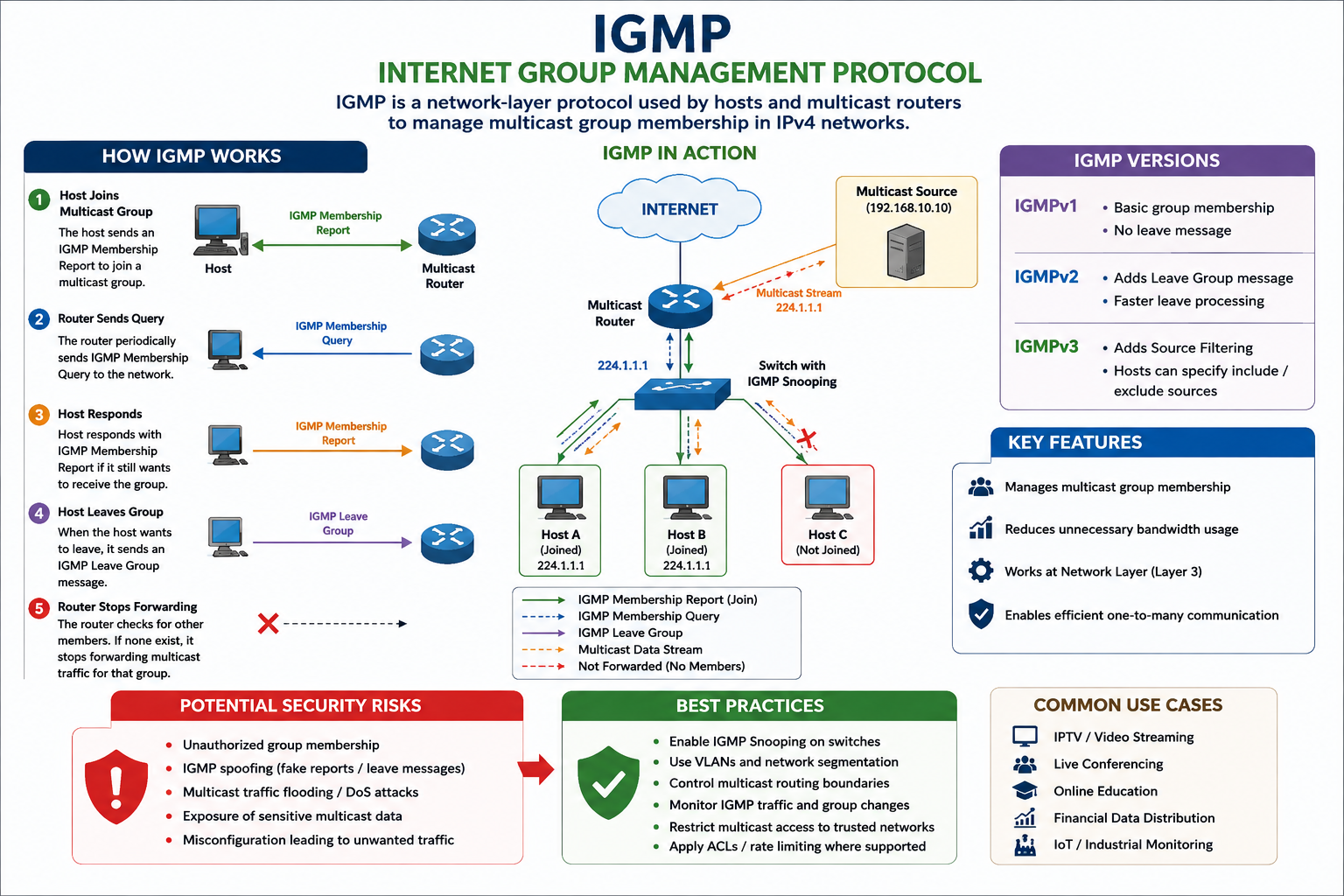
Introduction To IGMP
Internet Group Management Protocol (IGMP) Is A Network-layer Communication Protocol Used Primarily In IPv4 Networks To Manage multicast Group Membership. Multicast Allows A Single Source To Transmit Data To Multiple Receivers Simultaneously Without Sending An Individual Copy Of The Same Data To Every Device.
IGMP Enables Hosts And Multicast Routers To Communicate About Which Multicast Groups Are Needed On A Network. It Is Particularly Important For Applications Such As IPTV, Live Video Streaming, Online Conferencing, Financial Market Data Distribution, And Other One-to-many Communication Systems. Unlike TCP Or UDP, IGMP Does Not Transport Application Data Itself. Instead, It Manages The Membership Relationship Between Devices And Multicast Groups.
Meaning Of Multicast Communication
To Understand IGMP, It Is Useful To Understand Multicast Communication. Traditional Unicast Communication Involves One Sender Communicating With One Receiver. Broadcast Communication Sends Traffic To Every Device Within A Broadcast Domain.
Multicast Provides A Middle Ground: A Sender Transmits Traffic To A Specific Multicast Group, And Only Devices Interested In That Group Receive The Traffic. IPv4 Multicast Addresses Range From 224.0.0.0 To 239.255.255.255. A Device That Wants To Receive A Particular Multicast Stream Joins The Corresponding Multicast Group. IGMP Helps Routers Determine Which Local Devices Have Joined These Groups.
Why IGMP Is Required?
Without IGMP, Multicast Routers Would Have Difficulty Determining Which Hosts Actually Want Multicast Traffic. Consider An Organization Distributing A Live Training Video To Hundreds Of Computers. Sending The Video Separately To Every Computer Would Consume Significant Bandwidth.
Multicast Can Distribute The Stream Efficiently, But The Network Needs A Mechanism To Determine Which Devices Are Interested. IGMP Provides This Mechanism. Hosts Use IGMP Messages To Report Their Multicast Memberships, While Multicast Routers Use Queries To Discover Active Members. This Makes Multicast Delivery More Efficient And Prevents Unnecessary Multicast Traffic From Reaching Uninterested Systems.
How IGMP Works?
The Basic Operation Of IGMP Involves Multicast Hosts And Multicast Routers. When A Host Wants To Receive Traffic From A Multicast Group, It Sends An IGMP Membership Report. A Multicast Router Receives This Information And Records That At Least One Host On Its Interface Wants That Group. Periodically, The Router Sends IGMP Membership Queries To Discover Whether Hosts Are Still Interested.
Hosts Respond With Membership Reports When Necessary. When A Host No Longer Wants The Multicast Stream, It May Send A Leave Message, Depending On The IGMP Version. This Process Allows Multicast Forwarding Decisions To Adapt To Changing Network Requirements.
IGMP Versions
There Are Three Commonly Discussed Versions Of IGMP: IGMPv1, IGMPv2, And IGMPv3. IGMPv1 Introduced The Basic Multicast Membership-management Mechanism. IGMPv2 Improved Group-leave Handling And Introduced The Ability For Hosts To Explicitly Indicate That They Were Leaving A Multicast Group.
IGMPv3 Introduced source Filtering, Allowing Hosts To Specify Which Multicast Sources They Want To Receive From Or Exclude. IGMPv3 Is Therefore Particularly Useful For Applications Requiring More Precise Multicast Control. Network Administrators Should Understand The IGMP Version Supported By Their Routers, Switches, Operating Systems, And Multicast Applications.
IGMPv1
IGMPv1 Provides Fundamental Multicast Group Membership Functionality. Hosts Can Report That They Belong To A Multicast Group, While Routers Periodically Query Hosts To Determine Membership. However, IGMPv1 Does Not Provide An Explicit Leave Mechanism.
When A Host Stops Participating In A Multicast Group, The Router Eventually Discovers The Change Through Subsequent Membership Queries And Reports. Although This Approach Works, It Can Result In Multicast Traffic Continuing Temporarily After The Last Interested Host Has Stopped Receiving It. Modern Networks Generally Use Newer Versions Where Supported.
IGMPv2
IGMPv2 Introduced Several Improvements Over IGMPv1. One Important Enhancement Was The Leave Group Message. When A Host Leaves A Multicast Group, It Can Notify The Local Multicast Router. The Router Can Then Perform Additional Checks To Determine Whether Any Other Hosts Still Require The Multicast Stream.
This Can Reduce Unnecessary Multicast Traffic More Quickly. IGMPv2 Also Introduced A More Efficient Query Mechanism For Discovering Group Membership. These Improvements Made Multicast Management More Responsive And Practical For Applications Such As IPTV And Multimedia Distribution.
IGMPv3 And Source Filtering
IGMPv3 Provides More Sophisticated Multicast Membership Management By Supporting Source Filtering. A Host Can Indicate That It Wants Multicast Traffic From Specific Sources Or Does Not Want Traffic From Particular Sources. This Capability Is Important In Environments Where Multiple Sources Transmit To The Same Multicast Group.
Source Filtering Can Help Administrators Achieve More Precise Traffic Control And Can Contribute To Better Network Security. However, IGMP Itself Should Not Be Considered A Complete Security Mechanism Because Its Primary Purpose Is Multicast Membership Management Rather Than Authentication Or Encryption.
IGMP And The OSI Model
IGMP Operates At The Network Layer, Or Layer 3, Of The OSI Model. It Is Closely Associated With IPv4 Multicast Communication. IGMP Messages Are Carried Directly Within IPv4 Packets Rather Than Using TCP Or UDP Ports. This Is An Important Distinction Because Administrators Cannot Protect IGMP Simply By Blocking A Traditional TCP Or UDP Port.
Network Devices Such As Routers And Managed Switches Can Inspect And Control IGMP-related Traffic Using Multicast-management Features. Understanding Its Layer 3 Position Helps Network Engineers Design Appropriate Monitoring And Security Policies.
Is IGMP A Security Risk?
Yes, IGMP Can Introduce Security Risks If Multicast Traffic Is Not Properly Controlled, But IGMP Itself Is Not Inherently Malicious Or Insecure. The Potential Risk Comes From The Way Multicast Membership And Traffic Can Be Manipulated In Poorly Configured Networks.
An Attacker With Access To A Suitable Network Segment May Attempt To Generate Fraudulent IGMP Messages, Join Multicast Groups Unnecessarily, Create Excessive Multicast Traffic, Or Exploit Weaknesses In Multicast Configurations. Therefore, IGMP Should Be Managed As Part Of An Overall Network-security Strategy Rather Than Automatically Being Considered A Vulnerability.
IGMP-Based Traffic Abuse
One Potential Concern Is Unauthorized Multicast Membership. If A Network Accepts Multicast Membership Reports From Untrusted Devices, An Attacker May Attempt To Join Multicast Groups That Contain Sensitive Or Resource-intensive Traffic.
For Example, An Organization Might Use Multicast For Internal Video Distribution, Operational Information, Or Specialized Data Feeds. If Access Controls Are Weak, Unauthorized Systems Could Potentially Receive Traffic Intended For Legitimate Users. The Actual Exposure Depends Heavily On Network Architecture, Switch Configuration, Router Policies, Multicast Boundaries, And Whether The Application Itself Provides Additional Authentication Or Encryption.
IGMP Spoofing
Another Potential Security Issue Is IGMP Spoofing. Spoofing Occurs When An Attacker Creates Network Packets That Appear To Originate From Another System Or Represent Legitimate IGMP Messages. Depending On Network Configuration, Forged Membership Reports Could Cause Multicast Traffic To Be Forwarded To Unintended Interfaces. An Attacker Might Also Attempt To Generate Misleading Leave Or Query-related Traffic.
Network Devices With Appropriate IGMP Controls Can Reduce These Risks. Administrators Should Avoid Treating All IGMP Messages From Every Connected Device As Automatically Trustworthy, Especially On Networks Containing Untrusted Users.
Multicast Traffic Flooding
IGMP Can Also Be Associated With Multicast Traffic Flooding. An Attacker May Attempt To Join Many Multicast Groups Or Generate Large Amounts Of Multicast-related Traffic. Excessive Multicast Traffic Can Consume Switch Resources, Router Resources, Bandwidth, Or Endpoint Processing Capacity.
In Poorly Designed Networks, This May Contribute To Network Congestion Or A Denial-of-service Condition. The Impact Depends On The Bandwidth Available, Multicast Routing Configuration, Switch Architecture, And Whether Mechanisms Such As IGMP Snooping And Rate Limiting Are Enabled.
IGMP And Denial-of-Service Risks
A Poorly Configured Multicast Environment Can Potentially Become A Target For denial-of-service (DoS) Activity. An Attacker Might Attempt To Exploit Multicast Behavior To Cause Excessive Traffic Or Overload Network Devices. Multicast Amplification And Flooding Concerns Are Especially Important When Multicast Traffic Crosses Network Boundaries Without Appropriate Filtering.
Administrators Should Therefore Establish Clear Multicast Boundaries And Ensure That Multicast Forwarding Occurs Only Where Operationally Necessary. Monitoring Unusual Changes In Multicast Membership Can Also Help Identify Suspicious Activity.
IGMP Snooping
One Of The Most Important Technologies For Controlling Multicast Traffic On Ethernet Networks Is IGMP Snooping. Managed Switches Can Inspect IGMP Messages And Build A Table Identifying Which Switch Ports Are Interested In Particular Multicast Groups.
Instead Of Forwarding Multicast Traffic To Every Port, The Switch Can Send It Only To Ports With Interested Receivers. This Improves Bandwidth Utilization And Can Reduce Unnecessary Multicast Exposure. IGMP Snooping Is Therefore Useful For Both Network Performance And Security, Although It Should Not Be Viewed As A Complete Security Solution.
IGMP Snooping And Security
IGMP Snooping Can Reduce Some Security Risks Because It Limits Multicast Delivery To Ports That Have Expressed Interest In Specific Groups. However, It Does Not Automatically Authenticate The Identity Of Every Multicast Receiver. A Compromised Or Unauthorized Device May Still Attempt To Join Multicast Groups.
Administrators Should Combine IGMP Snooping With VLAN Segmentation, Port-security Mechanisms, Access-control Policies, And Appropriate Multicast Filtering. Where Supported, Features Such As IGMP Snooping Queriers And Controlled Multicast VLAN Configurations Can Further Improve Network Management.
IGMP Querier
An IGMP Querier Is A Device Responsible For Sending IGMP Queries On A Network Segment. Its Purpose Is To Discover Which Hosts Continue To Belong To Multicast Groups. In Networks Without A Multicast Router Performing This Role, A Switch Configured As An IGMP Snooping Querier May Provide The Required Functionality.
Incorrect Querier Configuration Can Cause Multicast Membership Information To Become Unreliable. From A Security Perspective, Administrators Should Ensure That Unauthorized Devices Cannot Easily Manipulate Multicast-control Behavior Or Introduce Unexpected Multicast-management Devices Into Trusted Network Segments.
Unauthorized Multicast Traffic
Unauthorized Multicast Traffic Can Become A Security Concern When An Organization Has No Defined Policy Governing Multicast Usage. A Network Might Contain Multicast Applications That Administrators Do Not Fully Understand Or Monitor. If Any Device Can Freely Generate Multicast Streams, Users Could Potentially Consume Significant Network Resources.
In Enterprise Environments, Multicast Should Normally Be Deployed Deliberately, With Documented Multicast Addresses, Source Systems, Receiver Groups, VLANs, And Routing Boundaries. Unknown Multicast Traffic Should Be Investigated Rather Than Automatically Allowed Throughout The Network.
IGMP And Sensitive Information
IGMP Does Not Encrypt Multicast Application Data. This Means That Joining A Multicast Group Does Not Provide Confidentiality. If Sensitive Information Is Transmitted Using Multicast, Additional Security Mechanisms May Be Required.
For Example, An Organization Distributing Confidential Video, Telemetry, Or Proprietary Information Should Consider Encryption And Application-level Authentication. Even If IGMP Membership Is Carefully Controlled, Protecting The Underlying Data Remains Essential. Network Administrators Should Remember That traffic Control And Data Confidentiality Are Separate Security Objectives.
Can IGMP Be Used For Network Attacks?
IGMP-related Traffic Can Potentially Be Abused As Part Of Broader Network Attacks. An Attacker Could Combine Multicast Manipulation With Traffic Flooding, Reconnaissance, Network Misconfiguration, Or Attempts To Exhaust Device Resources. However, The Severity Depends On The Specific Network Architecture And Security Controls.
IGMP Is Not Normally Considered An Attack Protocol By Itself. Rather, It Is A Legitimate Network-management Protocol That Can Become An Attack Surface When Implemented Or Configured Insecurely. This Distinction Is Important When Developing An Accurate Cybersecurity Policy.
Common IGMP Security Risks
Common Security Concerns Associated With IGMP And Multicast Environments Include Unauthorized Group Membership, Spoofed IGMP Messages, Multicast Flooding, Excessive Group Joins, Unauthorized Multicast Sources, Incorrect Multicast Routing, And Insufficient Network Segmentation.
Another Concern Is The Accidental Exposure Of Multicast Traffic To Network Segments That Do Not Require It. These Risks Become More Significant In Large Enterprise Networks, Campus Networks, Service-provider Environments, And Organizations Using IPTV Or Other High-bandwidth Multicast Applications.
How To Secure IGMP
Organizations Can Improve IGMP Security Through Several Measures. First, Enable IGMP Snooping On Managed Switches Where Multicast Is Required. Second, Use VLAN Segmentation To Separate Multicast Applications From Unrelated Users And Systems. Third, Establish Multicast Routing Boundaries So Traffic Cannot Travel Into Unauthorized Network Areas.
Fourth, Restrict Which Interfaces Can Participate In Multicast Where Possible. Fifth, Monitor Multicast Membership And Traffic Patterns. Finally, Keep Network-device Firmware And Operating Systems Updated. A Layered Approach Is More Effective Than Relying On IGMP Configuration Alone.
Network Segmentation And IGMP
Network Segmentation Is Particularly Important For Multicast Security. Organizations Can Place Multicast-enabled Applications Into Dedicated VLANs Or Controlled Network Segments. For Example, An IPTV Deployment May Use A Dedicated Multicast VLAN Rather Than Distributing Multicast Traffic Throughout The Entire Corporate Network.
Segmentation Limits The Number Of Systems Exposed To Multicast Traffic And Reduces The Potential Impact Of A Compromised Endpoint. Combining VLANs, Access-control Lists, Multicast Boundaries, And Switch-level Multicast Controls Can Create A Stronger Defense-in-depth Architecture.
Monitoring IGMP Traffic
Monitoring Is Another Important Part Of IGMP Security. Network Administrators Can Examine Multicast Group Memberships, IGMP Queries, Membership Reports, Leave Messages, Multicast Sources, And Traffic Volumes. Unexpected Changes Can Indicate Misconfiguration Or Potentially Malicious Activity.
Security Monitoring Platforms And Network-management Systems Can Help Establish A Baseline For Normal Multicast Behavior. For Example, A Sudden Increase In Multicast Groups Or Traffic From An Unfamiliar Device Should Trigger Investigation. Regular Monitoring Also Helps Identify Multicast Applications That Have Become Obsolete Or Unnecessarily Consume Network Resources.
IGMP Security In Enterprise Networks
In Enterprise Networks, IGMP Security Is Especially Relevant When Multicast Supports Business-critical Services. Examples Include IP Video Surveillance, Digital Signage, IPTV, Live Corporate Events, Industrial Telemetry, And Specialized Data Distribution.
Administrators Should Document Multicast Sources And Receivers And Apply Appropriate Access Policies. Multicast Should Not Automatically Be Enabled Across Every VLAN. Instead, Organizations Should Determine Where Multicast Is Genuinely Required And Limit Its Availability Elsewhere. This Reduces Both Performance Problems And Unnecessary Security Exposure.
IGMP Security In Campus And Educational Networks
Universities, Colleges, And Large Campuses May Have Thousands Of Devices Connected To Shared Network Infrastructure. If Multicast Is Used For Lectures, IPTV, Digital Signage, Or Other Services, Uncontrolled Multicast Can Create Significant Traffic.
Student Or Guest Networks Should Generally Be Separated From Trusted Administrative Multicast Environments. IGMP Snooping, VLAN Isolation, Access Controls, And Multicast Boundaries Can Help Prevent Unauthorized Access And Reduce The Possibility Of Multicast-related Disruption. Proper Configuration Becomes Increasingly Important As The Number Of Endpoints Grows.
IGMP And IPv6: An Important Distinction
A Common Misconception Is That IGMP Manages Multicast In Both IPv4 And IPv6. In Reality, IGMP Is Associated With IPv4 Multicast. IPv6 Uses The Multicast Listener Discovery (MLD) Protocol For Multicast Listener Management. MLD Serves A Similar Purpose In IPv6 Networks.
Therefore, Organizations Migrating To IPv6 Must Consider MLD Security And Multicast Controls As Well As IGMP. Understanding This Distinction Helps Network Engineers Avoid Applying IPv4-specific Security Assumptions To IPv6 Environments.
Advantages Of IGMP
Despite Its Potential Security Concerns, IGMP Provides Major Benefits. It Allows Networks To Efficiently Distribute One-to-many Traffic While Avoiding Unnecessary Duplication Of Data Streams. This Can Significantly Reduce Bandwidth Consumption Compared With Sending Separate Unicast Streams To Every Receiver.
IGMP Is Particularly Valuable For High-bandwidth Applications Such As Live Video, IPTV, Online Events, And Specialized Real-time Data Distribution. When Properly Designed And Secured, Multicast Can Be Highly Efficient And Reliable. The Objective Should Therefore Be Controlled And Secure Multicast Deployment Rather Than Eliminating IGMP Unnecessarily.
Best Practices For IGMP Security
A Strong IGMP Security Strategy Should Include IGMP Snooping, VLAN Segmentation, Multicast Access Controls, Controlled Multicast Routing, Network Monitoring, Device Hardening, Firmware Updates, And Traffic-rate Controls Where Appropriate.
Administrators Should Also Disable Unnecessary Multicast Functionality On Network Segments That Do Not Require It. Sensitive Multicast Applications Should Use Encryption And Application-level Authentication Where Appropriate. Regular Audits Should Identify Unexpected Multicast Sources And Receivers. These Practices Reduce The Likelihood That Multicast Configuration Weaknesses Can Be Exploited To Access Information Or Degrade Network Performance.
Conclusion
IGMP Is An Important Protocol For Managing Multicast Group Membership In IPv4 Networks. It Enables Hosts And Multicast Routers To Coordinate The Delivery Of Multicast Traffic Efficiently, Making It Useful For IPTV, Video Distribution, Conferencing, Telemetry, And Other One-to-many Applications.
IGMP Is Not Inherently A Security Threat, But Poorly Configured Multicast Networks Can Create Security And Availability Risks. Unauthorized Group Membership, Spoofed Messages, Multicast Flooding, Excessive Traffic, And Inadequate Segmentation Are Among The Concerns Administrators Should Consider.
Using IGMP Snooping, VLAN Isolation, Multicast Filtering, Access Controls, Monitoring, And Encryption For Sensitive Application Data Can Substantially Improve Security. Ultimately, IGMP Should Be Treated As A Legitimate Network Service That Requires Appropriate Controls Rather Than As A Protocol That Is Inherently Dangerous.
Tags:
What Is IGMP, Internet Group Management Protocol (IGMP), IGMP Versions, IGMP Spoofing