What Is NetBIOS In The Session Layer?
Category: NETWORKING | 21st September 2026, Monday
Introduction
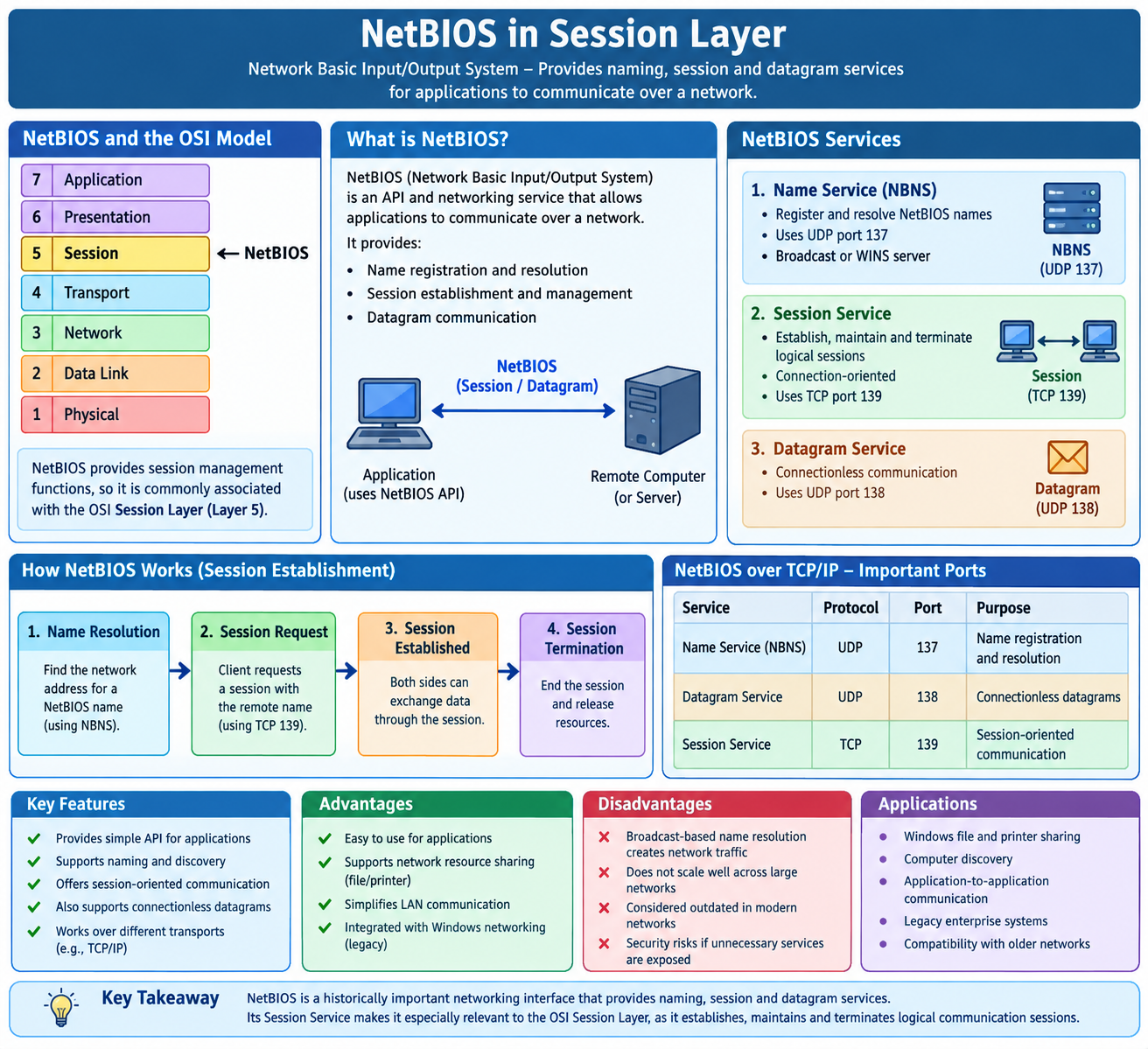
NetBIOS, Which Stands For Network Basic Input/Output System, Is An Application Programming Interface (API) And Communication Service Originally Designed To Allow Applications On Networked Computers To Communicate With One Another. It Provides Services For name Registration, Name Resolution, Session Establishment, And Datagram Communication. In The Context Of The OSI Model, NetBIOS Is Commonly Associated With The Session Layer (Layer 5) Because One Of Its Major Functions Is Establishing And Managing Communication Sessions Between Network Applications.
NetBIOS And The OSI Model
The OSI Model Divides Network Communication Into Seven Layers: Physical, Data Link, Network, Transport, Session, Presentation, And Application. NetBIOS Is Generally Discussed In Relation To The Session Layer, Although It Is Technically An API And Service Interface Rather Than A Pure OSI Layer 5 Protocol. Its Session-management Functions Provide Capabilities That Closely Correspond To Session Layer Responsibilities Such As Establishing, Maintaining, And Terminating Logical Communication Sessions.
Historical Background Of NetBIOS
NetBIOS Was Originally Developed By IBM For Its PC Network Technology During The 1980s. Microsoft Later Adopted And Extended NetBIOS For Networking Between Personal Computers. As LAN Technologies Evolved, NetBIOS Became Widely Used In Microsoft Windows Networking. It Was Particularly Important In Early Peer-to-peer Networks And Local-area Networks Where Computers Needed Simple Mechanisms For Identifying And Communicating With Other Computers.
Meaning Of NetBIOS
The Term Network Basic Input/Output System Indicates That NetBIOS Provides Basic Network Communication Capabilities To Applications. It Gives Applications An Interface Through Which They Can Communicate Without Having To Directly Implement Lower-level Networking Mechanisms. A Program Can Use NetBIOS Services To Identify A Computer Or Application, Establish A Session, Send Information, And Terminate The Communication.
NetBIOS Is Not The Same As NetBEUI
NetBIOS And NetBEUI Are Often Confused. NetBIOS Is Primarily An API And Networking Service Interface, While NetBEUI, Or NetBIOS Extended User Interface, Is A Protocol Implementation Associated With NetBIOS Communication. NetBEUI Was Designed For Small LAN Environments And Did Not Provide Routing Across Large IP Networks. NetBIOS Functionality Was Later Carried Over Protocols Such As TCP/IP.
NetBIOS Over TCP/IP
One Of The Most Important Implementations Is NetBIOS Over TCP/IP, Commonly Abbreviated As NetBT Or NBT. It Allows Applications Using NetBIOS Services To Communicate Over TCP/IP Networks. This Was Particularly Important Because TCP/IP Became The Dominant Networking Protocol Suite For LANs And The Internet. NetBIOS Applications Could Therefore Continue Operating While The Underlying Network Infrastructure Transitioned To TCP/IP.
NetBIOS Name Service
The NetBIOS Name Service (NBNS) Provides Name-related Functionality. NetBIOS Devices And Services Can Have NetBIOS Names That Identify Them Within A Network. Before Communication Occurs, A Computer May Need To Determine The Network Address Associated With A Particular NetBIOS Name. NBNS Provides Mechanisms For Registering And Resolving These Names.
NetBIOS Names
A NetBIOS Name Traditionally Consists Of Up To 15 Characters Plus A 16th Byte Used For Service Identification. The Additional Byte Can Identify A Particular Service Or Role Associated With The Name. For Example, Different NetBIOS Names Can Represent Workstation, Server, Messenger, Or Other Network Services. This Naming Mechanism Was Particularly Useful In Windows-based LAN Environments.
Name Registration
Before A NetBIOS Service Can Be Discovered, Its Name May Need To Be Registered. Name Registration Tells The Network That A Particular NetBIOS Name Is Associated With A Particular Computer Or Network Endpoint. Registration Can Be Performed Using Broadcast Mechanisms Or Through A NetBIOS Name Server When One Is Available.
Name Resolution
After Registration, Another Computer Can Perform NetBIOS Name Resolution To Determine Where A Particular Named Resource Is Located. Name Resolution Converts A Logical NetBIOS Name Into Information Needed To Communicate With The Corresponding System. This Is Conceptually Similar To The Role DNS Plays In Resolving Domain Names, Although NetBIOS Naming And DNS Are Different Systems.
NetBIOS Session Service
The NetBIOS Session Service Is Particularly Relevant To The OSI Session Layer. It Allows Two Applications To Establish A Logical Communication Session. A Session Provides A Structured Communication Relationship Between Two Endpoints. Once The Session Has Been Established, Applications Can Exchange Data Through The NetBIOS Session Interface.
Session Establishment
Session Establishment Generally Begins When A Client Requests Communication With A Remote NetBIOS Name. The Remote System Accepts Or Rejects The Session Request. If The Request Is Accepted, A Logical Session Is Established. Applications Can Then Exchange Data Through That Session Rather Than Repeatedly Establishing A New Communication Relationship For Every Message.
Session Maintenance
After A Session Is Established, NetBIOS Provides Mechanisms For Maintaining The Communication Relationship. The Endpoints Can Exchange Data And Control Information While The Session Remains Active. Session-oriented Communication Is Useful For Applications That Need An Ongoing Logical Connection Between Two Network Processes.
Session Termination
When Communication Is Finished, The NetBIOS Session Can Be Terminated. Either Endpoint Can Initiate The Termination Process Depending On The Circumstances. Proper Termination Releases Resources Associated With The Communication Session. This Reflects An Important Session Layer Responsibility: Controlling The Beginning And End Of Logical Communication Relationships.
NetBIOS Datagram Service
NetBIOS Also Provides A Datagram Service. Unlike The Session Service, Datagrams Are Connectionless. An Application Can Send A Datagram Without Establishing A Persistent Session With The Destination. This Makes Datagrams Useful For Certain Discovery, Notification, And Broadcast-oriented Operations.
Connection-Oriented And Connectionless Communication
NetBIOS Therefore Provides Two Important Communication Approaches. Session Service Provides Connection-oriented Communication, While Datagram Service Provides Connectionless Communication. The Choice Depends On Application Requirements. Applications Requiring An Ongoing Communication Relationship Can Use Sessions, While Applications Needing Simple Message Delivery Can Use Datagrams.
NetBIOS Session Service And TCP
When NetBIOS Is Implemented Over TCP/IP, The Session Service Commonly Uses TCP Port 139. TCP Provides Reliable, Connection-oriented Transport, While NetBIOS Session Service Provides An Application-facing Session Mechanism. Therefore, Several Layers Cooperate To Provide Communication Between Applications.
NetBIOS Name Service And UDP
NetBIOS Name Service Traditionally Uses UDP Port 137 When Operating Over TCP/IP. UDP Is Used Because Name Registration And Resolution Can Be Performed Using Relatively Small Request And Response Messages. Broadcast-based Discovery Can Also Benefit From UDP's Connectionless Communication Model.
NetBIOS Datagram Service And UDP
NetBIOS Datagram Service Traditionally Uses UDP Port 138 Over TCP/IP. Datagram Communication Does Not Require A Persistent TCP Connection. A NetBIOS Application Can Send A Datagram Directly Toward Another Endpoint Or Broadcast It To Multiple Systems, Depending On The Network Configuration.
Important NetBIOS Ports
The Three Traditional NetBIOS Over TCP/IP Ports Are Therefore UDP 137 For NetBIOS Name Service, UDP 138 For NetBIOS Datagram Service, And TCP 139 For NetBIOS Session Service. These Ports Are Important From Both Networking And Security Perspectives Because Exposed NetBIOS Services Can Reveal Information About Network Systems.
NetBIOS And Windows Networking
NetBIOS Became Deeply Associated With Microsoft Windows Networking. Earlier Windows Environments Used NetBIOS-based Mechanisms For Computer Discovery, File Sharing, Printer Sharing, And Communication Between Networked Systems. Users Could Often Access Computers By Familiar Computer Names Instead Of Manually Entering IP Addresses.
NetBIOS And SMB
NetBIOS Was Historically Used As A Transport Mechanism For Server Message Block (SMB) Communication. SMB Provides File And Printer Sharing And Other Network Services. Earlier Versions Of SMB Commonly Operated Over NetBIOS Session Service. Modern SMB Deployments, However, Can Operate Directly Over TCP Using TCP Port 445, Reducing Dependence On NetBIOS.
NetBIOS And Computer Discovery
NetBIOS Names Helped Computers Discover Other Systems On Local Networks. A User Could Browse A Network And See Computers Identified By Their Names. This Capability Contributed Significantly To The Usability Of Early Windows LAN Environments. Modern Windows Networks Increasingly Rely On Other Discovery And Naming Mechanisms.
Broadcast-Based NetBIOS
In Networks Without A Dedicated NetBIOS Name Server, NetBIOS Can Use Broadcast-based Mechanisms For Name Discovery. A Computer Can Broadcast A Name Query, And The System Owning That Name Can Respond. This Approach Works Reasonably Well On Local Networks But Does Not Scale Efficiently Across Routed Networks.
WINS
Windows Internet Name Service (WINS) Was Introduced To Provide Centralized NetBIOS Name Registration And Resolution. Instead Of Relying Entirely On Broadcasts, Computers Could Register Their NetBIOS Names With A WINS Server. Other Computers Could Query That Server When They Needed To Resolve A NetBIOS Name.
Advantages Of NetBIOS
NetBIOS Historically Provided Several Useful Capabilities. It Offered A Relatively Simple Programming Interface, Supported Network Naming, Enabled Session-oriented Communication, And Simplified Communication Between Applications On LANs. Its Integration With Windows Networking Also Made It Convenient For File Sharing And Printer Sharing In Traditional LAN Environments.
Disadvantages Of NetBIOS
NetBIOS Has Several Limitations. Broadcast-based Name Resolution Can Generate Network Traffic And Does Not Scale Well Across Large Networks. NetBIOS Was Also Designed During An Era When LAN Architectures Were Considerably Simpler Than Today's Internet-connected Environments. Modern Networks Frequently Use DNS, TCP/IP, SMB Over TCP, And Other Technologies Instead Of Relying On NetBIOS.
NetBIOS Security Concerns
NetBIOS Can Create Security Concerns When Its Services Are Unnecessarily Exposed. Information Associated With NetBIOS Name Services May Help Reveal Computer Names, Network Roles, And Other Details About A Local Environment. Attackers Can Potentially Use Network Enumeration Techniques To Identify Systems And Services.
NetBIOS Enumeration
NetBIOS Enumeration Refers To Collecting Information From NetBIOS-enabled Systems. Depending On Configuration, Information May Include Computer Names, Workgroup Or Domain Information, And Available Services. Security Professionals May Use Authorized Enumeration During Vulnerability Assessments To Identify Unnecessarily Exposed Services.
Network Scanning And NetBIOS
Network Administrators And Security Teams Can Examine Ports 137, 138, And 139 To Determine Whether NetBIOS-related Services Are Exposed. If These Services Are Unnecessary, Organizations Can Restrict Or Disable Them. Firewalls Can Also Limit NetBIOS Traffic To Trusted Network Segments.
NetBIOS And Modern Networks
NetBIOS Is Much Less Central To Modern Networking Than It Was In Earlier Windows Environments. Modern Windows Systems Commonly Use DNS For Name Resolution And SMB Directly Over TCP. Nevertheless, NetBIOS Remains Relevant When Dealing With Legacy Systems, Older Applications, Compatibility Requirements, And Certain Enterprise Network Configurations.
NetBIOS Compared With DNS
NetBIOS Name Service And DNS Both Perform Name-resolution Functions, But They Operate Differently. DNS Is A Hierarchical, Distributed Naming System Designed For Large-scale Networks And The Internet. NetBIOS Naming Was Primarily Designed For Local Network Environments. Modern Networks Generally Depend Heavily On DNS Rather Than Broadcast-based NetBIOS Resolution.
NetBIOS Compared With TCP/IP
NetBIOS And TCP/IP Serve Different Purposes. TCP/IP Is A Complete Protocol Suite Containing Protocols For Network Communication, Routing, Transport, And Applications. NetBIOS Provides An Application Programming And Communication Service Interface That Can Operate Over Different Network Transports. NetBIOS Over TCP/IP Combines The Two Technologies.
NetBIOS As A Session Layer Concept
From An OSI Perspective, The Most Important NetBIOS Concept Is Its Ability To Manage logical Sessions Between Applications. The Session Layer Is Responsible For Establishing, Maintaining, Synchronizing, And Terminating Communication Sessions. NetBIOS Session Service Provides Functions That Correspond Closely To These Responsibilities.
NetBIOS Session Synchronization
Session-oriented Communication Can Involve Synchronization And Control Mechanisms That Help Applications Maintain An Organized Exchange Of Information. NetBIOS Includes Session-level Control Operations That Allow Endpoints To Manage Communication And Respond To Session Events. This Makes It Useful As An Example When Studying Session Layer Concepts.
Applications Of NetBIOS
Historically, NetBIOS Was Used For Windows File Sharing, Printer Sharing, LAN Computer Discovery, Application-to-application Communication, And Network Resource Identification. It Was Particularly Common In Small And Medium-sized Windows Networks. Legacy Enterprise Applications May Also Continue To Depend On NetBIOS-related Functionality.
NetBIOS Troubleshooting
Network Administrators Troubleshooting Legacy Windows Connectivity May Encounter NetBIOS-related Problems. Common Issues Include Failed Name Resolution, Disabled NetBIOS Settings, Firewall Restrictions, Incorrect WINS Configuration, And Communication Problems Involving TCP/UDP Ports 137–139. Tools Such As nbtstat Can Provide Information About NetBIOS Names And Sessions.
NetBIOS Security Best Practices
Organizations That Do Not Require NetBIOS Should Consider Disabling Unnecessary NetBIOS Functionality, Particularly On Systems Where Compatibility Is Not Needed. Firewalls Should Restrict Unnecessary Access To Ports 137–139. Network Segmentation Can Further Limit Exposure. Administrators Should Also Maintain Modern SMB Configurations And Avoid Exposing Legacy Windows Networking Services Directly To Untrusted Networks Or The Internet.
Importance Of NetBIOS In Networking Education
Although NetBIOS Is No Longer The Primary Technology For Modern Network Communication, It Remains Valuable For Understanding Networking History And OSI Concepts. It Demonstrates How Application Interfaces, Naming Systems, Sessions, Datagrams, And Transport Protocols Can Work Together. It Is Particularly Useful When Studying The Session Layer And Legacy Windows Networking Architectures.
Conclusion
NetBIOS, Or Network Basic Input/Output System, Is A Historically Important Networking Interface That Provided Naming, Session, And Datagram Communication Services. Its Session Service Makes It Especially Relevant To The OSI Session Layer Because It Establishes, Maintains, And Terminates Logical Communication Sessions. When Used Over TCP/IP, NetBIOS Commonly Employs UDP 137 For Name Service, UDP 138 For Datagrams, And TCP 139 For Session Service. Although Modern Networks Increasingly Rely On DNS And SMB Over TCP Port 445 Instead Of NetBIOS, Understanding NetBIOS Remains Important For Networking Education, Legacy-system Administration, Troubleshooting, And Cybersecurity.
Tags:
NetBIOS, NetBIOS And The OSI Model, Meaning Of NetBIOS, NetBIOS Over TCP/IP, NetBIOS Name Service, NetBIOS Names