What Is SCTP? — Stream Control Transmission Protocol
Category: NETWORKING | 19th September 2026, Saturday
Introduction To SCTP
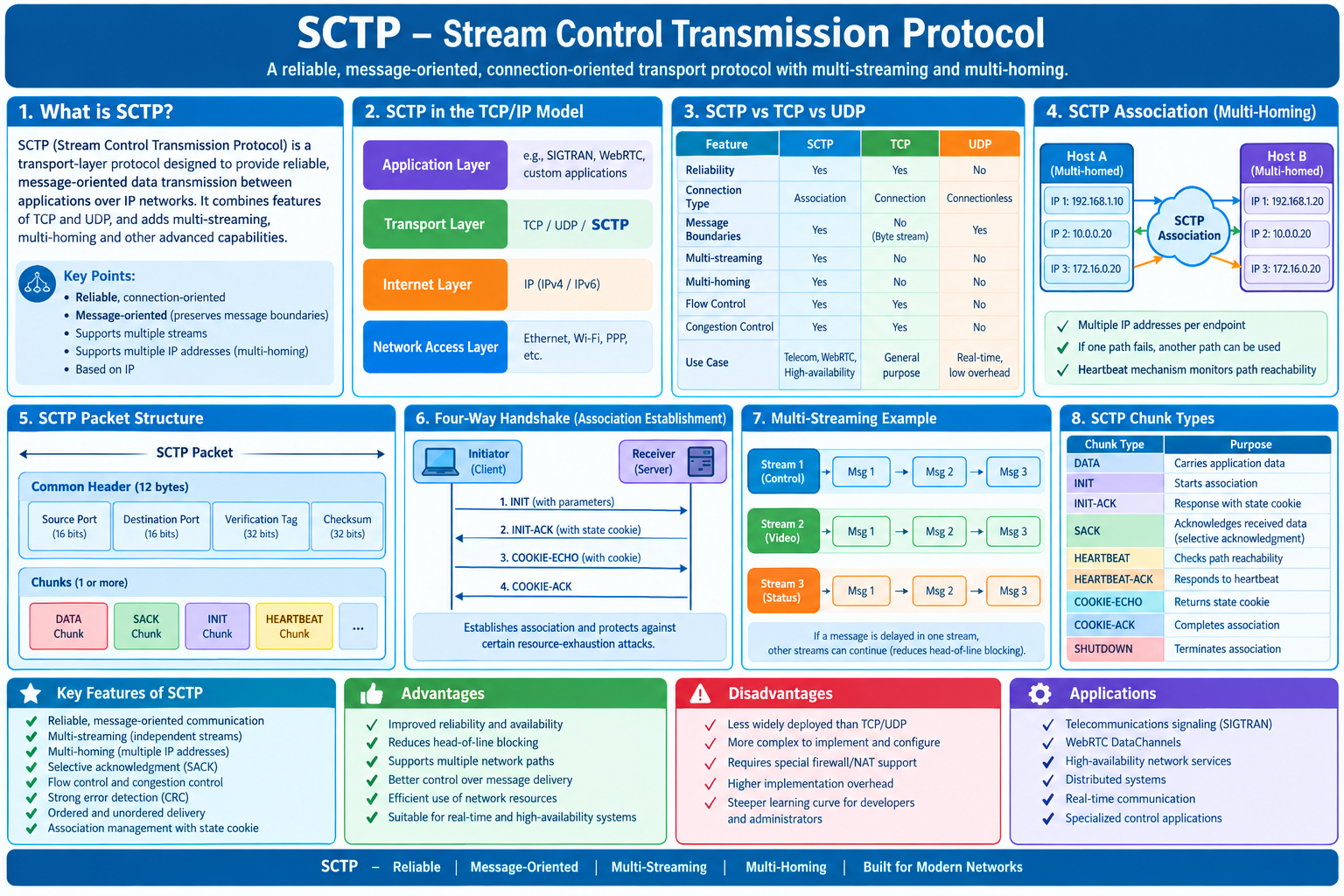
SCTP (Stream Control Transmission Protocol) Is A Transport-layer Communication Protocol Designed To Provide Reliable, Message-oriented Data Transmission Between Applications Over IP Networks. It Was Originally Developed To Transport Signaling Messages In Telecommunications Networks, But Its Capabilities Make It Useful For Many Other Applications. SCTP Combines Characteristics Of TCP And UDP While Introducing Additional Features Such As Multi-streaming, Multi-homing, Message Boundaries, And Improved Resistance To Certain Network Failures.
Definition Of SCTP
SCTP Is A reliable, Connection-oriented, Message-oriented Transport Protocol. It Operates Above The Internet Protocol (IP) And Provides Communication Between Applications Running On Different Hosts. Unlike TCP, Which Provides A Continuous Byte Stream, SCTP Preserves Individual Message Boundaries. This Means An Application Can Send A Message As One Unit, And SCTP Maintains That Message Structure During Transmission.
Development Of SCTP
SCTP Was Developed Primarily To Support The Requirements Of telecommunications Signaling Over IP Networks. Traditional Telecommunications Systems Used Specialized Signaling Networks, And The Migration Toward IP-based Infrastructures Created A Need For A Transport Protocol With Stronger Reliability And Availability Characteristics. SCTP Was Standardized By The Internet Engineering Task Force (IETF). Its Core Specification Is Defined In RFC 4960.
Why SCTP Was Needed
TCP Provides Reliable Transmission, But Its Design Has Limitations For Certain Telecommunications And Message-oriented Applications. TCP Treats Data As An Ordered Byte Stream And Normally Associates A Connection With One Local And One Remote Endpoint. SCTP Was Designed To Address Requirements Such As Preservation Of Message Boundaries, Multiple Independent Streams, And Multiple Network Addresses. These Capabilities Can Improve Resilience And Application-level Communication Efficiency In Appropriate Environments.
SCTP In The TCP/IP Model
SCTP Belongs To The Transport Layer Of The TCP/IP Protocol Architecture. The Transport Layer Provides Communication Services Between Applications Running On Different Hosts. Other Important Transport Protocols Include TCP And UDP. SCTP Occupies A Position Between The Application And Internet Layers: Applications Interact With SCTP, While SCTP Uses IP To Transport Packets Across Networks.
SCTP Compared With TCP And UDP
SCTP Combines Characteristics Associated With Both TCP And UDP While Adding Features Of Its Own. Like TCP, SCTP Provides Reliable Delivery, Sequencing, Acknowledgments, Flow Control, And Congestion Control. Like UDP, It Preserves Message-oriented Communication Rather Than Presenting Applications With Only A Byte Stream. SCTP Additionally Supports multi-streaming And Multi-homing, Which Are Two Of Its Most Distinctive Capabilities.
Association Instead Of Connection
TCP Commonly Describes Communication As A Connection, Whereas SCTP Uses The Term association. An SCTP Association Represents The Logical Communication Relationship Between Two Endpoints. An Association Can Involve Multiple IP Addresses On Either Endpoint. This Concept Is Particularly Important For Multi-homed Systems Because The Association Can Remain Operational Even When One Network Path Becomes Unavailable.
Message-Oriented Communication
One Of SCTP's Fundamental Characteristics Is That It Is message-oriented. Applications Send Messages To SCTP Rather Than Simply Writing An Uninterrupted Byte Stream. SCTP Preserves Message Boundaries. For Example, If An Application Sends Three Separate Messages, SCTP Can Deliver Them As Three Separate Messages To The Receiving Application, Subject To The Selected Stream And Ordering Options.
SCTP Packets
SCTP Communication Is Based On Packets Containing A Common Header Followed By One Or More chunks. The Common Header Contains Important Information Such As Source Port, Destination Port, Verification Tag, And Checksum. Chunks Contain Control Information Or User Data. This Chunk-based Architecture Allows SCTP To Combine Different Types Of Information Within SCTP Packets Efficiently.
SCTP Chunks
A chunk Is A Fundamental Building Block Of SCTP Packets. There Are Several Types Of Chunks, Including DATA, INIT, INIT-ACK, SACK, HEARTBEAT, HEARTBEAT-ACK, COOKIE-ECHO, COOKIE-ACK, And SHUTDOWN. DATA Chunks Carry Application Messages, While Control Chunks Perform Functions Such As Establishing Associations, Acknowledging Data, Monitoring Paths, And Terminating Associations.
SCTP Four-Way Handshake
SCTP Uses A Specialized four-way Association Establishment Procedure. The Initiating Endpoint Sends An INIT Chunk. The Receiving Endpoint Responds With INIT-ACK, Which Contains A State Cookie. The Initiating Endpoint Then Sends COOKIE-ECHO, And The Receiver Responds With COOKIE-ACK. This Procedure Helps Establish The Association And Provides Protection Against Certain Resource-exhaustion Attacks Associated With Connection Establishment.
SCTP State Cookie
The state Cookie Is An Important Feature Of SCTP Association Establishment. The Responding Endpoint Can Encode Association Information Into A Cookie Rather Than Immediately Maintaining Substantial State For The Initiator. The Initiator Returns The Cookie Using COOKIE-ECHO. This Mechanism Helps Reduce The Impact Of Certain Attacks In Which An Attacker Sends Large Numbers Of Fake Association Requests.
SCTP Data Transfer
After An SCTP Association Has Been Established, Applications Can Transfer Data Using DATA Chunks. Each DATA Chunk Contains Information That Allows SCTP To Identify The Stream, Sequence The Data, And Associate It With The Appropriate Transmission. SCTP Can Send Multiple Messages Within A Packet When Appropriate, Allowing Efficient Utilization Of Network Resources.
Transmission Sequence Number
SCTP Uses A Transmission Sequence Number (TSN) To Identify Transmitted DATA Chunks. TSNs Are Used By The Receiving Endpoint To Acknowledge Received Data And Identify Gaps In The Received Sequence. This Mechanism Helps SCTP Detect Missing Data And Perform Retransmission When Required. TSNs Are Associated With The Overall Association Rather Than Being Independently Numbered For Each Stream.
Stream Sequence Number
SCTP Also Uses A Stream Sequence Number (SSN) For Ordered Messages Within Individual Streams. This Distinction Between TSNs And Stream Sequence Numbers Is Important. TSNs Help SCTP Manage Reliable Transmission Across The Association, While Stream Sequence Numbers Allow The Receiving Application To Determine The Ordering Of Messages Within A Particular Stream.
Multi-Streaming
Multi-streaming Is One Of SCTP's Most Important Features. A Single SCTP Association Can Contain Multiple Logical Streams. Each Stream Can Carry A Separate Sequence Of Application Messages. If Data Is Delayed Or Lost In One Stream, It Does Not Necessarily Prevent Data From Other Streams From Being Delivered. This Can Reduce The Head-of-line Blocking Associated With TCP's Single Ordered Byte Stream.
Example Of Multi-Streaming
Consider An Application Transmitting Three Categories Of Information: Control Messages, Video Information, And Status Information. SCTP Can Place These Messages Into Separate Streams Within The Same Association. If A Message In The Video Stream Requires Retransmission, Messages In Another Stream May Continue To Be Delivered Without Waiting For The Delayed Message, Depending On The Application's Ordering Requirements.
Ordered And Unordered Delivery
SCTP Supports Both ordered And Unordered Message Delivery. In Ordered Delivery, Messages Within A Stream Are Delivered According To Their Sequence. In Unordered Delivery, An Application Can Request That Messages Be Delivered Without Waiting For Earlier Messages In That Stream. Unordered Delivery Can Be Useful When The Latest Information Is More Important Than Maintaining Strict Message Order.
Multi-Homing
Another Major SCTP Capability Is multi-homing. An SCTP Endpoint Can Have Multiple IP Addresses Associated With An SCTP Association. These Addresses Can Represent Multiple Network Interfaces Or Network Paths. If One Path Fails, SCTP Can Use Another Available Path. This Provides A Degree Of Network Redundancy That Is Not Inherent In A Traditional Single-path TCP Connection.
Primary And Secondary Paths
In A Multi-homed SCTP Association, One Path Can Be Designated As The primary Path For Data Transmission. Other Paths Can Serve As Alternative Or Backup Paths. SCTP Can Monitor These Paths And Detect Failures. When The Primary Path Becomes Unavailable, SCTP Can Switch Transmission Toward An Alternative Path When The Association And Network Configuration Permit It.
Heartbeat Mechanism
SCTP Uses A HEARTBEAT Mechanism To Monitor The Reachability Of Network Paths. An Endpoint Can Send A HEARTBEAT Chunk To A Destination Address, And The Remote Endpoint Responds With HEARTBEAT-ACK. Successful Responses Provide Evidence That The Path Remains Reachable. This Mechanism Is Particularly Useful For Multi-homed Systems Because SCTP Needs To Know Which Paths Are Currently Operational.
Reliability Of SCTP
SCTP Provides Reliable Data Transfer Through Acknowledgments, Sequence Information, Retransmission Mechanisms, And Checksums. When An SCTP Endpoint Receives Data, It Can Acknowledge Received Information Using SACK (Selective Acknowledgment) Chunks. Missing Data Can Be Identified Through Gaps In Acknowledgment Information, Allowing SCTP To Retransmit Only The Required Information.
Selective Acknowledgment
Selective Acknowledgment, Or SACK, Is An Important SCTP Feature. Rather Than Merely Indicating That Data Has Been Received Up To A Particular Point, An SCTP Receiver Can Report Additional Chunks That Arrived Beyond A Missing Chunk. The Sender Can Therefore Determine Which Data Is Missing And Which Data Has Already Arrived. This Can Improve Efficiency When Packet Loss Occurs.
Flow Control
SCTP Provides flow Control To Prevent A Sender From Overwhelming A Receiver. The Receiving Endpoint Advertises Available Receive-buffer Capacity. The Sender Considers This Information When Determining How Much Data Can Be Outstanding. Flow Control Helps Ensure That Differences In Processing Speed And Memory Resources Do Not Cause Excessive Buffering Or Data Loss At The Receiving Host.
Congestion Control
SCTP Also Implements congestion-control Mechanisms. The Protocol Monitors Network Conditions And Adjusts Transmission Behavior When Congestion Is Detected. SCTP Congestion Control Has Similarities To TCP's Congestion-control Principles. Its Objective Is To Use Network Capacity Efficiently While Reducing The Possibility That An SCTP Sender Will Contribute Excessively To Network Congestion.
Error Detection
SCTP Uses A 32-bit CRC (Cyclic Redundancy Check) To Detect Corruption In SCTP Packets. The CRC Checksum Provides Stronger Error-detection Properties Than A Simple Checksum. If A Packet Fails The Integrity Check, The Receiving Endpoint Can Discard It Rather Than Passing Corrupted Data To The Transport Processing Or Application.
SCTP Security Considerations
SCTP Includes Mechanisms Designed To Make Association Establishment More Resistant To Certain Attacks, Including The Use Of State Cookies. However, SCTP Is Not A Complete Security Solution. Confidentiality And Authentication Of Application Data May Require Additional Technologies Such As TLS Over SCTP, IPsec, Or Application-specific Security Mechanisms. Firewalls And Intrusion-detection Systems Must Also Be Configured To Recognize SCTP Traffic When It Is Used.
SCTP Port Numbers
Like TCP And UDP, SCTP Uses source And Destination Port Numbers. Port Numbers Allow Multiple Applications Or Services To Communicate Through The Same IP Address. A Client Can Use A Source Port While Connecting To A Service Identified By A Destination Port. This Mechanism Allows SCTP To Support Multiple Services On The Same Host.
SCTP And Telecommunications
SCTP Was Initially Associated Strongly With telecommunications Signaling. One Important Use Is Transporting Signaling Protocols Such As SIGTRAN Over IP Networks. Telecommunications Systems Require Reliable Signaling, Message Boundaries, And High Availability. SCTP's Multi-homing And Multi-streaming Capabilities Make It Suitable For Environments Where Network Resilience And Structured Message Transport Are Important.
SCTP And SIGTRAN
SIGTRAN Is A Family Of Protocols Used To Transport Traditional Telecommunications Signaling Over IP Networks. SCTP Provides The Transport Foundation For Several SIGTRAN Protocols. For Example, Protocols Such As M2PA, M2UA, M3UA, And SUA Can Use SCTP To Transport Signaling Information. This Combination Helped Telecommunications Networks Migrate From Traditional Signaling Infrastructures Toward IP-based Networks.
SCTP In WebRTC
SCTP Also Has An Important Role In WebRTC (Web Real-Time Communication). WebRTC DataChannels Use SCTP, Commonly Carried Over DTLS And UDP In The WebRTC Architecture. This Allows Browsers And Other WebRTC Implementations To Exchange Application Data With Features Such As Reliable Or Partially Reliable Delivery, Ordered Or Unordered Transmission, And Multiple Logical Channels.
Partial Reliability
SCTP Can Support Partial Reliability SCTP (PR-SCTP) Through An Extension. Traditional Reliable Transport Attempts To Retransmit Lost Information Until It Can Be Delivered Or The Association Fails. Some Real-time Applications May Not Need Every Message To Arrive If It Becomes Obsolete. Partial Reliability Allows Applications To Specify Policies Under Which Certain Data May Be Abandoned Instead Of Being Retransmitted Indefinitely.
Advantages Of SCTP
SCTP Provides Several Advantages. These Include reliable Message-oriented Communication, Multi-streaming, Multi-homing, Selective Acknowledgment, Flow Control, Congestion Control, Strong Error Detection, Ordered And Unordered Delivery, And Association-level Resilience. These Capabilities Make SCTP Particularly Attractive For Applications Where Reliability, Availability, And Message Boundaries Are Important.
Disadvantages Of SCTP
Despite Its Capabilities, SCTP Also Has Limitations. It Is Less Widely Deployed Than TCP And UDP, Which Means Application And Network-device Support Can Be More Limited. Network Administrators May Need Additional Configuration For Firewalls, NAT Devices, And Security Systems. Developers And Administrators Also Need Specialized Knowledge Of SCTP Concepts Such As Associations, Streams, Chunks, TSNs, And Multi-homing.
SCTP Vs TCP
SCTP And TCP Both Provide Reliable Transport, But They Differ Significantly. TCP Provides An Ordered Byte Stream, Whereas SCTP Provides Message-oriented Communication. TCP Generally Uses A Single Network Path Per Connection, While SCTP Can Support Multiple IP Addresses Through Multi-homing. SCTP Also Provides Multiple Streams Within An Association, Reducing Certain Forms Of Head-of-line Blocking.
SCTP Vs UDP
SCTP Provides Considerably More Functionality Than UDP. UDP Is Connectionless And Does Not Guarantee Delivery, Ordering, Or Retransmission. SCTP Provides Reliable Delivery, Acknowledgments, Congestion Control, Flow Control, And Association Management. However, UDP Has Very Low Protocol Complexity And Extremely Broad Deployment. Therefore, The Choice Depends On The Application's Communication Requirements.
SCTP Packet Structure
An SCTP Packet Consists Of A common Header Followed By One Or More Chunks. The Common Header Contains The Source Port, Destination Port, Verification Tag, And Checksum. Chunks Contain A Type Field, Flags, Length, And Chunk-specific Information. DATA Chunks Contain Application Data, While Control Chunks Contain Information Required For Association Management, Acknowledgment, Path Management, And Termination.
Applications Of SCTP
SCTP Can Be Used In telecommunications Signaling, SIGTRAN Networks, WebRTC Data Communication, High-availability Network Services, Distributed Systems, Specialized Control Applications, And Environments Requiring Multi-homing Or Multi-streaming. It Can Be Particularly Useful When An Application Needs Reliable Message Delivery While Avoiding Some Limitations Of A Single TCP Byte Stream.
Importance Of SCTP In Modern Networking
Although TCP And UDP Remain Much More Common Across General Internet Applications, SCTP Demonstrates How Transport Protocols Can Be Designed Around Specific Application Requirements. Its Support For Message Boundaries, Independent Streams, Multiple Network Paths, Selective Acknowledgment, And Resilience Makes It Valuable For Specialized Communication Systems. SCTP Is Therefore An Important Protocol To Study In Advanced Computer Networking And Telecommunications.
Conclusion
Stream Control Transmission Protocol (SCTP) Is A Powerful Transport-layer Protocol That Provides Reliable, Message-oriented Communication Over IP Networks. Its Most Distinctive Characteristics Are multi-streaming, Multi-homing, Message Preservation, Selective Acknowledgment, Congestion Control, Flow Control, And Strong Error Detection. SCTP Was Developed Particularly With Telecommunications Signaling Requirements In Mind And Became An Important Transport Component For SIGTRAN.
It Has Also Found Use In Technologies Such As WebRTC DataChannels. Compared With TCP, SCTP Provides Additional Capabilities For Multiple Streams And Multiple Network Paths, While Compared With UDP, It Provides Substantially Stronger Reliability And Transport Management. Its Relatively Limited Deployment Compared With TCP And UDP Remains A Practical Consideration. Nevertheless, SCTP Is An Important Transport Protocol For Understanding Advanced Networking, Telecommunications, High-availability Communication, And Modern Real-time Data Systems.
Tags:
Stream Control Transmission Protocol, SCTP, Applications Of SCTP, SCTP In Modern Networking, Congestion Control