What Is TCP/IP? — Complete Explanation, Features, Advantages, Disadvantages, And Applications
Category: NETWORKING | 19th September 2026, Saturday
Introduction To TCP/IP
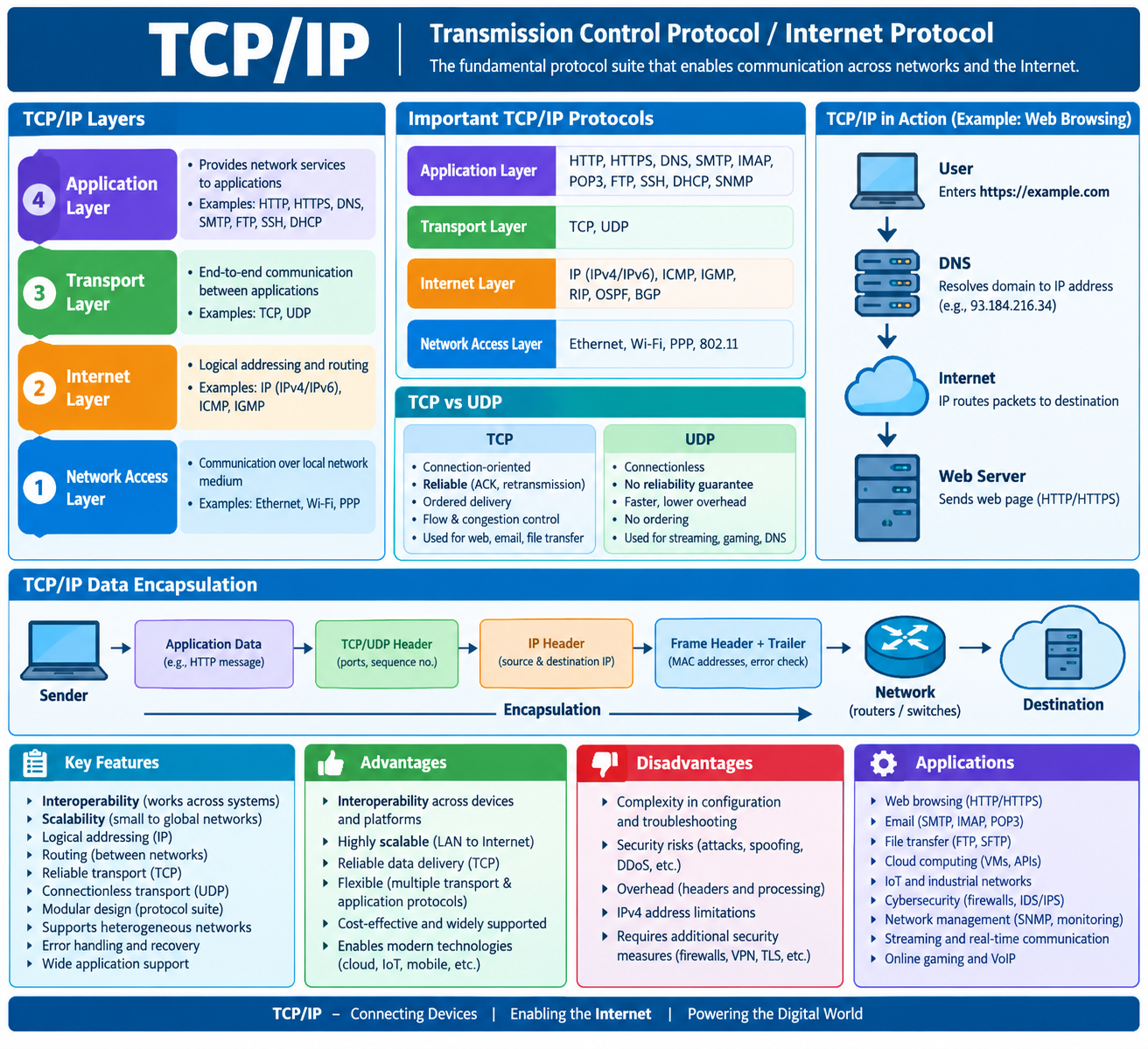
TCP/IP Stands For Transmission Control Protocol/Internet Protocol. It Is The Fundamental Communication Protocol Suite Used To Connect Computers, Servers, Smartphones, IoT Devices, Network Equipment, And Other Systems Over Interconnected Networks. The Modern Internet Depends Heavily On TCP/IP For Addressing, Routing, Transporting, And Delivering Data. Rather Than Being A Single Protocol, TCP/IP Is A collection Of Protocols That Work Together At Different Layers Of Networking.
Meaning Of TCP/IP
The Name TCP/IP Comes Primarily From Two Important Protocols: TCP (Transmission Control Protocol) And IP (Internet Protocol). TCP Provides Reliable, Connection-oriented Communication Between Applications, While IP Provides Logical Addressing And Routing Of Packets Between Networks. Other Protocols, Such As HTTP, HTTPS, DNS, DHCP, FTP, SMTP, SSH, UDP, And ICMP, Operate Within The Broader TCP/IP Protocol Suite.
History Of TCP/IP
The Development Of TCP/IP Is Closely Associated With Research Conducted For ARPANET And The Development Of Internetworking Technologies. Vint Cerf And Bob Kahn Played Major Roles In The Development Of TCP/IP Concepts During The 1970s. The Objective Was To Create A Communication Architecture That Could Allow Heterogeneous Networks To Exchange Information Reliably. TCP/IP Subsequently Became The Foundation For The Global Internet.
Need For TCP/IP
Before Widespread Internetworking, Different Computer Networks Often Used Different Communication Mechanisms. Such Networks Could Have Difficulty Communicating With One Another. TCP/IP Addressed This Problem By Providing Standardized Mechanisms For Addressing, Packet Delivery, Routing, Transport, And Application Communication. Consequently, Devices Using Different Hardware And Operating Systems Can Communicate When They Implement Compatible TCP/IP Protocols.
TCP/IP As A Protocol Suite
TCP/IP Should Be Understood As A protocol Suite Rather Than A Single Protocol. A Protocol Defines Rules Governing Communication Between Systems. The TCP/IP Suite Contains Protocols Designed For Different Networking Functions. For Example, IP Handles Addressing And Routing, TCP Provides Reliable Transport, UDP Provides Connectionless Transport, DNS Translates Domain Names Into IP Addresses, And HTTP/HTTPS Supports Web Communication.
TCP/IP Architecture
The Traditional TCP/IP Architecture Is Commonly Described Using four Layers: Application, Transport, Internet, And Network Access. Some Educational Models Map These Layers To The Seven-layer OSI Model. The TCP/IP Architecture Is Designed Around Practical Internet Communication Rather Than Strict Separation Of Every Individual Networking Function. Each Layer Provides Services To The Layer Above It And Uses Services From The Layer Below It.
Application Layer
The Application Layer Is The Highest Layer Of The TCP/IP Model. It Provides Networking Services Directly To Applications And Users. Protocols Operating At This Layer Include HTTP, HTTPS, DNS, SMTP, IMAP, POP3, FTP, SSH, DHCP, And Others. When A User Accesses A Website, Sends An Email, Transfers A File, Or Remotely Connects To A Server, Application-layer Protocols Provide The Required Communication Mechanisms.
Transport Layer
The Transport Layer Provides End-to-end Communication Between Applications Running On Different Devices. The Two Most Important Transport Protocols Are TCP And UDP. TCP Provides Reliable And Ordered Data Transmission, Whereas UDP Emphasizes Simplicity And Low Overhead. Transport Protocols Also Use Port Numbers To Identify Particular Applications Or Services On A Host.
Internet Layer
The Internet Layer Is Responsible Primarily For Logical Addressing And Packet Delivery Across Interconnected Networks. The Principal Protocol Is Internet Protocol (IP). IPv4 And IPv6 Are The Two Major Versions Of IP. Routers Examine Destination IP Addresses And Determine Appropriate Paths For Forwarding Packets Toward Their Destinations.
Network Access Layer
The Network Access Layer, Sometimes Called The Link Layer, Deals With Communication Over The Local Network Medium. It Encompasses Technologies Such As Ethernet, Wi-Fi, And Other Link Technologies. This Layer Is Concerned With Transmitting Frames Over A Particular Physical Or Logical Network. Network Interface Cards, Switches, Wireless Access Points, And Related Technologies Participate In This Portion Of Communication.
TCP — Transmission Control Protocol
TCP Is A connection-oriented Transport Protocol. Before Transferring Application Data, TCP Establishes A Logical Connection Between The Communicating Endpoints. TCP Uses Mechanisms Such As Acknowledgments, Sequence Numbers, Retransmissions, Flow Control, And Congestion Control To Provide Reliable Communication. These Mechanisms Make TCP Suitable For Applications Where Accurate And Complete Delivery Is Important.
TCP Three-Way Handshake
TCP Normally Establishes A Connection Using A three-way Handshake. The Initiating Host Sends A SYN Segment, The Receiving Host Responds With SYN-ACK, And The Initiating Host Responds With ACK. This Process Establishes Initial Sequence-number Information And Confirms That Both Endpoints Are Prepared To Communicate. Once The Connection Is Established, Application Data Can Be Transmitted.
TCP Reliability
One Of TCP's Major Characteristics Is Reliable Data Delivery. Network Packets Can Be Delayed, Duplicated, Corrupted, Or Lost. TCP Uses Sequence Numbers And Acknowledgments To Identify Successfully Received Data. If Necessary, TCP Retransmits Data That Has Not Been Acknowledged. It Also Reorders Segments So That Applications Receive The Byte Stream In The Appropriate Sequence.
TCP Flow Control
TCP Uses flow Control To Prevent A Fast Sender From Overwhelming A Slower Receiver. A Receiving System Advertises How Much Additional Data It Can Accept Through The TCP Receive Window. The Sender Uses This Information To Regulate The Amount Of Unacknowledged Data Transmitted. This Mechanism Helps Accommodate Differences In Processing Speed And Available Buffer Capacity.
TCP Congestion Control
TCP Also Implements congestion-control Mechanisms To Respond To Network Congestion. If Excessive Traffic Causes Packet Loss Or Other Congestion Signals, TCP Can Reduce Its Sending Rate. Mechanisms Such As Slow Start, Congestion Avoidance, Fast Retransmit, And Fast Recovery Have Historically Been Important Components Of TCP Implementations. Modern TCP Variants May Implement Additional Algorithms To Improve Performance On Different Networks.
IP — Internet Protocol
The Internet Protocol Provides Logical Addressing And Packet Forwarding. IP Treats Application Data As Packets, Often Called Datagrams At The IP Layer. Each Packet Contains Source And Destination IP Addresses. Routers Use These Addresses And Their Routing Information To Forward Packets Between Networks. IP Itself Does Not Guarantee That Packets Will Arrive, Arrive In Order, Or Arrive Only Once.
IPv4
IPv4, Or Internet Protocol Version 4, Uses 32-bit Addresses. An IPv4 Address Is Commonly Represented Using Four Decimal Numbers Separated By Dots, Such As 192.168.1.10. IPv4 Supports Approximately 4.3 Billion Theoretical Address Combinations, Although Not All Are Globally Assignable. The Rapid Growth Of Internet-connected Devices Contributed To The Exhaustion Of Publicly Available IPv4 Addresses.
IPv6
IPv6 Was Developed To Address Limitations Associated With IPv4 Addressing Capacity And Other Requirements. IPv6 Uses 128-bit Addresses, Providing An Extremely Large Address Space. An IPv6 Address Is Represented Using Hexadecimal Notation, For Example 2001:db8::1. IPv6 Also Includes Improvements In Areas Such As Address Configuration And Protocol Design.
Packet Encapsulation
TCP/IP Communication Uses A Process Called encapsulation. Application Data Is Passed To The Transport Layer, Where TCP Or UDP Adds Its Header. The Resulting Transport-layer Data Is Passed To IP, Which Adds An IP Header. Finally, The Network-access Technology Adds Its Own Framing Information. At The Receiving System, The Reverse Process, Called Decapsulation, Removes The Headers As Data Moves Upward Through The Protocol Stack.
TCP/IP Data Units
Different TCP/IP Layers Use Different Terminology For Their Data Units. At The Application Layer, The Information May Simply Be Called Application Data Or A Message. TCP Commonly Handles segments, While UDP Uses datagrams. IP Handles Packets Or IP Datagrams, And Network-access Technologies Such As Ethernet Transmit frames. These Units Are Created Through Encapsulation And Processed Through Decapsulation.
IP Addressing
IP Addressing Enables Devices To Be Identified Logically Within An IP Network. An Address Can Identify A Host Interface And Help Routers Determine Where Packets Should Be Forwarded. IPv4 Networks Historically Use Concepts Such As Network Addresses, Subnet Masks, And Host Addresses. IPv6 Uses A Different Addressing Architecture With Prefix-based Addressing And A Much Larger Address Space.
Port Numbers
IP Addresses Identify Network Interfaces Or Hosts, But Applications Need Another Mechanism To Distinguish Services. Port Numbers Perform This Function At The Transport Layer. For Example, Web Services Commonly Use TCP Port 80 For HTTP And TCP Port 443 For HTTPS. DNS Commonly Uses Port 53. Ports Allow Multiple Applications To Communicate Simultaneously Using The Same Network Interface And IP Address.
TCP/IP And Routing
Routing Is An Essential TCP/IP Function. Routers Examine Destination IP Addresses And Consult Routing Tables To Determine Where Packets Should Be Forwarded. Routing Can Be Static Or Dynamic. Dynamic Routing Protocols Such As OSPF, BGP, And RIP Can Exchange Routing Information According To Their Respective Designs. Internet-scale Routing Relies Particularly Heavily On BGP Between Autonomous Systems.
TCP/IP And DNS
The Domain Name System (DNS) Is An Important Application-layer Component Of Internet Networking. Humans Generally Prefer Names Such As example.com Rather Than Numerical IP Addresses. DNS Translates Domain Names Into IP Addresses And Provides Other Types Of Resource Information. When A User Enters A Website Address Into A Browser, DNS Resolution Can Occur Before The Browser Establishes Communication With The Destination Service.
TCP/IP And HTTP/HTTPS
Web Applications Commonly Use HTTP Or HTTPS Over TCP/IP. HTTP Defines How Web Clients And Servers Exchange Requests And Responses. HTTPS Adds Cryptographic Protection Using TLS. For Example, When A Browser Accesses An HTTPS Website, TCP/IP Provides Network Communication While TLS Helps Provide Confidentiality, Integrity, And Authentication For The Protected Application Connection.
Important Features Of TCP/IP
TCP/IP Has Several Important Features. These Include interoperability, Scalability, Logical Addressing, Routing, Reliable Transport Through TCP, Connectionless Transport Through UDP, Modular Protocol Design, Support For Heterogeneous Networks, Error Handling Mechanisms, And Extensive Application Support. Its Layered Architecture Allows Individual Protocols To Perform Specialized Functions While Cooperating As Part Of A Larger Networking System.
Advantage: Interoperability
A Major Advantage Of TCP/IP Is interoperability. Different Operating Systems, Hardware Platforms, Vendors, And Network Technologies Can Communicate Using Standardized TCP/IP Protocols. Windows, Linux, MacOS, Android, Network Routers, Servers, Embedded Devices, And Cloud Systems Can All Participate In TCP/IP Networks When Compatible Implementations Are Available.
Advantage: Scalability
TCP/IP Is Highly Scalable. It Can Support Communication Between Devices On A Small Local Network As Well As Communication Across The Global Internet. Hierarchical Addressing, Subnetting, Routing Protocols, Autonomous Systems, And Other Mechanisms Allow TCP/IP Networks To Grow From Small Private Networks To Extremely Large Interconnected Infrastructures.
Advantage: Reliability And Flexibility
TCP Provides Mechanisms For Reliable Data Delivery, While The Overall TCP/IP Suite Supports Multiple Transport And Application Protocols. Applications Can Select Protocols According To Their Requirements. For Example, File Transfers May Use TCP-based Protocols Where Reliability Is Important, Whereas Real-time Applications May Use UDP When Minimizing Latency And Protocol Overhead Is Important.
Disadvantage: Complexity
Although TCP/IP Is Modular, Large TCP/IP Networks Can Become Complex To Design, Configure, Troubleshoot, And Secure. Administrators May Need To Understand IP Addressing, Subnetting, Routing, DNS, DHCP, TCP/UDP Ports, Firewalls, NAT, VPNs, TLS, And Application Protocols. Incorrect Configuration Can Result In Connectivity, Performance, Or Security Problems.
Disadvantage: Security Risks
TCP/IP Itself Was Designed Primarily To Enable Communication Rather Than Provide Comprehensive Modern Security. Many Attacks Can Target IP Networks And TCP/IP-based Services, Including Packet Spoofing, Denial-of-service Attacks, Scanning, Session Attacks, And Exploitation Of Vulnerable Applications. Modern Networks Therefore Use Additional Security Technologies Such As Firewalls, IDS/IPS, VPNs, TLS, Authentication, Segmentation, And Access-control Mechanisms.
Disadvantage: Overhead
Protocols Such As TCP Introduce Headers And Processing Requirements. Reliability Mechanisms, Acknowledgments, Retransmissions, Connection Establishment, And Congestion Control Can Increase Overhead. For Some Real-time Applications, Such As Interactive Voice Or Gaming, Excessive Retransmission Delays May Be Undesirable. Consequently, Applications Sometimes Use UDP Or Specialized Protocols Instead.
Disadvantage: Address Management
IPv4 Address Availability Is Limited, Creating Challenges For Organizations Operating Large Networks. Technologies Such As Network Address Translation (NAT) Help Conserve IPv4 Addresses, But NAT Can Introduce Additional Complexity. IPv6 Provides A Vastly Larger Address Space, But Transitioning From IPv4 To IPv6 Requires Appropriate Infrastructure, Configuration, And Compatibility Planning.
Application In Web Browsing
One Of The Most Visible Applications Of TCP/IP Is web Browsing. When A User Opens A Website, Multiple Protocols May Participate. DNS Can Resolve The Domain Name, IP Can Route Packets, TCP Or Another Suitable Transport Can Provide Communication, TLS Can Protect HTTPS Traffic, And HTTP Can Carry Web Requests And Responses. This Layered Cooperation Allows Browsers To Access Services Across The Internet.
Application In Email
Email Systems Also Rely Heavily On TCP/IP. Protocols Such As SMTP Are Used For Sending And Transferring Email, While IMAP And POP3 Are Commonly Used For Retrieving Messages. DNS Records Help Mail Servers Locate Appropriate Destinations Through MX Records. Security Technologies Such As TLS, SPF, DKIM, And DMARC Can Provide Additional Protections Around Email Transport And Domain-level Authentication.
Application In File Transfer
TCP/IP Supports File-transfer Applications Through Protocols Such As FTP, FTPS, SFTP, And HTTP/HTTPS-based File Transfer. TCP-based Mechanisms Can Provide Reliable Delivery Of Files Where Preserving Complete And Ordered Data Is Important. Modern Cloud Storage Platforms Also Rely Extensively On TCP/IP-based Communications, Although The Application Protocols And Underlying Infrastructure Can Differ.
Application In Cloud Computing
Cloud Computing Depends Fundamentally On Network Communication. Virtual Machines, Containers, Databases, Storage Services, APIs, Web Applications, And Management Systems Communicate Using TCP/IP-based Networking. Data Centers Use IP Networks To Connect Servers And Network Devices, While Routing, Load Balancing, Firewalls, Encryption, And Service-discovery Mechanisms Provide Additional Functionality.
Application In IoT And Industrial Networks
The Internet Of Things (IoT) Uses IP Networking To Connect Sensors, Controllers, Cameras, Appliances, Vehicles, And Industrial Equipment. Depending On The Application, Devices May Use TCP, UDP, Or Specialized Protocols Operating Over IP. Industrial Systems Can Also Use IP-based Communication For Monitoring And Control, Although Safety, Reliability, Latency, And Security Requirements Must Be Carefully Addressed.
Application In Cybersecurity And Network Management
TCP/IP Is Extremely Important In cybersecurity And Network Management. Security Professionals Analyze IP Addresses, Ports, TCP Sessions, DNS Traffic, HTTP Requests, And Other Protocol Information When Investigating Network Activity. Tools Such As Packet Analyzers, Intrusion-detection Systems, Firewalls, SIEM Platforms, And Network-monitoring Systems Frequently Process TCP/IP Traffic To Identify Abnormal Or Potentially Malicious Behavior.
Conclusion
TCP/IP Is The Fundamental Protocol Suite That Enables Communication Across Modern Computer Networks And The Internet. TCP Provides Reliable, Connection-oriented Transport, While IP Provides Logical Addressing And Routing.
Together With Protocols Such As UDP, DNS, HTTP, HTTPS, SMTP, DHCP, ICMP, And Many Others, TCP/IP Forms A Flexible Networking Architecture Capable Of Supporting Local Networks, Enterprise Infrastructure, Cloud Computing, Mobile Systems, IoT, Cybersecurity, And Global Internet Communication.
Its Major Strengths Include Interoperability, Scalability, Flexibility, And Broad Application Support, While Its Challenges Include Complexity, Security Exposure, Overhead, And IPv4 Address Limitations. Understanding TCP/IP Is Therefore Essential For Students And Professionals Studying computer Networks, Cybersecurity, Cloud Computing, IoT, System Administration, And Internet Technologies.
Tags:
TCP/IP, Network Access Layer, Transmission Control Protocol, TCP Flow Control, Internet Protocol, IPv4, IPv6, TCP/IP Data Units