What Is The Data Link Layer? Complete Guide To Layer 2 Of The OSI Model
Category: NETWORKING | 26th August 2026, Wednesday
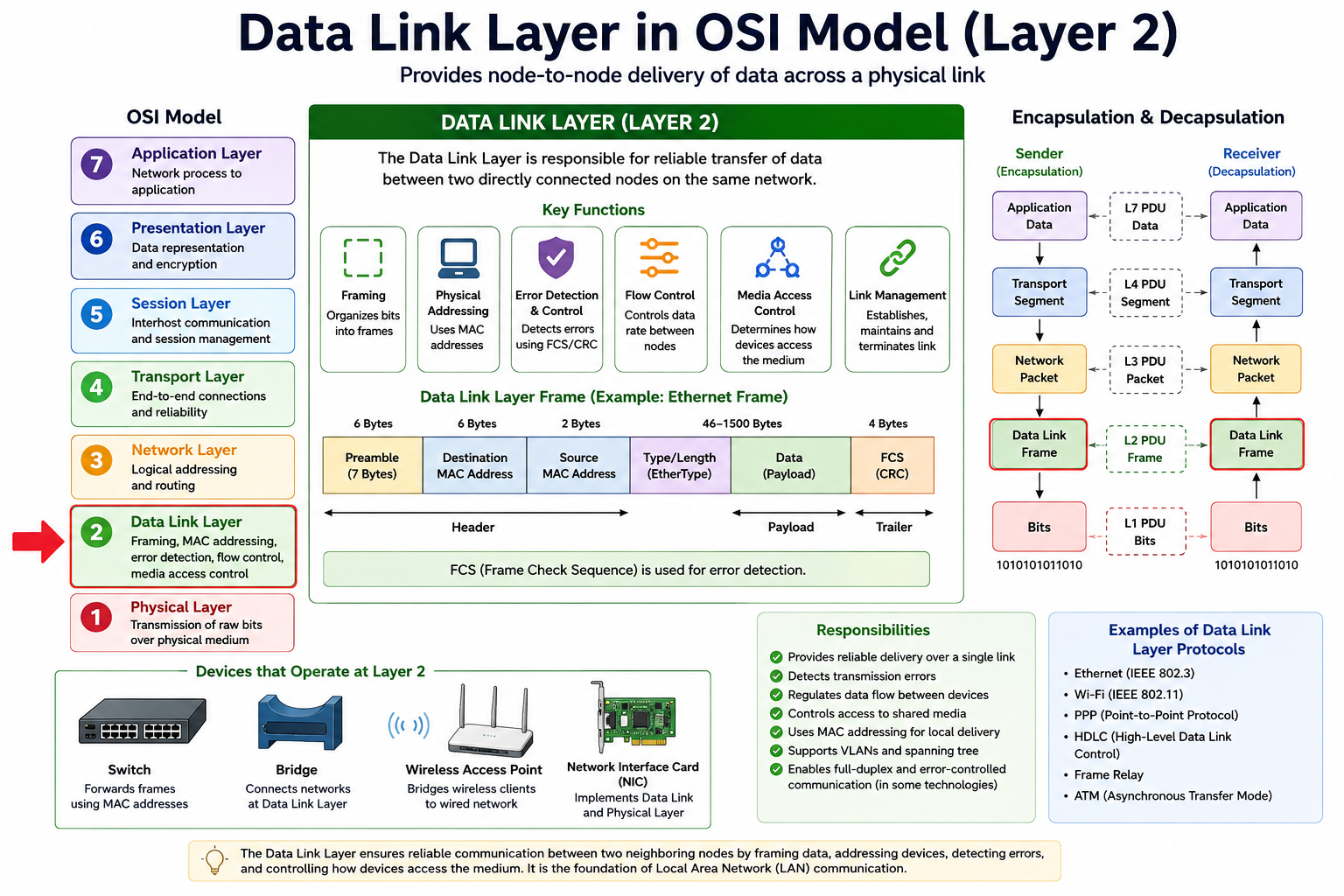
1. Introduction To The Data Link Layer
The Data Link Layer Is The Second Layer Of The OSI (Open Systems Interconnection) Model And Plays A Fundamental Role In Computer Networking. Positioned Between The Physical Layer And The Network Layer, It Is Responsible For Providing Reliable Communication Between Two Directly Connected Network Devices. While The Physical Layer Transmits Raw Bits Through A Physical Medium Such As Copper Cable, Fiber-optic Cable, Or Wireless Signals, The Data Link Layer Organizes Those Bits Into Structured Units Called frames.
It Also Handles Important Networking Functions Such As Physical Addressing, Frame Synchronization, Error Detection, Flow Control, And Media Access Control. The Data Link Layer Is Therefore Essential For Transforming An Unreliable Stream Of Physical Signals Into An Organized Communication Channel Between Neighboring Devices.
In Modern Networks, Technologies Such As Ethernet, Wi-Fi, PPP, And HDLC Implement Data Link Layer Functions. Understanding Layer 2 Is Particularly Important For Students, Network Administrators, Cybersecurity Professionals, And Researchers Because Many Network Technologies And Security Mechanisms Operate Directly At This Layer.
2. Position Of The Data Link Layer In The OSI Model
The OSI Model Divides Network Communication Into Seven Conceptual Layers: Physical, Data Link, Network, Transport, Session, Presentation, And Application. The Data Link Layer Is Layer 2, Located Directly Above The Physical Layer And Below The Network Layer. Its Position Gives It An Important Intermediary Role. The Physical Layer Is Concerned With Transmitting Electrical, Optical, Or Radio Signals, While The Data Link Layer Determines How Those Transmitted Bits Are Grouped, Addressed, And Checked For Errors.
Above Layer 2, The Network Layer Handles Logical Addressing And Routing Between Different Networks. For Example, IP Addresses Are Primarily Associated With Layer 3, While Ethernet MAC Addresses Operate At Layer 2. During Transmission, Data From The Network Layer Is Encapsulated Into A Data Link Layer Frame. The Frame Is Then Converted Into Physical Signals By The Physical Layer.
At The Receiving Device, The Reverse Process Occurs: Physical Signals Are Converted Into Bits, Bits Are Organized Into Frames, And The Data Link Layer Processes Those Frames Before Passing The Encapsulated Packet To The Network Layer.
3. What Is Data Link Layer?
The Data Link Layer Can Be Defined As The OSI Layer Responsible For node-to-node Or Hop-to-hop Delivery Of Data Across A Directly Connected Network Link. It Provides Mechanisms That Allow Devices Sharing The Same Local Network Segment To Exchange Information Efficiently. One Of Its Most Important Functions Is Framing. Instead Of Treating A Continuous Stream Of Bits As One Large Sequence, The Data Link Layer Divides Information Into Manageable Units Called Frames.
Each Frame Contains Control Information, Addressing Information, Payload Data, And Usually An Error-detection Field. The Data Link Layer Also Uses Hardware Addresses To Identify Devices On A Local Network. In Ethernet, These Addresses Are Known As MAC (Media Access Control) Addresses.
The Layer Can Also Determine How Devices Access A Shared Communication Medium. Historically, Ethernet Networks Used Collision-detection Mechanisms, While Modern Switched Ethernet Networks Typically Use Full-duplex Communication. Wireless Networks Use Their Own Media-access Mechanisms Because Radio Channels Are Shared And Subject To Interference.
4. Main Functions Of The Data Link Layer
The Data Link Layer Performs Several Critical Functions Required For Efficient Local Network Communication. These Include framing, Physical Addressing, Error Detection, Error Handling, Flow Control, Media Access Control, Link Management, And Reliable Node-to-node Delivery. Framing Identifies The Beginning And End Of Individual Data Units. Physical Addressing Identifies Devices Within A Local Network.
Error Detection Helps Determine Whether A Frame Was Corrupted During Transmission. Flow Control Can Prevent A Fast Sender From Overwhelming A Slower Receiver In Technologies That Provide Such Mechanisms. Media Access Control Determines How Devices Share A Communication Medium. The Layer Can Also Manage Communication Between Network Interfaces And Switches. These Functions Vary According To The Specific Data Link Layer Protocol.
Ethernet, Wi-Fi, PPP, And Other Layer 2 Technologies Have Different Frame Formats, Addressing Methods, And Access-control Mechanisms. Consequently, The Data Link Layer Is Better Understood As A Collection Of Functions Implemented By Specific Link Technologies Rather Than As One Universal Protocol.
5. Framing In The Data Link Layer
Framing Is One Of The Most Important Responsibilities Of Layer 2. The Network Layer Creates Packets, But The Data Link Layer Encapsulates Those Packets Into Frames Suitable For Transmission Across A Particular Link. A Frame Normally Contains A Header, Payload, And Trailer. The Header Can Contain Source And Destination MAC Addresses And Other Control Information. The Payload Contains The Packet Received From The Network Layer. The Trailer Commonly Contains An Error-detection Mechanism Such As A Frame Check Sequence (FCS).
Framing Allows The Receiving Device To Determine Which Bits Belong To A Particular Communication Unit. Without Appropriate Framing, A Receiver Would Have Difficulty Identifying Where One Message Ends And Another Begins. Different Technologies Use Different Frame Structures. An Ethernet Frame, For Example, Contains Destination And Source MAC Addresses, An EtherType Or Length Field, Payload Information, And An FCS. Wireless Frames Contain Additional Fields Required For Wireless Communication And Management.
6. MAC Addresses And Physical Addressing
Another Major Responsibility Of The Data Link Layer Is physical Addressing. Ethernet Networks Use MAC Addresses To Identify Network Interfaces On A Local Network. A Conventional Ethernet MAC Address Is Represented As A 48-bit Value, Usually Written In Hexadecimal Notation, Such As 00:1A:2B:3C:4D:5E. MAC Addresses Are Associated With Network Interfaces And Are Used By Layer 2 Devices To Make Forwarding Decisions Within A Local Network.
A Switch Maintains A MAC Address Table That Associates Learned MAC Addresses With Specific Switch Ports. When A Frame Arrives, The Switch Examines Its Destination MAC Address And Determines Where The Frame Should Be Forwarded. This Is Different From IP Routing, Which Occurs At Layer 3. MAC Addresses Are Therefore Fundamental To Local Ethernet Communication, While IP Addresses Are Used For Logical Addressing And Communication Across Interconnected Networks.
7. Error Detection And Error Control
Network Signals Can Be Affected By Noise, Interference, Attenuation, Damaged Cables, Faulty Connectors, Or Wireless Interference. As A Result, Transmitted Bits May Sometimes Be Altered. The Data Link Layer Can Detect Certain Transmission Errors Using Techniques Such As Cyclic Redundancy Check (CRC). Ethernet Frames, For Example, Include An FCS Calculated From The Frame Contents.
The Receiving Device Calculates The Relevant Value Again And Compares It With The Received FCS. If The Values Do Not Match, The Frame Is Considered Corrupted And Is Normally Discarded. Error Detection Is Different From Error Correction. Many Ethernet Implementations Primarily Detect Corrupted Frames And Rely On Higher-layer Protocols Or Retransmission Mechanisms To Recover From Loss. Some Data Link Layer Technologies Can Provide More Extensive Error Recovery. The Exact Error-control Behavior Therefore Depends On The Underlying Layer 2 Protocol.
8. Media Access Control
The Data Link Layer Is Divided Conceptually Into Two Important Sublayers In The IEEE Networking Architecture: Logical Link Control (LLC) And Media Access Control (MAC). The MAC Sublayer Is Concerned With Access To The Communication Medium And Frame Addressing. This Is Particularly Important When Multiple Devices Share The Same Physical Medium. Traditional Shared Ethernet Networks Used CSMA/CD (Carrier Sense Multiple Access With Collision Detection) To Manage Access To The Shared Medium.
Wireless LANs Use CSMA/CA (Carrier Sense Multiple Access With Collision Avoidance) Because Detecting Collisions While Transmitting Over Radio Is More Difficult. Modern Switched Ethernet Networks Generally Use Dedicated Full-duplex Links, So Traditional Collision Detection Is No Longer Required On Those Links. Media Access Control Remains Important In Wireless And Other Shared-medium Technologies Because Multiple Devices Still Need Mechanisms For Coordinating Access.
9. Logical Link Control
The Logical Link Control (LLC) Sublayer Is Traditionally Described As The Upper Portion Of The Data Link Layer In IEEE Networking Architecture. LLC Provides Services That Help Support Communication Between The Data Link Layer And Network Layer. Historically, LLC Was Particularly Important For Allowing Different Network-layer Protocols To Operate Over Common Data-link Technologies. IEEE 802.2 Defined LLC Mechanisms.
Modern Ethernet Networks Frequently Identify Upper-layer Protocols Using The EtherType Field In Ethernet Frames, So The Practical Role Of Traditional LLC Mechanisms Varies Depending On The Technology. Nevertheless, Understanding The LLC And MAC Sublayers Is Important For Networking Students Because They Explain How Layer 2 Functions Can Be Separated Conceptually Into Logical Link Management And Access To The Physical Transmission Medium.
10. Data Link Layer Devices
Several Networking Devices Operate At Or Interact Strongly With The Data Link Layer. The Most Important Modern Layer 2 Device Is The network Switch. A Switch Forwards Ethernet Frames Based On Destination MAC Addresses. It Learns Which MAC Addresses Are Reachable Through Which Ports By Examining The Source MAC Addresses Of Incoming Frames.
Bridges Perform Similar Layer 2 Forwarding Functions And Historically Played A Major Role In Ethernet Networks. A Network Interface Card, Or NIC, Also Implements Important Physical And Data Link Layer Functionality. Wireless Access Points Similarly Perform Substantial Layer 2 Operations When Bridging Wireless Clients To Wired Ethernet Networks.
Routers Primarily Operate At Layer 3, Although Modern Network Equipment Can Perform Functions Across Multiple Layers. Understanding The Distinction Between Switches And Routers Is Essential: Switches Primarily Forward Frames Within A Layer 2 Domain, While Routers Forward Packets Between Layer 3 Networks.
11. Ethernet And The Data Link Layer
Ethernet Is The Dominant Wired LAN Technology And Provides Important Data Link And Physical Layer Specifications. Ethernet Frames Contain Destination And Source MAC Addresses, An EtherType Or Length Field, Payload Data, And An FCS. Ethernet Switches Inspect These Fields To Make Forwarding Decisions.
Ethernet Has Evolved Considerably, From Early 10 Mbps Implementations To Fast Ethernet, Gigabit Ethernet, 10 Gigabit Ethernet, And Much Faster Standards. Technologies Such As 10BASE-T, 100BASE-TX, 1000BASE-T, And 10GBASE-T Demonstrate How Ethernet's Physical Layer Has Evolved While Retaining Important Layer 2 Concepts. Ethernet's Widespread Adoption Is Largely Due To Its Scalability, Interoperability, Cost Effectiveness, And Support Across Virtually Every Category Of Modern Computer-networking Equipment.
12. Wireless LAN And The Data Link Layer
Wireless Networking Also Implements Data Link Layer Functionality. The Most Widely Recognized Wireless LAN Family Is IEEE 802.11, Commonly Known As Wi-Fi. Wi-Fi Frames Differ From Ethernet Frames Because Wireless Networks Have Different Communication Requirements.
A Wireless Network May Include Access Points, Mobile Clients, Shared Radio Channels, Authentication Procedures, Retransmission Mechanisms, And Power-management Features. The Data Link Layer Therefore Has To Coordinate Access To The Wireless Medium And Provide Mechanisms For Reliable Frame Delivery In An Environment Affected By Interference And Changing Signal Conditions.
Wi-Fi Commonly Uses CSMA/CA-based Medium Access Techniques. Security Mechanisms Such As WPA2 And WPA3 Also Interact Significantly With Wireless Layer 2 Communication. As Wireless Networks Have Become Ubiquitous, Data Link Layer Concepts Have Become Increasingly Important In Mobile Computing, IoT, Enterprise Networking, And Cybersecurity.
13. VLANs And The Data Link Layer
Virtual Local Area Networks (VLANs) Are Another Important Layer 2 Concept. VLANs Allow A Physical Switched Network To Be Logically Divided Into Separate Broadcast Domains. IEEE 802.1Q Defines VLAN Tagging Mechanisms That Allow Ethernet Frames To Carry VLAN Identification Information. For Example, An Organization Can Use Separate VLANs For Employees, Servers, Guest Devices, Security Cameras, And Voice Communication While Using The Same Physical Switching Infrastructure.
VLANs Improve Network Organization, Segmentation, And Security. Switches Use VLAN Information To Determine Which Layer 2 Broadcast Domain A Frame Belongs To. VLAN Configuration Is Therefore An Important Responsibility For Network Administrators. Proper VLAN Design Can Reduce Unnecessary Broadcast Traffic And Help Isolate Different Categories Of Devices.
14. Switching And MAC Address Tables
Layer 2 Switching Is Fundamental To Modern Ethernet Networks. When A Switch Receives A Frame, It Examines The Source MAC Address And Learns Which Port Is Associated With That Address. This Information Is Stored In A MAC Address Table, Sometimes Called A Forwarding Database. When The Switch Receives Another Frame, It Examines The Destination MAC Address. If The Destination Is Known, The Switch Forwards The Frame Through The Appropriate Port.
If The Destination Is Unknown, The Switch May Flood The Frame To Appropriate Ports Within The Same VLAN. Broadcast Frames Are Also Distributed Within The Relevant Broadcast Domain. This Process Allows Switches To Efficiently Forward Traffic Without Sending Every Frame To Every Port. Layer 2 Switching Therefore Significantly Improves Network Performance Compared With Traditional Shared-medium Ethernet Hubs.
15. Data Link Layer And Broadcast Domains
A Broadcast Domain Is A Logical Network Area In Which Layer 2 Broadcast Frames Can Reach Participating Devices. In A Basic Switched Ethernet Network Without VLAN Segmentation, Many Devices May Belong To The Same Broadcast Domain. Routers Traditionally Separate Broadcast Domains Because Broadcasts Are Not Normally Forwarded Between Layer 3 Networks.
VLANs Can Also Divide A Switched Infrastructure Into Multiple Broadcast Domains. Understanding Broadcast Domains Is Important For Network Design Because Excessive Broadcast Traffic Can Consume Network Resources. Segmenting Networks With VLANs And Routing Can Improve Scalability, Performance, And Security. Data Link Layer Behavior Therefore Has A Direct Impact On Network Architecture And Traffic Management.
16. Data Link Layer And Network Layer Differences
The Data Link Layer And Network Layer Are Closely Related But Perform Different Functions. The Data Link Layer Provides local Or Hop-to-hop Delivery, Whereas The Network Layer Provides logical Addressing And Routing Between Networks. Ethernet MAC Addresses Are Associated With Layer 2, While IPv4 And IPv6 Addresses Operate At Layer 3. A Switch Generally Forwards Frames Using MAC Addresses, Whereas A Router Forwards Packets Using Layer 3 Addresses And Routing Information.
For Example, When A Computer Communicates With A Device On The Same Local Ethernet Network, The Communication Involves Layer 2 Delivery Between The Two Network Interfaces. When The Destination Is On Another Network, The Computer Sends The Frame To Its Default Gateway, And The Router Forwards The Packet Toward The Destination Network. Thus, Layer 2 And Layer 3 Work Together But Solve Different Networking Problems.
17. Data Link Layer Security
Layer 2 Security Is An Important Part Of Enterprise Cybersecurity. Attackers Can Exploit Weaknesses In Local Network Protocols Through Techniques Such As MAC Flooding, ARP Spoofing, VLAN Hopping, Rogue DHCP Services, And Unauthorized Network Access. Network Administrators Can Deploy Security Mechanisms Such As Switch Port Security, DHCP Snooping, Dynamic ARP Inspection, VLAN Segmentation, 802.1X Authentication, And Appropriate Access-control Policies.
Physical Security Is Also Important Because Unauthorized Physical Access To Ethernet Ports Can Provide An Attacker With Direct Network Connectivity. Monitoring Layer 2 Traffic Can Help Security Teams Identify Suspicious Behavior, Abnormal MAC-address Activity, And Other Indicators Of Compromise. Therefore, The Data Link Layer Should Not Be Viewed Only As A Mechanism For Transporting Frames; It Is Also An Important Part Of Network Security Architecture.
18. Data Link Layer In Modern Networks
Modern Networking Environments Increasingly Combine Wired Ethernet, Wi-Fi, Cloud Infrastructure, Virtualization, IoT Devices, And Software-defined Networking. Despite These Changes, Data Link Layer Concepts Remain Fundamental. Virtual Switches In Virtualization Platforms Perform Layer 2 Forwarding Between Virtual Machines And Physical Interfaces.
Cloud Environments Implement Virtual Networking Constructs That Abstract Many Traditional Layer 2 And Layer 3 Concepts. Enterprise Wi-Fi Systems Continue To Rely Heavily On Layer 2 Mechanisms. Industrial Networks And IoT Systems Also Use Various Ethernet And Wireless Technologies.
Data Link Layer Knowledge Is Therefore Relevant Not Only To Traditional LAN Administration But Also To Cloud Computing, Cybersecurity, Network Virtualization, Data Centers, And Distributed Systems.
19. Advantages And Limitations Of The Data Link Layer
The Data Link Layer Provides Several Important Advantages. It Organizes Raw Bits Into Frames, Supports Physical Addressing, Detects Transmission Errors, Enables Efficient Local Delivery, And Provides Mechanisms For Controlling Access To Communication Media. Layer 2 Switching Also Enables High-performance Local-area Networks With Relatively Low Forwarding Latency.
VLANs Provide Additional Segmentation And Organizational Flexibility. However, Layer 2 Networks Have Limitations. Large Broadcast Domains Can Generate Unnecessary Traffic, And Layer 2 Loops Can Cause Severe Network Problems Such As Broadcast Storms.
Protocols Such As Spanning Tree Protocol (STP) Help Prevent Switching Loops In Ethernet Networks. Layer 2 Attacks Can Also Exploit Weaknesses In Local Network Protocols. Consequently, Network Administrators Must Carefully Design Switching Architectures, VLANs, Redundancy Mechanisms, And Security Controls.
20. Conclusion
The Data Link Layer, Or Layer 2 Of The OSI Model, Is A Fundamental Component Of Computer Networking. It Provides Node-to-node Communication By Organizing Raw Physical-layer Bits Into Frames And Using Mechanisms For Addressing, Error Detection, Media Access Control, And Link Management.
Technologies Such As Ethernet And Wi-Fi Demonstrate The Practical Importance Of Data Link Layer Protocols In Modern Networks. MAC Addresses Identify Local Network Interfaces, Switches Forward Frames Based On MAC Address Information, VLANs Divide Networks Into Logical Broadcast Domains, And Layer 2 Security Mechanisms Protect Local Communication Infrastructure.
The Data Link Layer Also Works Closely With The Physical Layer And Network Layer, Creating An Essential Bridge Between Physical Transmission And Logical Network Routing. For Networking Students, IT Professionals, Cybersecurity Specialists, And Researchers, Understanding Layer 2 Provides The Foundation For Learning Switching, VLANs, Ethernet, Wi-Fi, Network Segmentation, Troubleshooting, And Advanced Network Security.
As Networking Continues To Evolve Toward Higher Speeds, Virtualization, Cloud Computing, And Intelligent Infrastructure, Data Link Layer Concepts Remain Essential To Understanding How Modern Digital Networks Communicate.
SEO Keywords
Data Link Layer, Data Link Layer In OSI Model, Layer 2 Networking, OSI Layer 2, What Is Data Link Layer, Data Link Layer Functions, Data Link Layer Protocols, Ethernet Data Link Layer, MAC Address, MAC Layer, LLC Layer, Network Switch, Ethernet Frame, Framing In Networking, Error Detection, VLAN, Layer 2 Switching, Data Link Layer Security, Physical Addressing, Computer Networking, Networking Layers, OSI Model Explained.
Tags:
Data Link Layer, Data Link Layer In OSI Model, Layer 2 Networking, OSI Layer 2, What Is Data Link Layer, Data Link Layer Functions, Data Link Layer Protocols