What Is The Transport Layer? — Complete Guide
Category: NETWORKING | 18th September 2026, Friday
Introduction To The Transport Layer
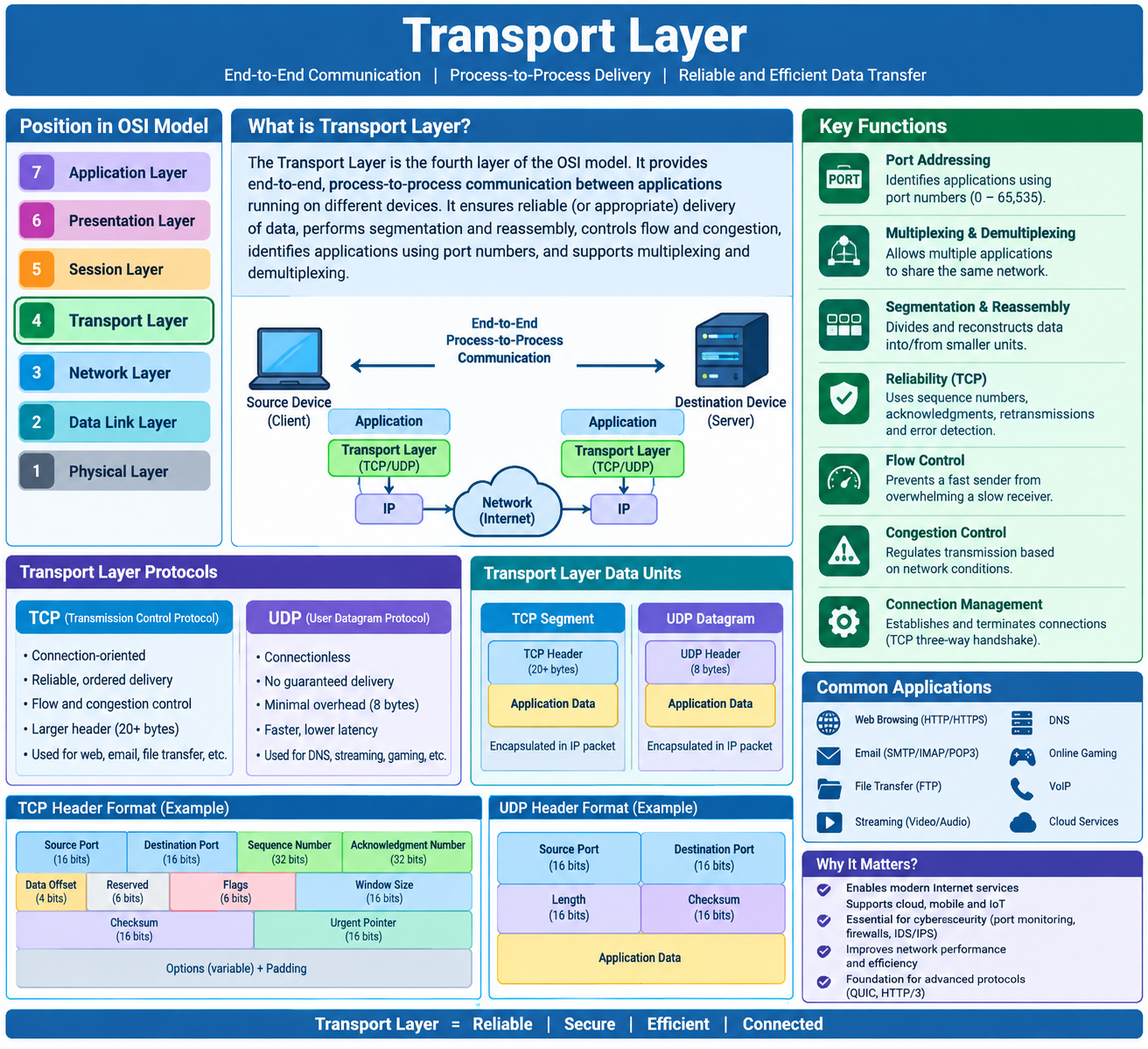
The Transport Layer Is The Fourth Layer Of The OSI (Open Systems Interconnection) Model And Plays A Fundamental Role In Computer Networking. It Provides End-to-end Communication Services Between Applications Running On Different Devices. While Lower Layers Are Mainly Responsible For Moving Packets Across Networks, The Transport Layer Focuses On Delivering Data From A Particular Application On The Source Computer To The Correct Application On The Destination Computer. It Provides Mechanisms For Reliability, Flow Control, Error Recovery, Segmentation, Reassembly, And Communication Management.
Position In The OSI Model
The Transport Layer Is Located Between The Network Layer (Layer 3) And The Session Layer (Layer 5). The Complete OSI Model Consists Of Seven Layers: Physical, Data Link, Network, Transport, Session, Presentation, And Application. The Transport Layer Receives Data From The Session Layer And Divides It Into Smaller Units Suitable For Transmission. At The Receiving System, It Reconstructs The Original Data And Delivers It To The Appropriate Application Process.
End-to-End Communication
One Of The Most Important Characteristics Of The Transport Layer Is end-to-end Communication. Network Layer Protocols Such As IP Primarily Provide Host-to-host Delivery, Whereas The Transport Layer Provides Process-to-process Or Application-to-application Delivery. For Example, When A Web Browser Communicates With A Web Server, The Transport Layer Ensures That The Received Data Reaches The Appropriate Browser Or Server Process Rather Than Merely Reaching The Destination Computer.
Transport Layer And TCP/IP Model
In The TCP/IP Model, Transport Layer Functionality Is Represented By The Transport Layer, Positioned Above The Internet Layer And Below The Application Layer. Important Transport Layer Protocols Include TCP (Transmission Control Protocol) And UDP (User Datagram Protocol). TCP Provides Connection-oriented And Reliable Communication, Whereas UDP Provides Connectionless Communication With Lower Protocol Overhead. Modern Networking Also Includes Protocols Such As SCTP And QUIC, Which Provide Additional Transport Capabilities.
Main Objectives Of The Transport Layer
The Major Objectives Of The Transport Layer Are To Provide Reliable Or Appropriate End-to-end Communication, Identify Applications, Perform Segmentation And Reassembly, Control Data Flow, Detect Transmission Errors, Manage Connections, And Support Multiplexing And Demultiplexing. Different Transport Protocols Implement These Functions Differently. For Example, TCP Provides Extensive Reliability Mechanisms, While UDP Intentionally Provides A Simpler Service With Minimal Overhead.
Process-to-Process Delivery
The Transport Layer Provides process-to-process Delivery Using Port Numbers. An IP Address Identifies A Network Interface Or Host, While A Port Number Identifies A Particular Service Or Application Endpoint. For Example, A Web Server May Listen On TCP Port 443 For HTTPS Connections. Therefore, An IP Address Combined With A Port Number Can Identify A Communication Endpoint, Often Represented As An IP Address And Port Pair.
Port Numbers
Port Numbers Are 16-bit Identifiers Ranging From 0 To 65,535. They Allow Multiple Applications To Communicate Simultaneously Over The Same Network Connection. Ports From 0 To 1023 Are Known As Well-known Ports And Are Associated With Widely Used Services. Registered And Dynamic/private Ports Occupy Other Ranges. Examples Include TCP Port 80 For HTTP, TCP Port 443 For HTTPS, UDP Port 53 For DNS, And TCP Port 22 For SSH.
Multiplexing
Multiplexing Allows Data From Multiple Applications To Share The Same Network Infrastructure. Suppose A Computer Simultaneously Runs A Web Browser, Email Client, Video-conferencing Application, And File-transfer Application. Each Application Can Use Different Source Ports. The Transport Layer Adds Appropriate Port Information To Outgoing Segments Or Datagrams So That Multiple Application Streams Can Coexist.
Demultiplexing
At The Receiving System, The Reverse Process Is Called demultiplexing. The Transport Layer Examines Information Such As Destination Port Numbers And Determines Which Application Should Receive The Incoming Data. For Example, An Incoming Packet Destined For TCP Port 443 Can Be Delivered To The HTTPS Service. This Mechanism Allows A Single Computer To Support Many Network Applications Simultaneously.
Segmentation
Applications Can Generate Data That Is Much Larger Than The Amount Conveniently Transmitted In One Network Packet. The Transport Layer Can Divide Application Data Into Smaller Units Called segments In TCP Terminology. Segmentation Improves The Ability Of Networks To Process Data Efficiently And Allows Large Application Messages To Be Transmitted Across Networks With Different Limitations.
Reassembly
At The Destination, The Transport Layer Performs reassembly. The Smaller Units Received From The Network Are Reconstructed Into The Appropriate Application Data Stream Or Messages. In TCP, Sequence Numbers Allow The Receiver To Identify The Correct Ordering Of Bytes. If Segments Arrive Out Of Order, TCP Can Use Sequence Information To Organize The Data Before Presenting It To The Application.
Reliability
Reliability Is One Of The Major Services Associated With TCP. Networks Can Experience Packet Loss, Duplication, Corruption, Congestion, And Reordering. TCP Addresses These Problems Through Sequence Numbers, Acknowledgments, Retransmissions, Checksums, And Other Mechanisms. UDP Does Not Provide The Same Built-in Reliable Delivery Service, Leaving Reliability, If Required, To Higher-level Protocols Or Applications.
Error Detection
Transport Protocols Can Use checksums To Detect Corruption In Transmitted Data. A Checksum Is Calculated Over Relevant Portions Of The Transport Data And Compared At The Receiving Side. If The Calculated Value Does Not Match The Received Value, The Data Is Considered Corrupted. The Subsequent Response Depends On The Protocol. TCP Can Retransmit Missing Or Corrupted Information Under Appropriate Conditions.
Flow Control
Flow Control Prevents A Fast Sender From Overwhelming A Slower Receiver. TCP Implements Flow Control Using A Receive Window. The Receiver Advertises How Much Additional Data It Can Accept, And The Sender Adjusts Its Transmission Accordingly. This Mechanism Helps Prevent Receiver Buffer Overflow And Allows Communication Between Devices With Different Processing And Memory Capabilities.
Congestion Control
Flow Control And Congestion Control Are Related But Different Concepts. Flow Control Protects The receiver, While Congestion Control Protects The network. TCP Uses Mechanisms Such As Slow Start, Congestion Avoidance, And Congestion-window Management To Regulate Transmission When Network Congestion Is Detected. Congestion Control Is Essential For Maintaining Efficient Network Operation And Reducing Excessive Packet Loss.
Connection-Oriented Communication
TCP Is A connection-oriented Transport Protocol. Before Application Data Is Exchanged, TCP Establishes A Logical Connection Between Two Endpoints. This Process Normally Begins With The TCP Three-way Handshake. The Handshake Allows The Endpoints To Synchronize Sequence Information And Establish Communication Parameters Before Regular Data Transfer Begins.
TCP Three-Way Handshake
The TCP Three-way Handshake Normally Involves Three Messages: SYN, SYN-ACK, And ACK. The Client First Sends A SYN Segment To Request Synchronization. The Server Responds With SYN-ACK, Acknowledging The Request And Providing Its Own Synchronization Information. The Client Then Sends An ACK. After This Process, The TCP Connection Can Normally Begin Carrying Application Data.
Connection Termination
TCP Also Provides Mechanisms For Gracefully Terminating Connections. A Typical Termination Involves FIN And ACK Messages Exchanged Between Endpoints. Because TCP Communication Is Bidirectional, Each Direction Can Be Closed Independently. This Allows Outstanding Data To Be Handled Appropriately Before The Connection Is Completely Terminated.
UDP
User Datagram Protocol (UDP) Is Another Important Transport Layer Protocol. UDP Is Connectionless And Has A Relatively Small Header. It Does Not Establish A Connection Before Sending Data And Does Not Guarantee Delivery, Ordering, Or Retransmission. Its Simplicity Can Be Useful For Applications Where Low Latency And Minimal Overhead Are More Important Than Guaranteed Delivery.
Applications Of UDP
UDP Is Widely Used For Applications Such As DNS Queries, Real-time Audio And Video, Online Gaming, Streaming, And Other Latency-sensitive Communications. If A Real-time Application Loses A Small Amount Of Information, Retransmitting It After A Significant Delay May Be Less Useful Than Continuing With Newer Information. UDP Allows Application Developers To Design Their Own Reliability Or Recovery Mechanisms When Necessary.
TCP Versus UDP
TCP And UDP Provide Different Transport Services. TCP Offers Connection-oriented Communication, Reliable Byte-stream Delivery, Acknowledgments, Retransmissions, Sequencing, Flow Control, And Congestion Control. UDP Provides Connectionless Datagram Delivery With Significantly Less Overhead. Therefore, Choosing TCP Or UDP Depends On The Requirements Of The Application Rather Than Simply Treating One Protocol As Universally Better.
Transport Layer Header
Transport Protocols Add A header To Application Data. A TCP Header Contains Fields Such As Source Port, Destination Port, Sequence Number, Acknowledgment Number, Flags, Receive Window, Checksum, And Urgent Pointer. UDP Has A Simpler Header Containing Source Port, Destination Port, Length, And Checksum. These Fields Provide The Information Required By Each Protocol To Perform Its Transport Functions.
TCP Sequence Numbers
TCP Uses sequence Numbers To Identify The Position Of Bytes Within A Communication Stream. They Enable The Receiver To Determine Whether Data Has Arrived In The Correct Order. Sequence Numbers Also Help Identify Missing Information. If A Segment Is Lost, The Receiver Can Indicate The Missing Data Through Acknowledgments Or Other Mechanisms, Allowing The Sender To Retransmit It.
Acknowledgments
An acknowledgment (ACK) Informs A Sender That Data Has Been Successfully Received Up To A Particular Point. TCP Uses Acknowledgments As Part Of Its Reliability Mechanism. The Sender Can Use Acknowledgment Information To Determine Whether Additional Data Needs To Be Retransmitted. Modern TCP Implementations May Also Use Selective Acknowledgment Mechanisms To Improve Recovery From Multiple Losses.
Retransmission
When TCP Determines That Data Has Probably Been Lost, It Can Retransmit The Relevant Data. Loss Detection Can Involve Retransmission Timers And Duplicate Acknowledgments, Among Other Mechanisms. Retransmission Improves Reliability But Also Increases Network Traffic. Therefore, TCP's Retransmission And Congestion-control Mechanisms Work Together To Prevent Aggressive Retransmission From Making Congestion Worse.
Ordered Delivery
Packets Do Not Necessarily Travel Through A Network Using Identical Paths. Consequently, Data May Arrive At The Destination Out Of Order. TCP Uses Sequence Numbers To Reconstruct The Byte Stream In The Correct Order. This Is Important For Applications Such As File Transfers And Web Communications Where The Correct Sequence Of Bytes Is Essential.
Connectionless Communication
UDP Uses connectionless Communication. There Is No Requirement For A Handshake Before Sending An Individual Datagram. This Reduces Startup Delay And Protocol Overhead. However, The Application Does Not Automatically Receive TCP-like Guarantees That The Data Will Arrive, Arrive Once, Or Arrive In The Original Order.
Transport Layer And Real-Time Applications
Transport Protocols Have An Important Relationship With Real-time Applications. Voice Communication, Video Conferencing, Gaming, And Interactive Multimedia Often Prioritize Latency And Timely Delivery. In Such Situations, Delayed Data May Have Limited Value. Applications Can Therefore Use UDP Or Modern Protocols Built Over UDP While Implementing Mechanisms Suitable For Their Particular Communication Requirements.
Transport Layer Security Considerations
The Transport Layer Itself Should Not Be Confused With Transport Layer Security (TLS). TLS Is A Cryptographic Security Protocol That Operates Above The Basic Transport Service And Provides Encryption, Authentication, And Integrity Protection For Many Applications. HTTPS, For Example, Combines HTTP With TLS And Normally Uses TCP, Although HTTP/3 Uses QUIC Over UDP. Thus, "Transport Layer" And "Transport Layer Security" Are Different Concepts.
Transport Layer In Network Security
The Transport Layer Is Important In Cybersecurity Because Network Services Are Commonly Identified By Port Numbers. Security Tools Can Monitor TCP And UDP Connections, Identify Unusual Port Activity, Detect Suspicious Connection Patterns, And Apply Access-control Rules. Firewalls Can Use Transport Information Such As Protocol And Port Numbers When Determining Whether Traffic Should Be Allowed Or Blocked.
Port Scanning
Port Scanning Is A Technique Used To Determine Which Network Services Are Accessible On A Host. Security Professionals Use Authorized Port Scanning For Vulnerability Assessment And Network Inventory. Attackers Can Also Use Scanning During Reconnaissance. Transport Protocols Are Central To This Activity Because TCP And UDP Ports Represent Potential Communication Endpoints.
Stateful Firewalls
Many Firewalls Maintain Information About Active Transport Connections. A stateful Firewall Can Track TCP Connection States And Determine Whether Packets Belong To An Established Communication Session. This Provides More Context Than Simply Examining Individual Packets. Such Mechanisms Are Important For Implementing Network Security Policies And Reducing Unauthorized Communication.
Transport Layer And Network Performance
Transport Protocols Have A Major Impact On Network Performance. TCP Attempts To Balance Throughput, Reliability, Fairness, And Congestion Avoidance. Network Conditions Such As Latency, Packet Loss, Bandwidth, And Congestion Can Affect Transport Performance. Understanding Transport Behavior Is Therefore Important When Designing High-performance Networks, Cloud Systems, Distributed Applications, And Communication Platforms.
Transport Layer In Cloud Computing
Cloud Applications Depend Heavily On Transport Layer Communication. Web Servers, Databases, APIs, Microservices, Container Platforms, And Distributed Systems Continuously Exchange Data Using Transport Protocols. TCP Remains Widely Used For Reliable Application Communication, While UDP-based Protocols Are Increasingly Important For Applications Requiring Low Latency And Modern Connection-management Features.
Modern Transport Protocols
Networking Has Evolved Beyond Traditional TCP And UDP. QUIC, For Example, Is A Modern Transport Protocol Built Over UDP And Provides Features Including Encrypted Transport, Stream Multiplexing, And Connection Migration. QUIC Forms The Transport Foundation For HTTP/3. This Demonstrates That Transport Layer Technology Continues To Evolve In Response To Requirements Such As Lower Latency, Mobility, Security, And Improved Web Performance.
Transport Layer And OSI Layer Interaction
The Transport Layer Works Closely With Both Upper And Lower Layers. It Receives Application Data From Higher Layers And Creates Transport Units. The Network Layer Then Encapsulates These Units Into Packets For Routing. At The Destination, The Process Occurs In Reverse: The Network Layer Delivers The Data To The Transport Layer, Which Processes The Transport Information And Passes The Resulting Application Data Upward.
Transport Layer Data Unit
The Name Of The Transport Layer Data Unit Depends On The Protocol. In TCP, The Transport Data Unit Is Commonly Called A segment, While UDP Uses A datagram. These Transport Units Are Encapsulated Inside IP Packets At The Network Layer. The Process Of Adding Headers As Data Moves Down The Protocol Stack Is Called encapsulation.
Importance In Modern Computer Networks
The Transport Layer Is Essential For The Operation Of The Modern Internet. Web Browsing, Email, File Transfer, Cloud Applications, Databases, Streaming, Online Gaming, Remote Administration, And Many Other Services Depend On Transport Protocols. Without Process Identification, Reliability Mechanisms Where Required, Flow Control, And Appropriate Communication Semantics, Network Applications Would Have To Implement Many Fundamental Communication Functions Independently.
Advantages And Limitations
The Transport Layer Provides Several Advantages, Including Application Identification, Segmentation, Reassembly, Reliability Mechanisms, Flow Control, Congestion Control, And Multiplexing. However, These Services Can Introduce Overhead And Processing Requirements. TCP, For Example, Requires Connection Establishment, Acknowledgments, Retransmissions, And State Management. UDP Reduces Overhead But Sacrifices Many Built-in Guarantees. Protocol Selection Therefore Depends On Application Requirements.
Conclusion
The Transport Layer Is Layer 4 Of The OSI Model And Provides End-to-end, Process-to-process Communication Between Applications. Its Major Responsibilities Include Port Addressing, Segmentation, Reassembly, Multiplexing, Demultiplexing, Error Detection, Flow Control, And, For Protocols Such As TCP, Reliable And Ordered Delivery. TCP And UDP Represent Two Fundamental Approaches: TCP Emphasizes Reliable Communication, While UDP Provides A Lightweight Connectionless Service. Modern Protocols Such As QUIC Further Demonstrate The Continuing Evolution Of Transport Technology. A Strong Understanding Of The Transport Layer Is Essential For Studying Computer Networks, Cybersecurity, Cloud Computing, Distributed Systems, Network Performance, And Internet Protocol Architecture.
Tags:
Transport Layer, TL Layer, Advantages And Limitations, Importance In Modern Computer Networks, OSI Transport Layer