What Is UDP? — User Datagram Protocol Explained
Category: NETWORKING | 18th September 2026, Friday
Introduction To UDP
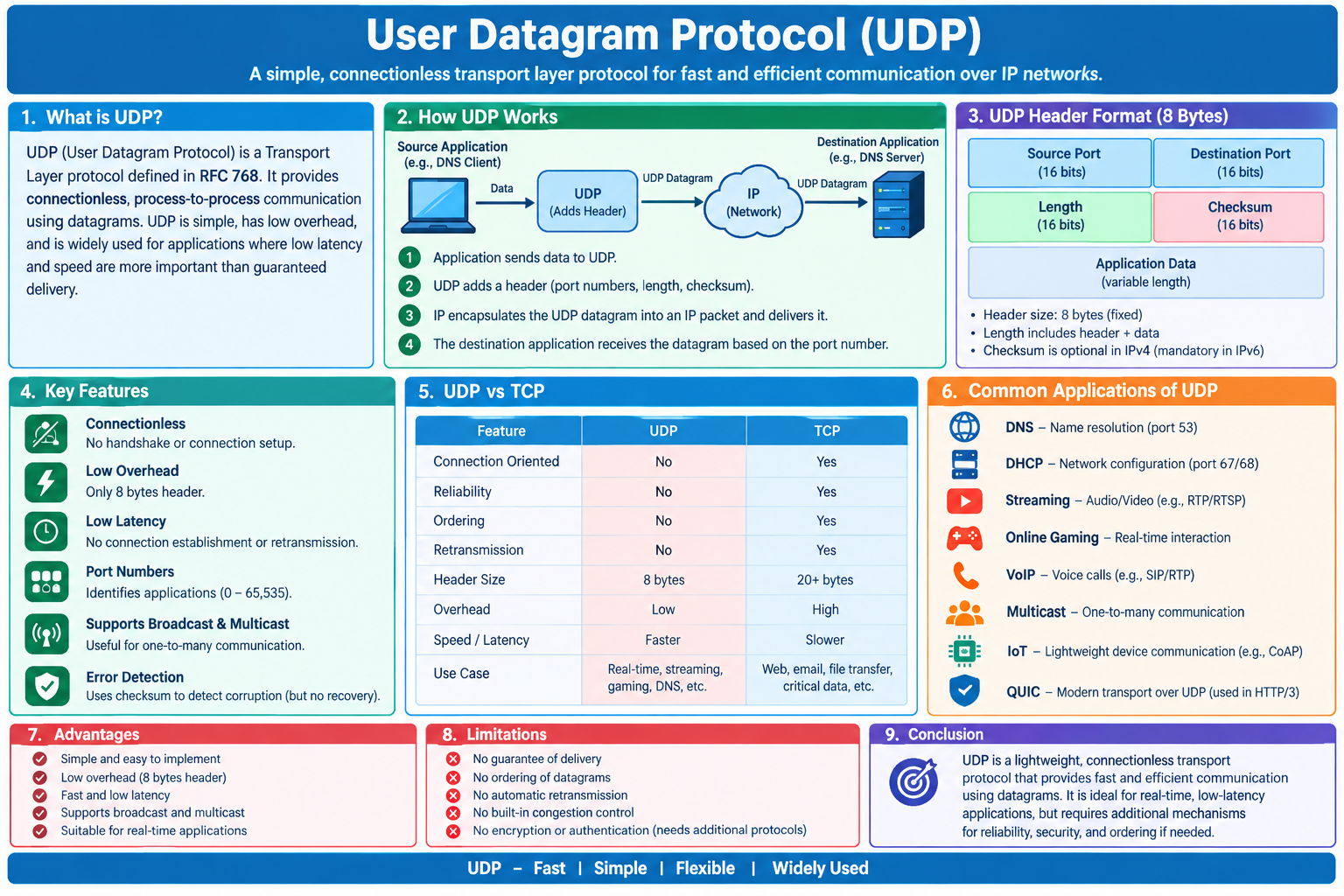
UDP (User Datagram Protocol) Is A Transport Layer Communication Protocol Used In Computer Networks And The Internet. It Is Defined In RFC 768 And Provides A Simple, Connectionless Mechanism For Sending Data Between Applications. Unlike TCP, UDP Does Not Establish A Connection Before Transmitting Data And Does Not Guarantee That Packets Will Reach Their Destination. Its Simplicity Makes It Particularly Useful For Applications Where Low Latency, Reduced Overhead, And Fast Transmission Are More Important Than Guaranteed Delivery.
UDP And The Transport Layer
UDP Operates At Layer 4, The Transport Layer, Of The OSI Model. Its Primary Responsibility Is To Provide Process-to-process Communication Between Applications Running On Different Hosts. UDP Works Above The Internet Protocol (IP), Which Is Responsible For Delivering Packets Between Hosts. UDP Adds Transport-level Information Such As Source And Destination Port Numbers, Allowing Data To Reach The Appropriate Application.
Meaning Of User Datagram Protocol
The Name "User Datagram Protocol" Describes Its Basic Operation. A datagram Is An Independent Unit Of Data Containing Sufficient Information For Delivery. UDP Does Not Treat A Series Of Datagrams As A Continuous Connection. Each UDP Datagram Is Handled Independently By The Network. The Term "user" Refers To Application Processes That Use UDP As Their Transport Service.
Connectionless Protocol
UDP Is Called A connectionless Protocol Because It Does Not Perform A Connection-establishment Procedure Before Transmitting Data. There Is No TCP-style Three-way Handshake. An Application Can Create A UDP Datagram And Send It Toward A Destination Immediately. This Reduces Communication Overhead And Startup Delay, Which Is Valuable For Applications Where Rapid Communication Is Important.
How UDP Works?
The UDP Communication Process Is Relatively Simple. An Application Generates Data And Passes It To The UDP Layer. UDP Adds A Small Header Containing Information Such As Source Port, Destination Port, Length, And Checksum. The Resulting UDP Datagram Is Then Passed To IP. IP Encapsulates The UDP Datagram Into An IP Packet And Attempts To Deliver It To The Destination Host.
UDP Datagram
The Basic Data Unit Of UDP Is Called A UDP Datagram. It Consists Of A UDP Header Followed By Application Data. The UDP Header Is Only 8 Bytes Long, Which Is Considerably Smaller Than The Minimum TCP Header. This Small Header Contributes To UDP's Low Overhead And Makes It Suitable For Applications That Need To Transmit Relatively Small Messages Efficiently.
UDP Header Structure
The UDP Header Contains Four Primary Fields: Source Port, Destination Port, Length, And Checksum. Source And Destination Ports Are Each 16 Bits. The Length Field Indicates The Size Of The UDP Header And Data. The Checksum Field Is Used To Detect Errors In The UDP Datagram. These Fields Provide The Fundamental Information Needed By UDP To Support Application-level Communication.
Source Port
The Source Port Identifies The Application Endpoint That Generated The UDP Datagram. It Allows The Destination Application To Know Where The Datagram Originated At The Transport Level. In Some Communication Scenarios, The Source Port Can Also Be Used By The Receiver To Send A Response To The Originating Application.
Destination Port
The Destination Port Identifies The Application Or Service That Should Receive The UDP Datagram. For Example, DNS Commonly Uses UDP Port 53. When A DNS Client Sends A Query, The Destination Port Allows The Operating System At The DNS Server To Deliver The Received Datagram To The Appropriate DNS Service.
UDP Port Numbers
UDP Uses 16-bit Port Numbers, Giving A Range From 0 Through 65,535. Ports Allow Multiple Applications To Use UDP Simultaneously On The Same Host. Well-known Ports Are Associated With Commonly Used Services, While Other Port Ranges Can Be Used For Registered Services And Dynamically Assigned Application Endpoints. Port Numbers Are Therefore Fundamental To UDP Multiplexing And Demultiplexing.
UDP Length Field
The Length Field Specifies The Length Of The UDP Datagram, Including Both The UDP Header And Application Data. Because The UDP Header Is Fixed At 8 Bytes, The Length Of The Application Payload Can Be Determined From The Total Datagram Length. This Field Helps The Receiving System Determine The Boundaries Of The UDP Message.
UDP Checksum
The checksum Provides An Error-detection Mechanism. It Allows The Receiver To Determine Whether The UDP Datagram Was Corrupted During Transmission. The Checksum Calculation Can Cover The UDP Header, Application Data, And Relevant IP Addressing Information Through A Pseudo-header. If An Error Is Detected, The Datagram May Be Discarded. UDP Itself Does Not Automatically Retransmit The Lost Or Corrupted Datagram.
No Delivery Guarantee
One Of UDP's Defining Characteristics Is That It does Not Guarantee Delivery. A UDP Datagram Can Be Lost Because Of Congestion, Routing Problems, Buffer Overflow, Wireless Interference, Or Other Network Conditions. UDP Does Not Provide A Built-in Mechanism Equivalent To TCP's Acknowledgment And Retransmission System. If An Application Requires Reliability, It Must Implement Suitable Mechanisms Itself Or Use Another Protocol.
No Guaranteed Ordering
UDP Does Not Guarantee That Datagrams Will Arrive In The Same Order In Which They Were Transmitted. For Example, An Application Could Send Datagrams Numbered 1, 2, 3, And 4, But The Receiver Might Receive Them As 1, 3, 2, And 4. UDP Does Not Reorder Them. Applications That Require Ordered Delivery Must Implement Their Own Sequencing Mechanism.
No Automatic Retransmission
UDP Does Not Automatically Retransmit Lost Data. If A Datagram Disappears Somewhere Between The Source And Destination, UDP Does Not Know That The Application Data Needs To Be Sent Again. An Application Can Implement Acknowledgments And Retransmissions On Top Of UDP If Its Requirements Demand Them. This Flexibility Is One Reason UDP Is Used As A Foundation For Several Specialized Protocols.
No Connection State
UDP Generally Does Not Maintain Connection State In The Way TCP Does. A UDP Sender Can Transmit Independent Datagrams To Different Destinations Without Establishing Separate Transport Connections. This Reduces The Amount Of State And Processing Required By The Transport Protocol. However, Applications Can Still Maintain Their Own Logical Sessions When Necessary.
Low Overhead
UDP Has Very Low Protocol Overhead Because Its Header Is Only 8 Bytes. TCP, In Contrast, Has A Minimum Header Size Of 20 Bytes And Includes Substantially More State And Control Information. The Smaller UDP Header Can Be Advantageous When Applications Transmit Many Small Messages, Although Overall Network Efficiency Also Depends On IP Headers, Application Payload Size, And Other Factors.
Low Latency
UDP Can Reduce Communication Latency Because It Does Not Require Connection Establishment, Acknowledgments, Or Retransmission Before Continuing Communication. This Characteristic Makes UDP Attractive For Applications Where Timely Delivery Is Important. However, UDP Itself Does Not Make The Underlying Network Faster. Its Advantage Comes Primarily From Minimizing Transport-level Processing And Waiting.
UDP And Real-Time Communication
Real-time Applications Often Use UDP Because Stale Information May Be Less Useful Than Current Information. Consider An Online Voice Conversation. If A Small Audio Packet Is Lost, Retransmitting It Several Hundred Milliseconds Later May Not Improve The Conversation. The Application May Instead Continue With Newer Audio. UDP Gives Developers The Flexibility To Prioritize Timeliness Over Guaranteed Delivery.
UDP In DNS
The Domain Name System (DNS) Commonly Uses UDP For Ordinary Queries Because DNS Requests And Responses Are Often Relatively Small And Benefit From Low Overhead. A Client Can Send A Query To A DNS Server Without Establishing A TCP Connection First. DNS Can Also Use TCP And, In Modern Deployments, Other Transports Depending On The Query, Response Size, Security, And Implementation Requirements.
UDP In DHCP
Dynamic Host Configuration Protocol (DHCP) Uses UDP For Communication Between Clients And DHCP Servers. DHCP Is Used To Obtain Network Configuration Information Such As IP Addresses And Other Parameters. UDP Allows A Host That Is Still Being Configured To Exchange DHCP Messages Using Standardized Client And Server Ports.
UDP In Streaming
UDP Can Be Used By Streaming And Multimedia Systems Where Continuous Delivery And Low Latency Are Important. Video And Audio Applications Can Tolerate Some Packet Loss Depending On The Content And Encoding Scheme. Instead Of Waiting Indefinitely For Every Missing Packet, An Application May Continue Displaying Or Playing The Available Data. Modern Media Systems Can Also Use Application-level Recovery Mechanisms When Necessary.
UDP In Online Gaming
Online Multiplayer Games Can Use UDP For Rapid Exchange Of Game-state Information. Player Position, Movement, Actions, And Other Real-time Information May Need To Reach Other Players Quickly. If One Update Is Lost, A Subsequent Update Can Make The Older Information Irrelevant. Applications Can Therefore Design Custom Reliability, Sequencing, And Synchronization Mechanisms Around UDP.
UDP In VoIP
Voice Over IP (VoIP) Systems Can Use UDP Because Voice Communication Is Sensitive To Delay And Jitter. Lost Voice Packets May Produce Small Gaps Or Quality Degradation, While Retransmitting Old Audio May Introduce Additional Delay. Real-time Communication Protocols And Codecs Can Employ Techniques Such As Buffering, Packet-loss Concealment, And Forward Error Correction To Improve Perceived Quality.
UDP And Broadcast Communication
UDP Is Suitable For Certain broadcast And Multicast Communication Models. A Sender Can Transmit A Datagram Toward A Broadcast Or Multicast Destination Where Supported By The Network. This Can Allow Information To Reach Multiple Receivers Without Creating An Independent Transport Connection For Every Recipient. Multicast Is Particularly Useful For Certain Discovery And Distribution Applications.
UDP Multicast
Multicast Allows A Sender To Transmit Data To A Group Of Interested Receivers. UDP Is Commonly Associated With Multicast Because Its Connectionless Datagram Model Fits One-to-many Communication. Examples Can Include Service Discovery, Network Announcements, Multimedia Distribution, And Specialized Data-distribution Systems. Reliability, If Needed, Is Generally Handled By The Application Or An Additional Protocol.
UDP Versus TCP
The Most Common Comparison Is Between UDP And TCP (Transmission Control Protocol). TCP Is Connection-oriented And Provides Reliable, Ordered Byte-stream Delivery With Acknowledgments, Retransmissions, Flow Control, And Congestion Control. UDP Is Connectionless And Provides Datagram Delivery Without Those Built-in Guarantees. TCP Therefore Provides More Transport Functionality, While UDP Provides A Simpler Service That Gives Applications Greater Control Over Communication Behavior.
UDP And TCP Header Comparison
A TCP Header Contains Substantially More Fields Than A UDP Header. TCP Includes Sequence Numbers, Acknowledgment Numbers, Flags, Window Information, And Other Fields Needed For Connection Management And Reliable Communication. UDP Has Only Four Basic Header Fields. This Difference Reflects Their Design Philosophies: TCP Provides A Managed Transport Service, While UDP Provides A Lightweight Datagram Service.
Advantages Of UDP
UDP Has Several Advantages. It Has Low Overhead, Does Not Require Connection Establishment, Supports Fast Message Transmission, And Provides A Simple Interface For Applications. It Is Also Useful For Multicast And Broadcast Scenarios And Allows Application Developers To Implement Customized Reliability Or Timing Mechanisms. These Characteristics Make UDP An Important Component Of Modern Networking.
Limitations Of UDP
UDP Also Has Important Limitations. It Does Not Guarantee Delivery, Ordering, Or Duplicate Protection At The Transport-service Level. It Does Not Provide TCP-style Congestion-control Behavior As Part Of UDP Itself. Applications That Need Reliability May Therefore Need Additional Protocols Or Mechanisms. Developers Must Carefully Consider These Characteristics When Selecting UDP.
UDP And Security
UDP Itself Does Not Provide Encryption Or Authentication. A UDP Datagram Can Therefore Require Additional Security Mechanisms When Sensitive Information Is Transmitted. Protocols Such As DTLS (Datagram Transport Layer Security) Can Provide TLS-like Security Properties For Datagram-oriented Communication. Other Modern Protocols, Such As QUIC, Use Cryptographic Protection As Part Of Their Protocol Design.
UDP And Firewalls
Firewalls Commonly Inspect UDP Traffic Using Source And Destination IP Addresses, UDP Ports, Packet Characteristics, And Connection Or Flow State. Because UDP Does Not Establish A TCP-style Connection, Stateful Firewall Handling Can Require Different Mechanisms. Administrators May Restrict Unnecessary UDP Services And Monitor Unusual UDP Traffic As Part Of Network Security Operations.
UDP And Network Address Translation
UDP Is Frequently Used Through NAT (Network Address Translation) Devices. NAT Devices Maintain Mappings Between Internal Private Addresses And External Addresses And Ports. Because UDP Does Not Have A TCP-style Connection Establishment And Termination Process, NAT Implementations Use Timeouts And Traffic Activity To Maintain Mappings. Applications Requiring Long-lived UDP Communication May Therefore Need Keepalive Or Related Mechanisms.
UDP And Packet Loss
Packet Loss Is An Important Consideration When Using UDP. Network Congestion, Wireless Interference, Routing Changes, Overloaded Buffers, And Other Factors Can Cause Datagrams To Disappear. UDP Does Not Attempt To Recover From Such Loss Itself. Applications Must Decide Whether Missing Data Should Be Ignored, Requested Again, Reconstructed, Or Handled Using Another Recovery Technique.
UDP And Jitter
Jitter Refers To Variation In Packet Arrival Times. It Is Particularly Important For Voice And Video Applications. Even When Most UDP Packets Arrive Successfully, Significant Variation In Their Arrival Times Can Degrade Real-time Communication. Applications Commonly Use Jitter Buffers And Timing Mechanisms To Smooth Playback And Compensate For Variations In Packet Arrival.
UDP And QUIC
An Important Modern Development Is QUIC, Which Operates Over UDP. QUIC Adds Sophisticated Transport Functionality, Including Reliable Streams, Congestion Control, Encryption, And Connection Management, While Using UDP As Its Underlying Packet Transport. HTTP/3 Uses QUIC Rather Than Traditional TCP. This Demonstrates That UDP Can Serve As A Flexible Foundation For Advanced Transport Protocols.
UDP In IoT
UDP Can Be Useful In Internet Of Things (IoT) Environments Where Devices May Have Limited Processing Power, Memory, Bandwidth, Or Energy. Lightweight Datagram Communication Can Reduce Protocol Overhead. Protocols Designed For Constrained Environments, Such As CoAP (Constrained Application Protocol), Traditionally Use UDP-based Communication. Appropriate Security And Reliability Mechanisms Can Be Added Where Required.
UDP Performance Considerations
Although UDP Has Low Transport Overhead, Choosing UDP Does Not Automatically Guarantee Better Application Performance. Performance Depends On Bandwidth, Latency, Packet Loss, Congestion, Processing Capacity, Application Design, And Network Architecture. Developers Should Measure Real-world Behavior And Determine Whether Their Application Requires Reliability, Ordering, Congestion Management, Security, Or Other Transport Capabilities.
When Should UDP Be Used?
UDP Is Particularly Appropriate When An Application Needs low Overhead, Low Startup Latency, Independent Datagrams, Multicast/broadcast Capabilities, Or Application-controlled Reliability. Common Examples Include DNS, Real-time Multimedia, Online Gaming, Service Discovery, IoT Protocols, And Protocols Built On UDP Such As QUIC. The Choice Should Always Be Based On Application Requirements Rather Than Assuming That UDP Is Inherently Superior To TCP.
Conclusion
UDP (User Datagram Protocol) Is A Lightweight, Connectionless Transport Layer Protocol That Provides Process-to-process Datagram Communication Over IP Networks. Its 8-byte Header, Absence Of Connection Establishment, And Lack Of Built-in Retransmission And Ordering Make It Efficient And Flexible. UDP Is Widely Used In DNS, Real-time Multimedia, Online Gaming, VoIP, IoT, Multicast Applications, And As The Foundation For Modern Protocols Such As QUIC. Its Major Strength Is Simplicity And Low Overhead, While Its Major Limitation Is The Absence Of Built-in Reliable And Ordered Delivery. Understanding UDP Is Therefore Essential For Studying Computer Networks, Cybersecurity, Distributed Systems, Cloud Computing, IoT, Multimedia Networking, And Modern Internet Protocols.
Tags:
UDP, User Datagram Protocol, DP In IoT, UDP And QUIC, UDP And Jitter, UDP And Packet Loss, UDP And Firewalls